Representing and Analyzing SHM
Diperkenalkan 8:13
Osilasi
Di museum sains, bola kuningan tergantung dari kawat yang sangat panjang. Ia berayun sepanjang hari di atas lantai bertanda, tak tersentuh. Setiap ayunan memakan waktu yang sama dengan sebelumnya.…
Narasi bahasa Inggris · takarir bahasa Inggris dan 中文 yang dapat dipilih
In this lesson
| English | Makna |
|---|---|
| amplitude/ˈæmplɪtjuːd/ | amplitudo |
| phase/feɪz/ | fasa |
Drawing the wobble
- Trace a bobbing mass over time and you get a smooth wave on the graph.
- A sinusoidal curve describes ideal spring oscillations, small-angle pendulums, and single-frequency sound.
- Its height, speed, and steepness all follow from one equation.
- A single cosine captures the whole back-and-forth.
The position over time
- The displacement in SHM traces a cosine:
- $A$ is the amplitude 振幅, the maximum displacement.
- $\omega$ is the angular frequency and $\varphi$ the phase 相位, the starting point.
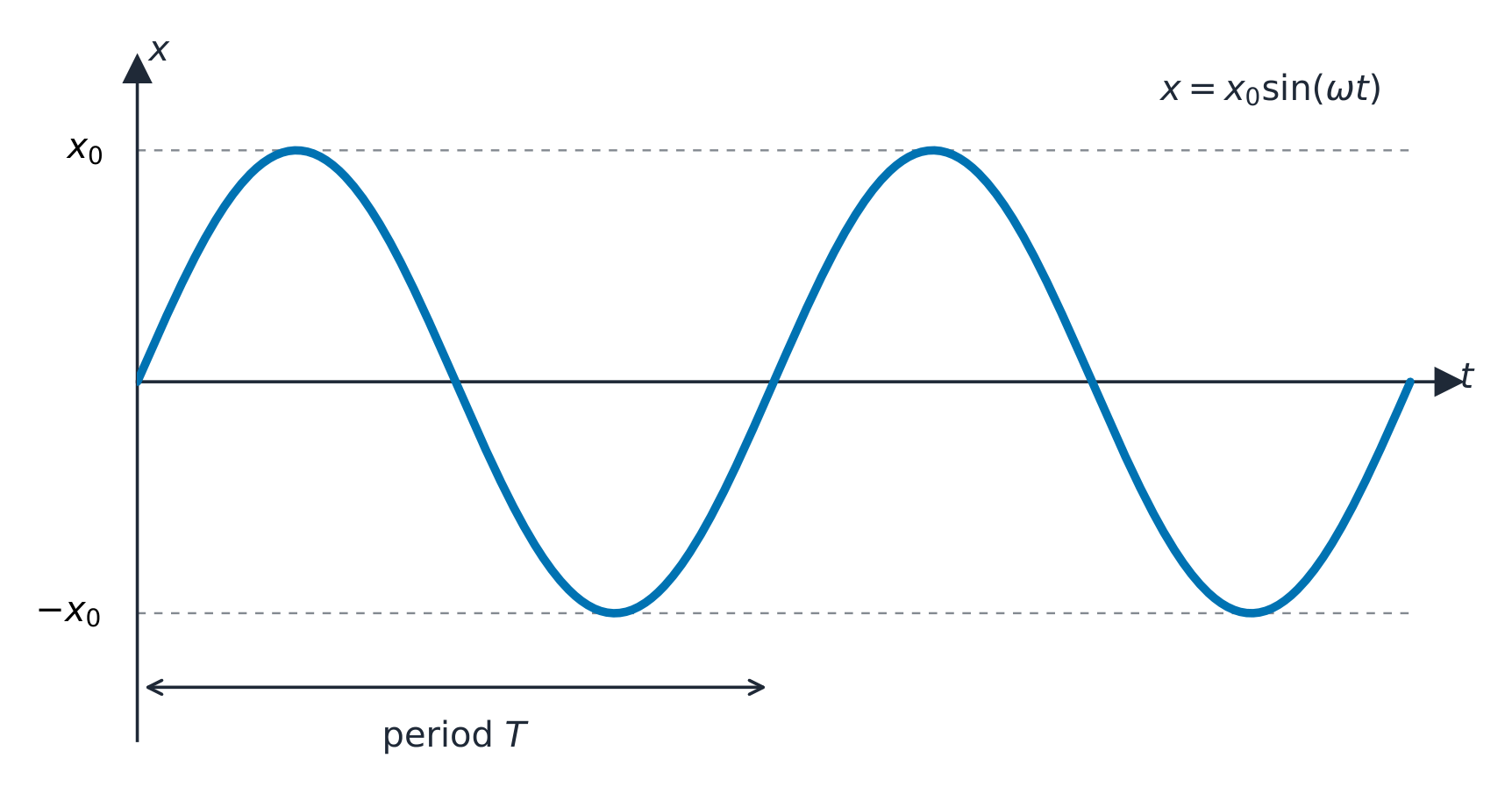
Displacement varies sinusoidally with time in simple harmonic motion
In $x = A\cos(\omega t + \varphi)$, the symbol A stands for the ____.
Kesulitan 1/5 · 100 koin + bonus kecil pada penyelesaian pertama hari ini
$A$ is the amplitude -- the largest displacement from equilibrium.
Speed and acceleration follow
- Differentiate to get the velocity and acceleration:
- Maximum speed $v_{max} = A\omega$; maximum acceleration $a_{max} = A\omega^2$.
An oscillator has $A = 0.2\ \text{m}$ dan $\omega = 4\ \text{rad/s}$. Its maximum speed (in m/s)?
Kesulitan 2/5 · 140 koin + bonus kecil pada penyelesaian pertama hari ini
$v_{max} = A\omega = 0.2 \times 4 = 0.8\ \text{m/s}$.
For the same oscillator ($A = 0.2\ \text{m}$, $\omega = 4\ \text{rad/s}$), the maximum acceleration (in m/s²)?
Kesulitan 2/5 · 140 koin + bonus kecil pada penyelesaian pertama hari ini
$a_{max} = A\omega^2 = 0.2 \times 16 = 3.2\ \text{m/s}^2$.
Opposite extremes
- Speed is greatest at equilibrium (where $x = 0$) and zero at the ends.
- Acceleration is greatest at the ends and zero at equilibrium.
- So $x$ and $a$ are perfectly out of step, while $v$ runs a quarter-cycle ahead.
SHM as a sine wave
The displacement of a simple harmonic oscillator traces a cosine curve in time.
Where in the motion is the speed greatest?
Kesulitan 1/5 · 100 koin + bonus kecil pada penyelesaian pertama hari ini
Speed peaks where $x = 0$ (the middle) and is zero at the ends.
In SHM, displacement and acceleration are exactly out of step (opposite phase).
Kesulitan 1/5 · 100 koin + bonus kecil pada penyelesaian pertama hari ini
$a = -\omega^2 x$, so $a$ is always opposite to $x$.
An oscillator has $A = 0.1\ \text{m}$ and $\omega = 5\ \text{rad/s}$.
- Max speed: $v_{max} = A\omega = 0.1 \times 5 = 0.5\ \text{m/s}$, reached at the middle.
- Max acceleration: $a_{max} = A\omega^2 = 0.1 \times 25 = 2.5\ \text{m/s}^2$, reached at the ends.
A mass undergoing SHM is released from rest at its positive maximum displacement at t = 0. Which position function describes it?
Kesulitan 1/5 · 100 koin + bonus kecil pada penyelesaian pertama hari ini
Pada $t = 0$ the displacement is maximum, which cosine gives with $\varphi = 0$.
Do not swap where speed and acceleration peak — they sit at opposite places: speed is largest in the middle, acceleration largest at the extremes. If it starts at the positive extreme, use cosine with $\varphi = 0$; at the negative extreme use $\varphi = \pi$. From equilibrium, use a sine with its sign chosen to match the initial velocity. And $\omega$ here is in rad/s, not the frequency $f$.
SHM is one cosine: $x = A\cos(\omega t + \varphi)$, with amplitude $A$ and phase $\varphi$. Its derivatives give $v_{max} = A\omega$ (at equilibrium) and $a_{max} = A\omega^2$ (at the extremes). Displacement and acceleration are exactly out of step, and velocity leads position by a quarter cycle.
Write from the data: find the maximum speed
- Amplitude is 0.50 m and angular frequency is 2 rad/s.
- Find the maximum speed.
An oscillator has amplitude 0.50 m and angular frequency 2 rad/s. What is its maximum speed, and where in the motion does that speed occur?
0.50 times 2 is 1.
An oscillator has amplitude 0.50 m and angular frequency 2 rad/s. What is its maximum speed, and where does it occur?
Kesulitan 1/5 · 100 koin + bonus kecil pada penyelesaian pertama hari ini
Amplitude times angular frequency is 0.50 times 2.