Policies to correct current account imbalances
Diperkenalkan| English | Makna |
|---|---|
| competitiveness/kəmˈpetɪtɪvnəs/ | daya saing |
| expenditure-switching/ekˈspendɪtʃə ˈswɪtʃɪŋ/ | pengalihan pengeluaran |
| depreciation/dɪˌpriːʃɪˈeɪʃn/ | pelemahan mata uang |
| expenditure-reducing/ekˈspendɪtʃə rɪˈdjuːsɪŋ/ | Pengurangan pengeluaran |
| supply-side/səˈplaɪ saɪd/ | Sisi penawaran |
A deficit that cannot last forever
- A country with a large current account deficit buys more goods, services and income from abroad than it sells. It pays for the gap by borrowing or selling assets to foreigners, and lenders may one day refuse, forcing a sudden crisis.
- Governments have three kinds of tool: switch spending toward home goods, reduce spending overall, or raise competitiveness 竞争力 on the supply side. Each works differently and each has a cost.
Arus akun berjalan
Track exports, imports and income flows into the current account.
Match each policy to its type.
Kesulitan 2/5 · 140 koin + bonus kecil pada penyelesaian pertama hari ini
Switching changes relative prices, reducing cuts total demand, supply-side raises competitiveness.
Expenditure-switching: change relative prices
- Expenditure-switching 支出转换 policies make imports dearer or exports cheaper, so buyers at home and abroad switch toward domestic goods: a depreciation 贬值 or devaluation of the currency, tariffs and quotas, or export subsidies.
- Worked example: the pound falls from 2.00 to 1.60 US dollars, a 20% depreciation. A British good priced £10 falls in the US from 20 to 16 dollars, so exports become more competitive. A US good priced 40 dollars rises in Britain from £20 to £25, so imports become less attractive.
The pound falls from 2.00 to 1.60 US dollars. What is the new US dollar price of a British good priced £25?
Kesulitan 2/5 · 140 koin + bonus kecil pada penyelesaian pertama hari ini
25 × 1.60 = 40 dollars (it was 25 × 2.00 = 50 dollars), so British exports become cheaper abroad.
Will a depreciation work? Marshall–Lerner and the J-curve
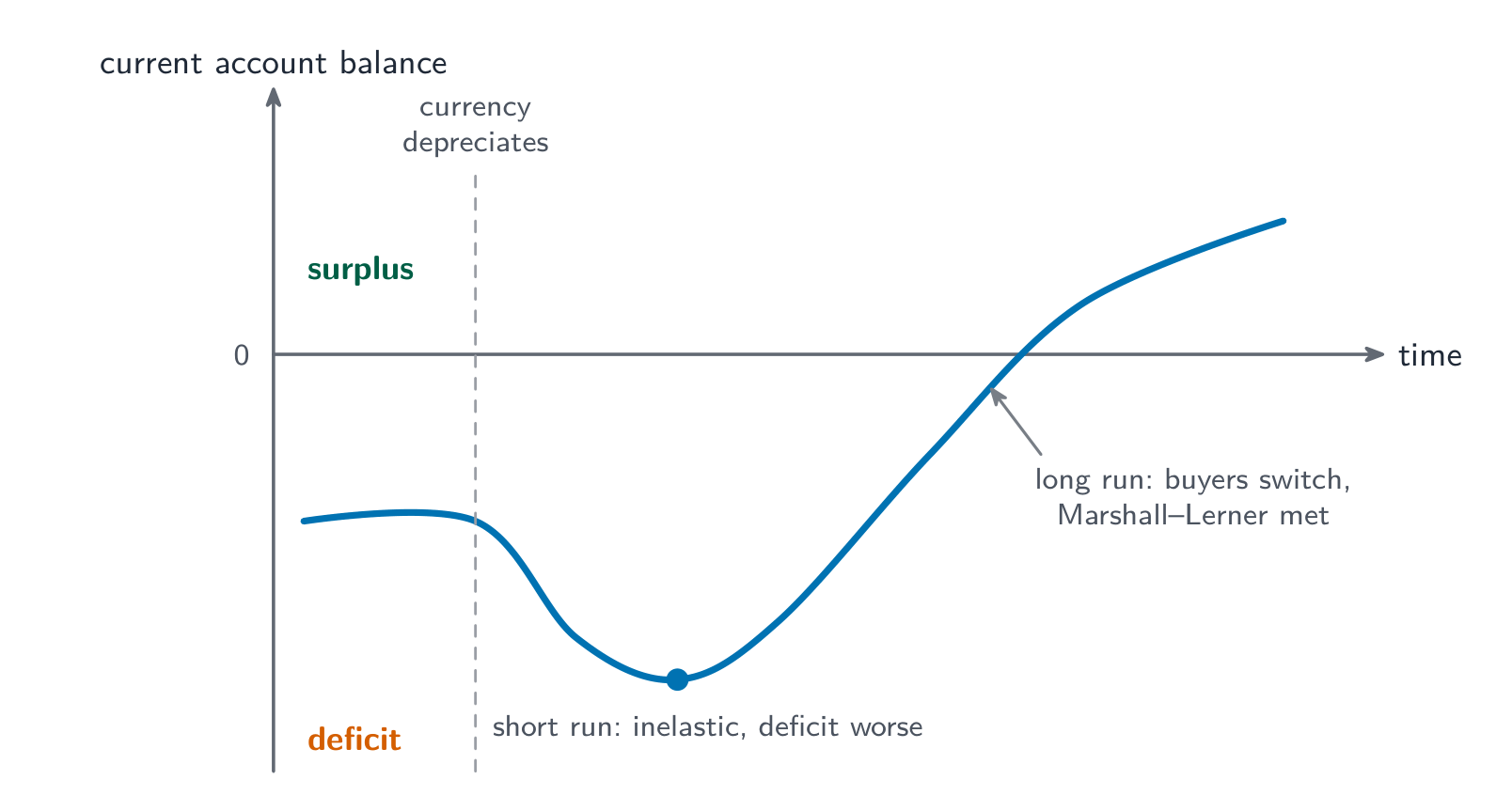
- The Marshall–Lerner condition: a depreciation improves the current account only if the price elasticities of demand for exports and imports, added together (ignoring signs), are greater than 1. If demand is inelastic, the country sells only a little more and pays more for its imports, so the deficit grows.
- In the short run demand is inelastic (contracts are fixed and buyers take time to find new suppliers), so the deficit first gets worse, then improves as buyers switch: the J-curve.
PED for exports is 0.4 and PED for imports is 0.3 (ignoring signs). What will a depreciation do?
Kesulitan 1/5 · 100 koin + bonus kecil pada penyelesaian pertama hari ini
The Marshall–Lerner condition fails (sum 0.7 < 1). Volumes change too little to make up for cheaper exports and dearer imports.
The J-curve shows that a depreciation can make the deficit worse before it makes it better.
Kesulitan 1/5 · 100 koin + bonus kecil pada penyelesaian pertama hari ini
In the short run demand is inelastic, so the deficit deepens; as buyers switch, it improves.
Expenditure-reducing: cut total demand
- Expenditure-reducing 支出减少 policies cut aggregate demand, so households buy fewer imports: contractionary fiscal policy (higher taxes, lower government spending) or contractionary monetary policy (higher interest rates).
- Worked example: if the marginal propensity to import is 0.2, a fall in national income of 50 billion cuts imports by about 0.2 × 50 = 10 billion. But the other 40 billion was spent on home goods, so output and jobs fall too. This is the main cost.
The marginal propensity to import is 0.25. Contractionary policy cuts national income by 40 billion. By how much do imports fall (billion)?
Kesulitan 2/5 · 140 koin + bonus kecil pada penyelesaian pertama hari ini
0.25 × 40 = 10 billion. The other 30 billion of lost spending fell on home goods, so output and jobs fall.
Supply-side: the long-run fix
- Supply-side 供给侧 policies raise productivity and quality: education and training, infrastructure, investment incentives, research. Exports then sell on quality and cost, without needing a weaker currency.
- They are the most lasting fix and do not cut output, but they take years, cost the government money now and their results are uncertain.
Which are drawbacks of supply-side policies for a current account deficit?
Kesulitan 2/5 · 140 koin + bonus kecil pada penyelesaian pertama hari ini
Supply-side policies are slow, costly and uncertain, but unlike expenditure-reducing policy they do not aim to cut output.
Imbalances also mean surpluses
- A persistent current account surplus can also be a problem: it may reflect weak domestic spending, cause trade disputes with deficit countries and put upward pressure on the currency.
- Remedies run the other way: let the currency appreciate (revaluation), expand domestic demand through fiscal or monetary policy, or remove export subsidies.
Which policy would reduce a persistent current account SURPLUS?
Kesulitan 1/5 · 100 koin + bonus kecil pada penyelesaian pertama hari ini
An appreciation makes exports dearer and imports cheaper. The other three would increase the surplus.
Worked exam paragraph (evaluate)
Question: A country has a large current account deficit and is close to full employment. Evaluate depreciation as a way to reduce the deficit.
Analysis: A depreciation makes exports cheaper abroad and imports dearer at home, so export volumes rise and import volumes fall, improving the current account.
Evaluation: This works only if the Marshall–Lerner condition holds, and even then the J-curve means the deficit may worsen for a year or more. Because the economy is near full employment, higher demand for exports cannot easily be met by more output, so prices rise; this inflation erodes the competitive gain. A depreciation is therefore most effective with spare capacity and elastic demand, and here it may need to be combined with expenditure-reducing policy to free resources for exports.
- Why it scores: the evaluation uses the specific situation in the question (full employment) and the theory (Marshall–Lerner, J-curve) to reach a conditional judgement, not a list of general drawbacks.
Why is a depreciation less effective when the economy is at full employment?
Kesulitan 1/5 · 100 koin + bonus kecil pada penyelesaian pertama hari ini
With no spare capacity, extra demand mainly causes inflation, which erodes the price advantage.
Don't say a depreciation "always" cures a deficit. It depends on elasticities (Marshall–Lerner), on time (the J-curve) and on spare capacity (inflation can cancel the price advantage).
Expenditure-switching (depreciation, tariffs) changes relative prices; it needs Marshall–Lerner to hold and follows a J-curve. Expenditure-reducing (contractionary fiscal or monetary policy) cuts imports but also output and jobs. Supply-side policy raises competitiveness lastingly but slowly. Surpluses are corrected the opposite way.
Evaluate whether raising interest rates is a good way to reduce a current account deficit. Write one paragraph of analysis and one of evaluation.
Evaluation weighs the policy in the situation given; it is not a list of disadvantages.