Utilitas
Diperkenalkan| English | Makna |
|---|---|
| diminishing marginal utility/dɪˈmɪnɪʃɪŋ ˈmɑːdʒɪnl juːˈtɪlɪti/ | Utilitas marjinal menurun |
| utility/juːˈtɪlɪti/ | Utilitas |
| total utility/ˈtəʊtl juːˈtɪlɪti/ | Total utilitas |
| marginal utility/ˈmɑːdʒɪnl juːˈtɪlɪti/ | Utilitas marjinal |
| equi-marginal principle/ˈekwi ˈmɑːdʒɪnl ˈprɪnsɪpl/ | Prinsip ekuimarginal |
Why the second ice cream is never as good
- On a hot day the first ice cream is wonderful, the second is nice, and the fourth makes you feel ill. Each extra one adds less satisfaction than the one before.
- That pattern, diminishing marginal utility 边际效用递减, explains why people buy more of a good only when its price falls: the root of the downward-sloping demand curve.
Total and marginal utility
- Utility 效用 is the satisfaction from consuming a good. Total utility 总效用 (TU) is the satisfaction from all units consumed; marginal utility 边际效用 (MU) is the extra utility from one more unit: MU = change in TU.
- Utility is measured here in imaginary units ("utils") so that we can compare choices; real satisfaction cannot be measured exactly.
Worked example: a utility table
| Ice creams | Total utility | Marginal utility |
|---|---|---|
| 1 | 30 | 30 |
| 2 | 50 | 20 |
| 3 | 60 | 10 |
| 4 | 60 | 0 |
| 5 | 55 | −5 |
- TU rises while MU is positive, is at its highest when MU = 0 (4 ice creams), and falls when MU becomes negative.
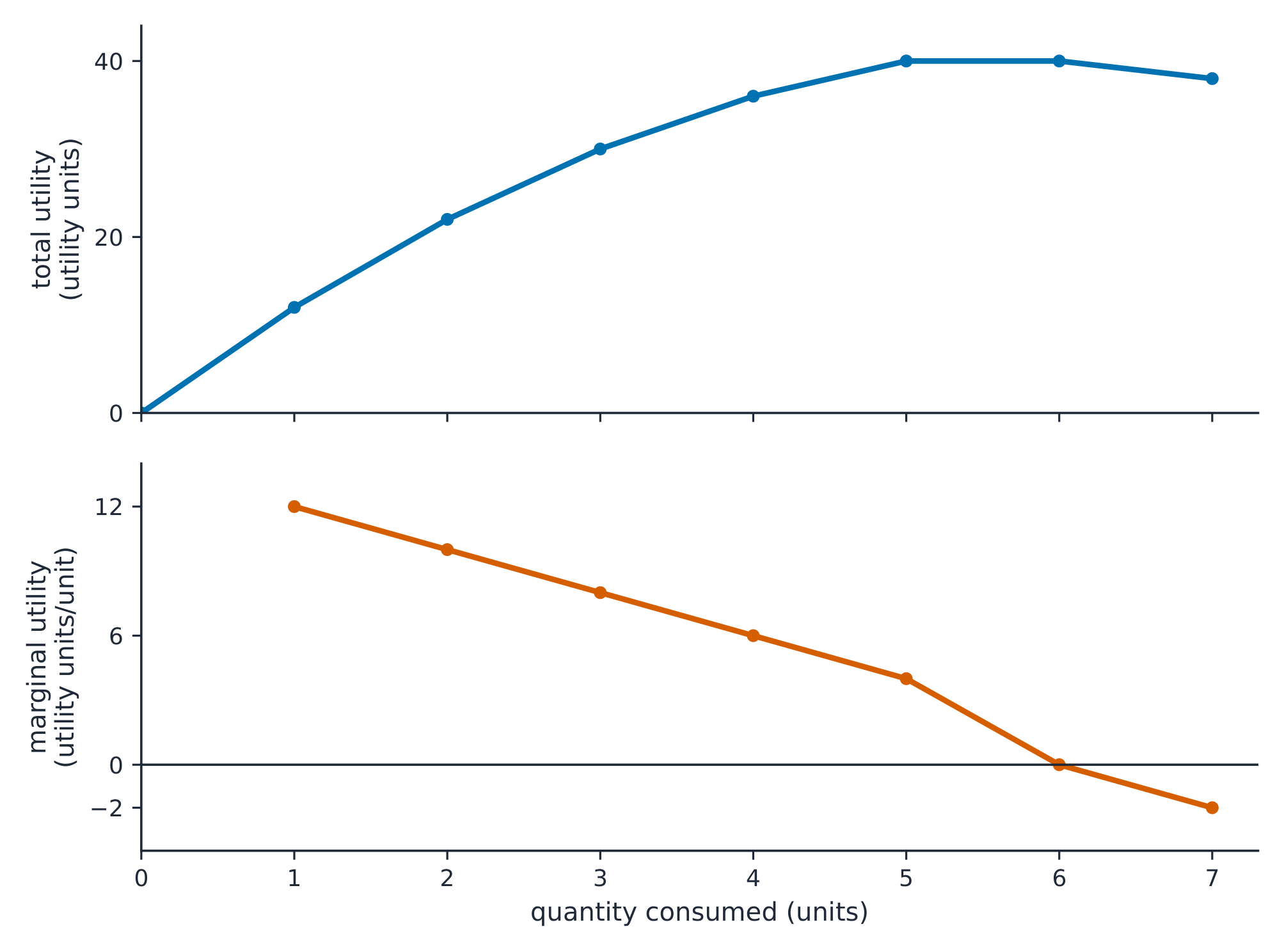
Diminishing marginal utility lab
total utility rises more slowly as quantity increases
Add units consumed and see why extra satisfaction usually falls.
Total utility rises from 50 to 60 when a third unit is consumed. What is the marginal utility of the third unit?
Kesulitan 2/5 · 140 koin + bonus kecil pada penyelesaian pertama hari ini
MU = change in TU = 60 − 50 = 10.
At what point is total utility at its maximum?
Kesulitan 1/5 · 100 koin + bonus kecil pada penyelesaian pertama hari ini
TU rises while MU is positive and falls once MU is negative.
The equi-marginal principle
- With a limited budget, a consumer maximises utility when the marginal utility per dollar is equal for every good: MU of A ÷ price of A = MU of B ÷ price of B. This is the equi-marginal principle 等边际原则.
- If one good gives more utility per dollar, switching spending towards it raises total utility, until the ratios are equal again.
Good A: MU 20, price $4. Good B: MU 15, price$5. To raise total utility, the consumer should:
Kesulitan 1/5 · 100 koin + bonus kecil pada penyelesaian pertama hari ini
A gives 5 utils per $, B gives 3, so switch towards A.
Worked example: deriving demand
A student has $10 to spend on coffee ($2) and sandwiches ($4). The last coffee gives MU = 12, so 12 ÷ 2 = **6 utils per$**. The last sandwich gives MU = 16, so 16 ÷ 4 = 4 utils per $.
Step 1: coffee gives more utility per dollar, so the student buys more coffee and fewer sandwiches. Coffee's MU falls and the sandwich's MU rises until the ratios are equal.
Step 2: now the price of coffee falls to $1. Its MU per dollar doubles, so the student buys still more coffee. A lower price leads to a higher quantity demanded: the demand curve slopes down.
- Exam reasoning: link each step: diminishing MU → buy more only if price falls → downward-sloping demand.
Total utility does not fall when marginal utility falls. TU keeps rising as long as MU is positive; it falls only when MU is negative.
When marginal utility falls but stays positive, total utility falls.
Kesulitan 1/5 · 100 koin + bonus kecil pada penyelesaian pertama hari ini
TU still rises, just more slowly.
Utility is satisfaction; marginal utility is the extra satisfaction from one more unit, and it diminishes as consumption rises. Consumers maximise utility when MU per dollar is equal across goods. A price fall raises MU per dollar, so quantity demanded rises: the demand curve slopes downwards.
Practice (data response). Explain, using the idea of diminishing marginal utility, why the demand curve for a good slopes downwards. (4 marks)
A chain of reasoning earns the marks.