The nerve impulse
Diperkenalkan 9:38
Saraf dan Otot
Sentuh sesuatu yang panas dan tangan anda sudah bergerak sebelum anda rasa sakit. Isyarat itu tidak pergi ke otak untuk meminta kebenaran. Ia berjalan ke sumsum tulang belakang…
Narasi bahasa Inggris · takarir bahasa Inggris dan 中文 yang dapat dipilih
In this lesson
| English | Makna |
|---|---|
| resting potential/ˈrestɪŋ pəˈtenʃl/ | potensial istirahat |
| action potential/ˈækʃn pəˈtenʃl/ | potensial tindakan |
| depolarisation/diːˌpəʊləraɪˈzeɪʃn/ | depolarisasi |
| repolarisation/rɪˌpəʊləraɪˈzeɪʃn/ | repolarisasi |
| refractory period/rɪˈfræktəri ˈpɪərɪəd/ | masa refrakteri |
| myelin sheath/ˈmaɪɪlɪn ʃiːθ/ | selubung mielin |
| saltatory conduction/ˈsɒltətəri kənˈdʌkʃn/ | konduksi saltatorius |
A wave of electricity
- An impulse is a change in the voltage across the neurone's membrane.
- At rest the inside is negative; an impulse flips it briefly positive.
- A fatty sheath can make it travel far faster.
The brief reversal of charge across a neurone membrane is an action ______.
Kesulitan 1/5 · 100 koin + bonus kecil pada penyelesaian pertama hari ini
It travels along the axon as the nerve impulse.
The resting potential 静息电位
- When no impulse passes, the inside is negative compared with the outside — the resting potential.
- It is kept this way by a pump that moves sodium out and potassium in, and by the membrane being more permeable to potassium.
Impuls saraf
resting −70 → spike +40 mV
Scrub the spike: Na⁺ floods in to depolarise, then K⁺ leaves to repolarise.
At the resting potential, the inside of the neurone is:
Kesulitan 1/5 · 100 koin + bonus kecil pada penyelesaian pertama hari ini
The resting potential keeps the inside negative, maintained by the Na⁺/K⁺ pump and K⁺ permeability.
The action potential 动作电位
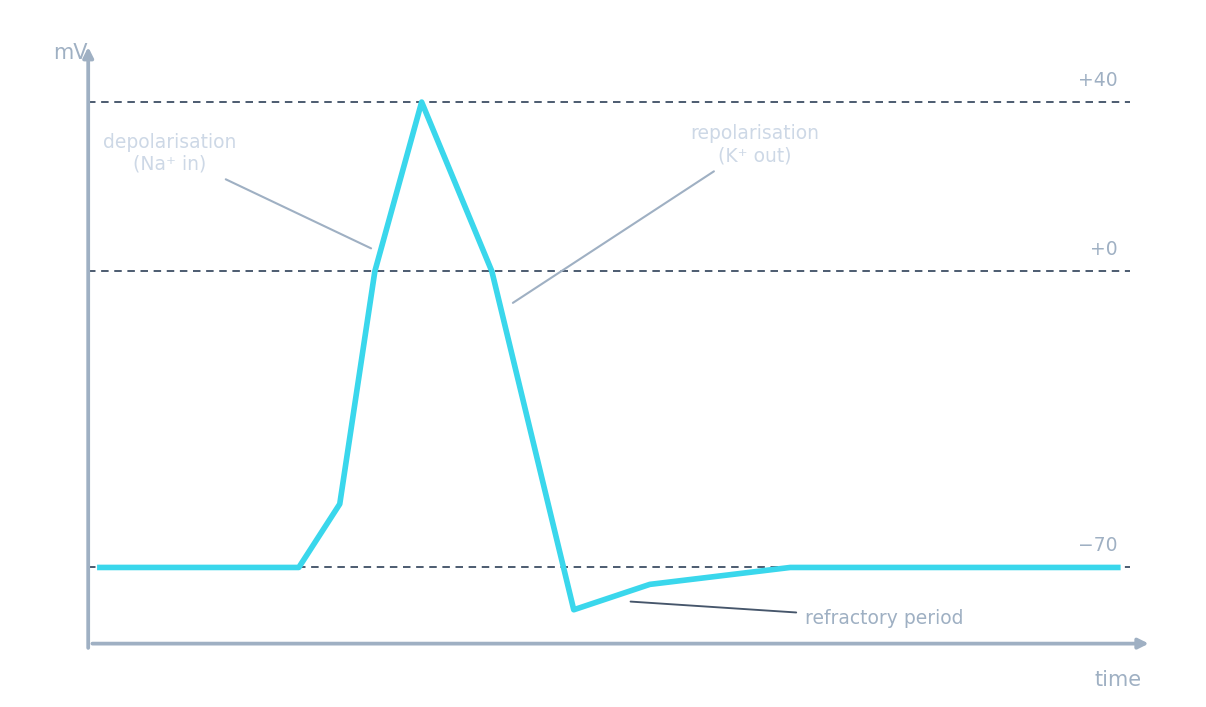
- A stimulus opens sodium channels → Na⁺ rushes in → inside briefly positive (depolarisation 去极化).
- Then potassium channels open → K⁺ leaves → the membrane returns to negative (repolarisation 复极化).
- A short refractory period 不应期 follows: sodium channels can't reopen, restoring rest and limiting how often impulses fire.
Depolarisation during an action potential is caused by:
Kesulitan 1/5 · 100 koin + bonus kecil pada penyelesaian pertama hari ini
Sodium channels open and Na⁺ floods in, reversing the charge (depolarisation); then K⁺ leaves to repolarise.
Put the action potential in order.
Kesulitan 3/5 · 200 koin + bonus kecil pada penyelesaian pertama hari ini
Rest → Na⁺ in (depolarise) → K⁺ out (repolarise) → reset. The spike is brief and all-or-nothing.
Match each phase to what is happening.
Kesulitan 2/5 · 140 koin + bonus kecil pada penyelesaian pertama hari ini
Na⁺ in flips the charge; K⁺ out restores it; the refractory period stops a backward impulse.
The refractory period resets the neurone and limits how often impulses can fire.
Kesulitan 1/5 · 100 koin + bonus kecil pada penyelesaian pertama hari ini
Sodium channels cannot reopen for a moment, so the neurone resets and impulses stay separate and one-way.
Faster: myelin
- Some axons are wrapped in a fatty myelin sheath 髓鞘 that the impulse cannot cross.
- So the impulse jumps from one gap (node) to the next — saltatory conduction 跳跃式传导 — travelling much faster.
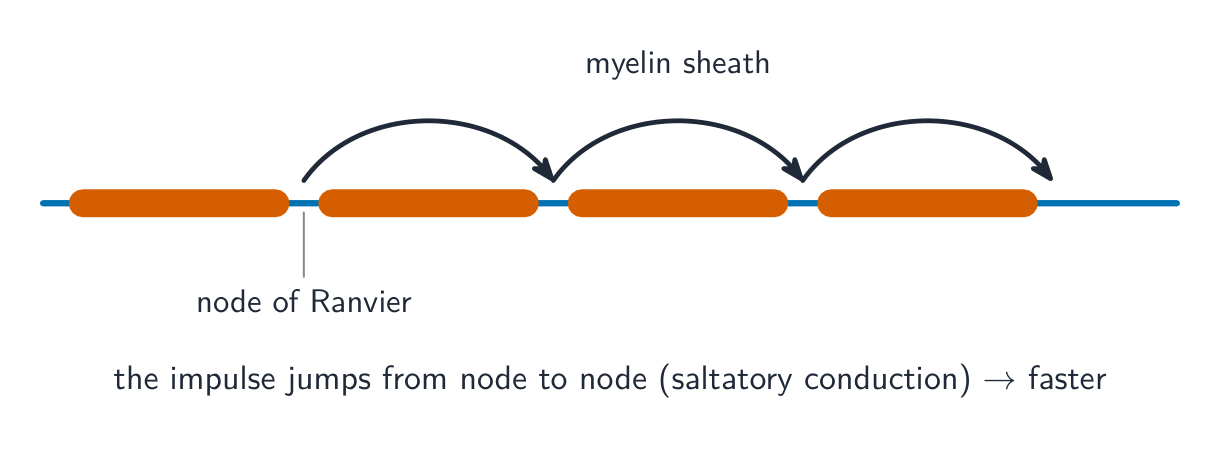
Saltatory conduction: the impulse jumps between the gaps in the myelin
Saltatory conduction makes impulses faster because the impulse:
Kesulitan 1/5 · 100 koin + bonus kecil pada penyelesaian pertama hari ini
The impulse cannot cross the myelin, so it jumps node to node — much faster than along a bare axon.
Worked example: reading an action potential trace
A trace starts at −70 mV, rises to +40 mV in 1 ms, falls to −80 mV, then returns to −70 mV. Explain each part.
- −70 mV: the resting potential, inside negative. Rise to +40 mV: voltage-gated Na⁺ channels open after the threshold (about −55 mV) is reached, and Na⁺ diffuses in: depolarisation. At the peak the Na⁺ channels close.
- Fall: K⁺ channels open and K⁺ diffuses out: repolarisation. The dip to −80 mV is hyperpolarisation, because K⁺ channels close slowly. The Na⁺/K⁺ pump then restores −70 mV. The total change from rest to peak is $40-(-70)=110$ mV.
A neurone rests at −65 mV and peaks at +35 mV. What is the change in potential, in mV?
Kesulitan 2/5 · 140 koin + bonus kecil pada penyelesaian pertama hari ini
35 − (−65) = 100 mV.
A stronger stimulus above threshold produces bigger action potentials.
Kesulitan 1/5 · 100 koin + bonus kecil pada penyelesaian pertama hari ini
Action potentials are all-or-nothing; a stronger stimulus gives them more often.
You've got it
- resting potential: inside negative (Na⁺ pumped out, K⁺ in; membrane leaks K⁺)
- action potential: Na⁺ in → depolarisation (+); K⁺ out → repolarisation (−)
- refractory period: Na⁺ channels can't reopen → limits impulse frequency
- myelin → saltatory conduction (jumps node to node) → much faster
Write from this case
- One stimulus is below threshold.
- A stronger stimulus is above threshold.
How do the two action potentials compare if both were above threshold?
The action potential does not come in half sizes.
What does a stimulus below threshold produce?
Kesulitan 1/5 · 100 koin + bonus kecil pada penyelesaian pertama hari ini
Threshold must be reached for a full impulse.