The magnetic effect of a current and the motor · L'effet magnétique d'un courant et le moteur
| English | Français |
|---|---|
| solenoid/ˈsəʊlənɔɪd/ | solénoïde |
| d.c. motor/ˌdiː ˈsiː ˈməʊtə/ | moteur c.c. |
| motor effect/ˈməʊtə ɪˈfekt/ | effet moteur |
| left-hand rule/left hænd ruːl/ | règle de la main gauche |
| commutator/ˈkɒmjuːteɪtə/ | commutateur |
Electricity makes magnetism
- A wire carrying a current creates a magnetic field around itself.
- Put that wire in another magnet's field and it feels a force — the idea behind every electric motor.
- This is where electricity and magnetism meet.
L'électricité crée du magnétisme
- Un fil parcouru par un courant génère un champ magnétique autour de lui.
- Placer ce fil dans le champ d'un autre aimant lui fait ressentir une force — c'est le principe de tout moteur électrique.
- C'est là que l'électricité et le magnétisme se rencontrent.
The magnetic effect of a current
- A current in a straight wire makes circular field lines around it; reverse the current and the field reverses.
- A solenoid 螺线管 (a long coil) makes a field just like a bar magnet, with a N and a S pole.
- Make it stronger by: more current, more turns, or a soft-iron core.
- Used in relays and loudspeakers.
A d.c. motor 直流电动机
L'effet magnétique d'un courant
- Un courant dans un fil droit produit des lignes de champ circulaires autour de lui ; inverser le courant inverse le champ.
- Un solénoïde 螺线管 (long bobinage) produit un champ identique à celui d'un aimant en barre, avec un pôle N et un pôle S.
- Le renforcer par : plus de courant, plus de spires, ou un noyau de fer doux.
- Utilisé dans les relais et les haut-parleurs.

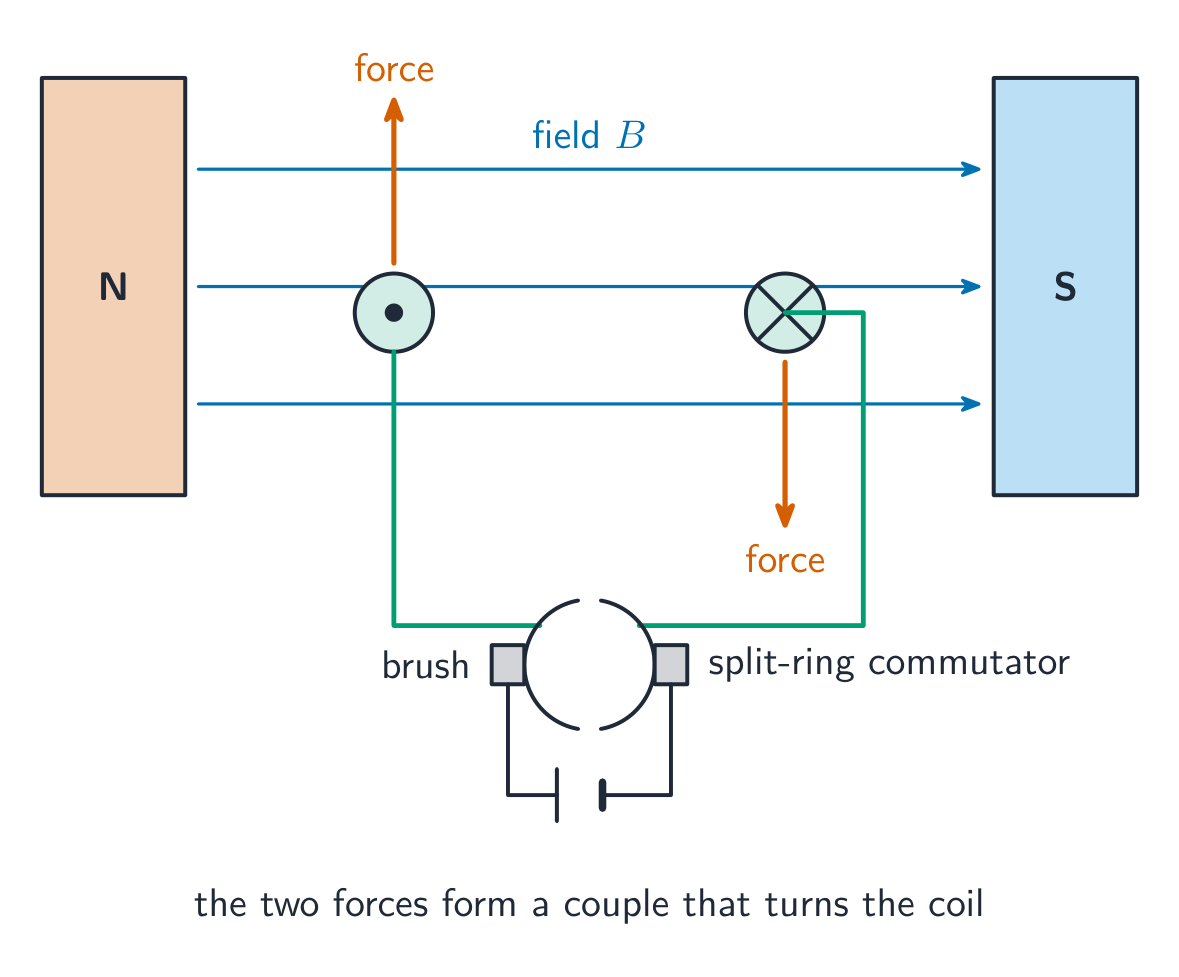
Un moteur continu 直流电动机
The force that spins a motor · La force qui fait tourner un moteur
A current in a magnetic field is pushed at right angles to both — reverse the current or flip the magnet and it pushes the other way. That is what turns a motor. · Un courant dans un champ magnétique est repoussé perpendiculairement aux deux — inversez le courant ou retournez l'aimant et il repousse dans l'autre sens. C'est ce qui fait tourner un moteur.
The magnetic field of a solenoid (a long coil carrying current) looks like the field of: · Le champ magnétique d'un solénoïde (long bobine parcourue par un courant) ressemble au champ de :
A solenoid produces a bar-magnet-like field, with a north pole at one end and a south at the other. · Un solénoïde produit un champ semblable à celui d'un aimant droit, avec un pôle nord à une extrémité et un pôle sud à l'autre.
Which change makes an electromagnet stronger? · Quel changement rend un électroaimant plus puissant ?
More current, more turns, and a soft-iron core all make the field stronger. · Plus de courant, plus de spires et un noyau en fer doux rendent tous le champ plus fort.
The motor effect 电动机效应
- A current-carrying wire in a magnetic field feels a force — the motor effect.
- Reverse the current, or reverse the field, and the force reverses.
- A bigger current or stronger field gives a bigger force; the force is greatest when the wire is at right angles to the field.
- Find the direction with the left-hand rule 左手定则: thumb = force, first finger = field (N→S), second finger = current.
L'effet moteur 电动机效应
- Un fil parcouru par un courant dans un champ magnétique subit une force — l'effet moteur.
- Inverser le courant, ou inverser le champ, inverse la force.
- Un courant plus grand ou un champ plus fort donne une force plus grande ; la force est maximale quand le fil est à angle droit par rapport au champ.
- Trouver la direction avec la règle de la main gauche 左手定则 : pouce = force, premier doigt = champ (N→S), deuxième doigt = courant.

In the motor effect, reversing the current direction: · Dans l'effet moteur, inverser la direction du courant :
Reversing either the current or the field reverses the force. Reversing both leaves it unchanged. · Inverser soit le courant soit le champ inverse la force. Inverser les deux la laisse inchangée.
In Fleming's left-hand rule, the thumb points in the direction of the: · Dans la règle de la main gauche de Fleming, le pouce pointe dans la direction de :
Thumb = force, first finger = field, second finger = current — all at right angles. · Pouce = force, premier doigt = champ, deuxième doigt = courant — tous perpendiculaires entre eux.
The force on a current-carrying wire is greatest when the wire is at right angles to the magnetic field. · La force sur un fil parcouru par un courant est maximale lorsque le fil est perpendiculaire au champ magnétique.
The force is largest when the wire is perpendicular to the field, and zero when the wire lies along the field. · La force est maximale lorsque le fil est perpendiculaire au champ, et nulle lorsque le fil est aligné avec le champ.
Match each idea to what it describes. · Reliez chaque idée à ce qu'elle décrit.
Each item links the term to its correct meaning. · Chaque élément relie le terme à sa signification correcte.
The d.c. motor
- A current-carrying coil in a field feels a turning effect: the forces on its two sides act in opposite directions.
- A split-ring commutator 换向器 swaps the current direction every half-turn, so the coil keeps spinning the same way.
- The turning effect is bigger with more turns, a bigger current, or a stronger field.
The motor effect on a current-carrying wire
Le moteur continu
- Une bobine parcourue par un courant dans un champ subit un couple : les forces sur ses deux côtés agissent en sens opposés.
- Un commutateur à anneaux fendus 换向器 inverse la direction du courant tous les demi-tours, pour que la bobine continue de tourner dans le même sens.
- Le couple augmente avec plus de spires, un courant plus grand, ou un champ plus fort.
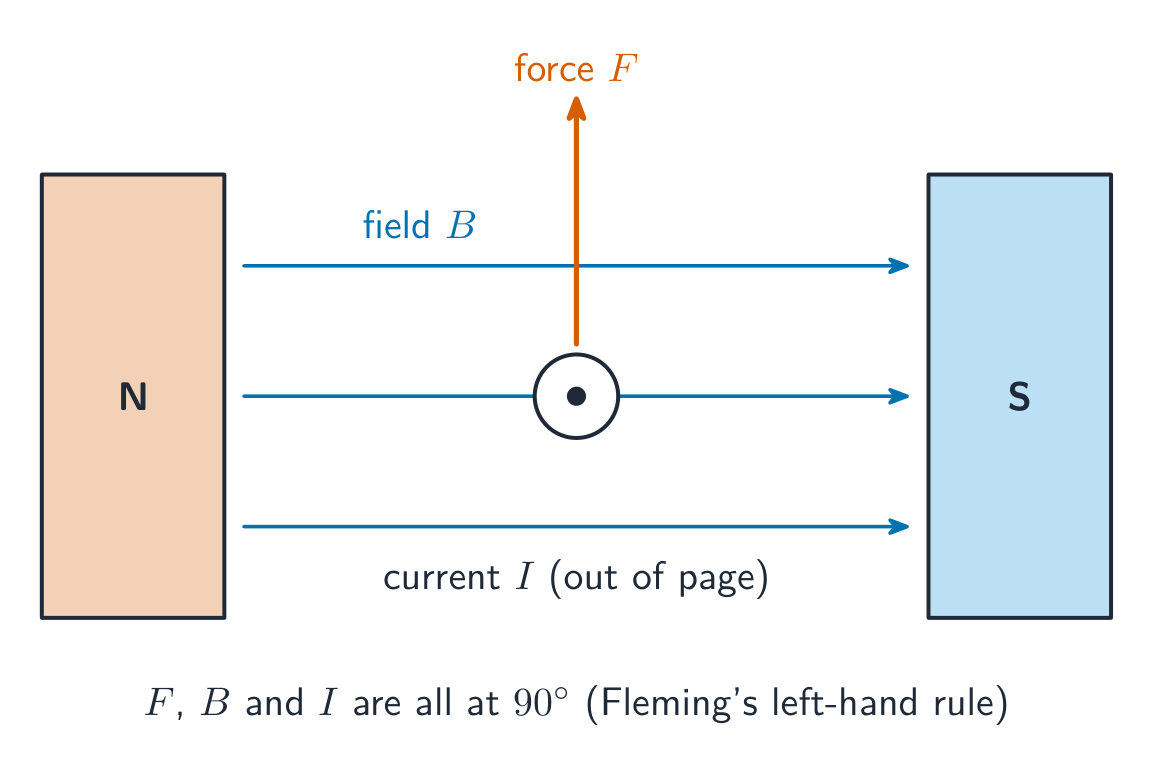
L'effet moteur sur un fil parcouru par un courant
What is the job of the split-ring commutator in a d.c. motor? · Quelle est la fonction du collecteur à bagues fendues dans un moteur c.c. ?
Without the commutator the coil would stop after half a turn. Swapping the current each half-turn keeps it rotating the same way. · Sans le collecteur, la bobine s'arrêterait après un demi-tour. Échanger le courant à chaque demi-tour la maintient en rotation dans le même sens.
You've got it
- a current makes a magnetic field: circles round a wire, bar-magnet field for a solenoid
- stronger electromagnet: more current, more turns, soft-iron core
- motor effect: a wire carrying current in a field feels a force (left-hand rule)
- a d.c. motor spins; the split-ring commutator reverses the current each half-turn
Vous avez compris
- un courant crée un champ magnétique : cercles autour d'un fil, champ aimant en barre pour un solénoïde
- électroaimant plus fort : plus de courant, plus de spires, noyau de fer doux
- effet moteur : un fil parcouru par un courant dans un champ subit une force (règle de la main gauche)
- un moteur continu tourne ; le commutateur à anneaux fendus inverse le courant chaque demi-tour