Magnetism · Magnétisme
| English | Français |
|---|---|
| magnet/ˈmæɡnɪt/ | aimant |
| poles/pəʊlz/ | pôles |
| magnetic field/mæɡˈnetɪk fiːld/ | champ magnétique |
| permanent magnet/ˈpɜːmənənt ˈmæɡnɪt/ | aimant permanent |
| induced magnetism/ɪnˈdjuːst ˈmæɡnɪtɪzəm/ | aimant induit |
| soft iron/sɒft ˈaɪən/ | fer doux |
| field lines/fiːld laɪnz/ | lignes de champ |
| electromagnets/ɪˌlektrəʊˈmæɡnɪts/ | électroaimants |
The pull of a magnet 磁体
- A fridge magnet sticks; a compass needle always swings to point north.
- A magnet has two ends, called poles 磁极: a north (N) and a south (S).
- Let's see the rules magnets follow — and how to picture their invisible field.
La force d'un aimant 磁体
- Un aimant de frigo colle ; l'aiguille d'une boussole pointe toujours vers le nord.
- Un aimant a deux extrémités appelées pôles 磁极 : un nord (N) et un sud (S).
- Voyons les règles que suivent les aimants — et comment visualiser leur champ invisible.
Poles and magnetic materials
- The pole rule is like the charge rule:
- Same poles (N–N or S–S) repel (push apart).
- Different poles (N–S) attract (pull together).
- A magnet attracts magnetic materials: iron, steel, cobalt, nickel. Copper, plastic and wood are not magnetic.
Iron filings line up along the magnetic field 磁场 of a bar magnet
Pôles et matériaux magnétiques
- La règle des pôles est comme la règle des charges :
- Les pôles identiques (N–N ou S–S) se repoussent (s'écartent).
- Les pôles différents (N–S) s'attirent (se rapprochent).
- Un aimant attire les matériaux magnétiques : fer, acier, cobalt, nickel. Le cuivre, le plastique et le bois ne sont pas magnétiques.

Des copeaux de fer s'alignent le long du champ magnétique 磁场 d'un aimant bar
Make the magnetic field visible · Rendre le champ magnétique visible
Compass needles trace the field from N to S; switch between attract and repel and watch the whole pattern reorganise, with a neutral point appearing for like poles. · Les aiguilles d'une boussole tracent le champ de N à S ; alternez attraction et répulsion et observez tout le motif se réorganiser, avec un point neutre apparaissant pour les pôles identiques.
Two north poles are brought close together. They: · Deux pôles nord sont rapprochés. Ils :
Like poles repel. Only different poles (N and S) attract. · Les pôles identiques repoussent. Seuls les pôles différents (N et S) s'attirent.
Which of these is a magnetic material (attracted by a magnet)? · Lequel de ceux-ci est un matériau magnétique (attiré par un aimant) ?
Iron (also steel, cobalt, nickel) is magnetic. Copper, plastic and wood are not. · Le fer (ainsi que l'acier, le cobalt, le nickel) est magnétique. Le cuivre, le plastique et le bois ne le sont pas.
Induced, temporary and permanent magnets 永磁体
- Put iron near a magnet and the iron becomes a magnet itself — induced magnetism 感应磁性. The near end gains the opposite pole, so they attract.
- Soft iron 软铁 magnetises easily but loses it quickly → a temporary magnet (great for electromagnet cores).
- Steel is harder to magnetise but keeps it → a permanent magnet (great for bar magnets).
The magnetic field of a bar magnet
Aimants induits, temporaires et permanents 永磁体
- Mettre du fer près d'un aimant et le fer devient lui-même un aimant — aimantation induite 感应磁性. L'extrémité proche acquiert le pôle opposé, donc ils s'attirent.
- Le fer tendre 软铁 se magnétise facilement mais perd rapidement cette propriété → un aimant temporaire (idéal pour les noyaux d'électroaimants).
- L'acier est plus difficile à magnétiser mais conserve cette propriété → un aimant permanent (idéal pour les aimants bars).

Le champ magnétique d'un aimant bar
Which material is best for a permanent magnet? · Quel matériau est le meilleur pour un aimant permanent ?
Steel is hard to magnetise but keeps it, so it makes a permanent magnet. Soft iron loses magnetism quickly, so it suits temporary magnets and electromagnet cores. · L'acier est difficile à aimanter mais la conserve, c'est pourquoi il sert aux aimants permanents. Le fer tendre perd l'aimantation rapidement, ce qui le convient aux aimants temporaires et aux noyaux d'électroaimants.
Match each magnetism idea to what it means. · Reliez chaque idée de magnétisme à ce qu'elle signifie.
Each item links the term to its correct meaning. · Chaque élément relie le terme à sa signification correcte.
Magnetic fields
- A magnetic field is a region where a magnetic pole feels a force.
- We draw it with field lines 磁感线 that come out of N and go into S.
- Where the lines are close together, the field is strong.
- Show the pattern with iron filings or a small plotting compass (the needle points along the field).
Champs magnétiques
- Un champ magnétique est une région où un pôle magnétique ressent une force.
- Nous le dessinons avec des lignes de champ 磁感线 qui sortent du N et entrent dans le S.
- Là où les lignes sont proches, le champ est fort.
- Montrez le motif avec des copeaux de fer ou un petit compas de traçage (l'aiguille pointe le long du champ).

Magnetic field lines around a bar magnet point: · Les lignes de champ magnétique autour d'un aimant droit pointent :
By convention, field lines come out of N and go into S; the closer together they are, the stronger the field. · Par convention, les lignes de champ sortent de N et entrent dans S ; plus elles sont rapprochées, plus le champ est intense.
Where the field lines are closer together, the magnetic field is stronger. · Là où les lignes de champ sont plus rapprochées, le champ magnétique est plus fort.
Closely spaced field lines mean a strong field — that is why the field is strongest near the poles. · Des lignes de champ espacées serrément signifient un champ fort — c'est pourquoi le champ est le plus intense près des pôles.
Uses of magnets
- Permanent magnets: fridge catches, compass needles, loudspeakers.
- Electromagnets 电磁铁 (magnetic only while a current flows): scrap-yard cranes, electric bells, relays.
- An electromagnet's big advantage: you can switch it on and off and make it stronger — a permanent magnet cannot.
Like poles repel; unlike poles attract
Utilisations des aimants
- Aimants permanents : accroches de frigo, aiguilles de boussole, haut-parleurs.
- Électroaimants 电磁铁 (magnétiques uniquement pendant qu'un courant circule) : grues de ferraille, cloches électriques, relais.
- Le grand avantage d'un électroaimant : vous pouvez le mettre en marche et l'arrêter et le rendre plus fort — un aimant permanent ne peut pas.
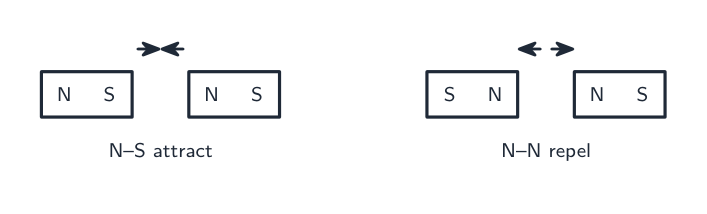
Pôles identiques se repoussent ; pôles différents s'attirent
What can an electromagnet do that a permanent magnet cannot? · Que peut faire un électroaimant qu'un aimant permanent ne peut pas ?
An electromagnet is magnetic only while a current flows, so it can be switched on/off and made stronger by increasing the current or turns. · Un électroaimant n'est magnétique que tant qu'un courant circule, donc il peut être allumé/éteint et rendu plus puissant en augmentant le courant ou le nombre de spires.
You've got it
- like poles repel, unlike poles attract; magnetic materials = iron, steel, cobalt, nickel
- soft iron = temporary magnet; steel = permanent magnet
- field lines go out of N, into S; closer lines = stronger field
- electromagnets can be switched on/off and made stronger
Vous avez compris
- pôles identiques se repoussent, pôles différents s'attirent ; matériaux magnétiques = fer, acier, cobalt, nickel
- fer tendre = aimant temporaire ; acier = aimant permanent
- les lignes de champ vont sortir de N, entrer dans S ; lignes plus proches = champ plus fort
- les électroaimants peuvent être allumés/éteints et rendus plus forts