Averages and range
Introduit| English | Sens |
|---|---|
| mean/miːn/ | moyenne |
| median/ˈmiːdiːən/ | médiane |
| mode/məʊd/ | mode |
| range/reɪndʒ/ | ensemble des valeurs |
| outlier/ˈaʊtlaɪə/ | valeur aberrante |
What's "normal"?
- The average salary in a company is 50 000 — but most people earn far less, because one CEO earns millions.
- Which average you choose changes the story. Mean 平均数, median 中位数, and mode 众数 each tell a different truth.
Laboratoire du choix de moyenne
Choose the average that fits the data situation.
The three averages
- Mean $= \dfrac{\text{sum of values}}{\text{how many}}$.
- Median $=$ the middle value when the data is ordered.
- Mode $=$ the most common value.
$4, 7, 7, 2, 5$: ordered $2, 4, 5, 7, 7$. Mean $= \dfrac{25}{5} = 5$; median $= 5$; mode $= 7$.
A box-and-whisker plot shows the five-number summary; the box length is the interquartile range 值域
Find the mean of 4, 7, 7, 2, 5.
Difficulté 2/5 · 140 pièces + un petit bonus lors de la première réussite aujourd'hui
(4 + 7 + 7 + 2 + 5)/5 = 25/5 = 5.
Find the mode of 4, 7, 7, 2, 5.
Difficulté 2/5 · 140 pièces + un petit bonus lors de la première réussite aujourd'hui
7 appears most often.
Find the median of 4, 7, 7, 2, 5.
Difficulté 2/5 · 140 pièces + un petit bonus lors de la première réussite aujourd'hui
Ordered: 2, 4, 5, 7, 7. The middle (3rd) value is 5.
Match each average or measure to how you find it.
Difficulté 2/5 · 140 pièces + un petit bonus lors de la première réussite aujourd'hui
Mean, median and mode are three kinds of average; the range measures spread.
The range
- Range $=$ largest $-$ smallest. It measures spread.
- Range of $4, 7, 7, 2, 5$: $7 - 2 = 5$.
The range is easily distorted. One extreme value (outlier 异常值) makes the range huge, even if most values are close together. The IQR (next lesson) is more robust.
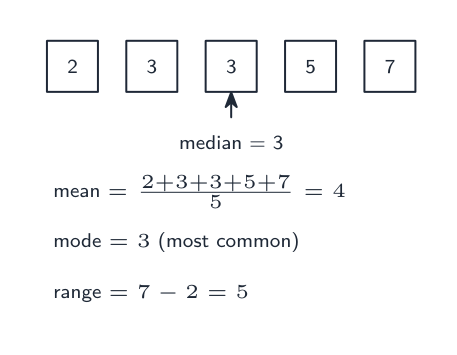
Mean, median, mode and range of a small data set
Find the range of 4, 7, 7, 2, 5.
Difficulté 2/5 · 140 pièces + un petit bonus lors de la première réussite aujourd'hui
Largest − smallest = 7 − 2 = 5.
The range is easily affected by a single extreme value (outlier).
Difficulté 1/5 · 100 pièces + un petit bonus lors de la première réussite aujourd'hui
The range uses only the largest and smallest values, so one outlier can make it very large.
Mean from a frequency table
- When values come with frequencies:
- Values $1, 2, 3$ with frequencies $4, 5, 1$: $\;\dfrac{1(4) + 2(5) + 3(1)}{10} = \dfrac{17}{10} = 1.7$.
Values 1, 2, 3 occur with frequencies 4, 5, 1. Find the mean (1 dp).
Difficulté 2/5 · 140 pièces + un petit bonus lors de la première réussite aujourd'hui
(1·4 + 2·5 + 3·1)/(4+5+1) = 17/10 = 1.7.
Which average to use?
- Mean: uses all the data, but affected by outliers.
- Median: usually less affected by extreme values than the mean — good for skewed data (like salaries).
- Mode: useful for categorical data (most popular colour, most common shoe size).
Even counts and frequency-table medians
- For $2,5,7,10$, the middle pair is 5 and 7, so median $M=(5+7)/2=6$; do not select only one middle value.
- Values 1,2,3 with frequencies 2,3,1 make six observations. Positions 3 and 4 are both 2, so median 2. Frequency counts determine the middle positions, not the number of table rows.
Values 1, 2, 3 have frequencies 2, 3, 1. Find the median.
Difficulté 2/5 · 140 pièces + un petit bonus lors de la première réussite aujourd'hui
Positions 3 and 4 in the six observations are both 2.
Worked examples: working back from a mean
1. A missing value. Five numbers have a mean of 8. Four of them are 6, 9, 10 and 5. Find the fifth.
- Total $=$ mean $\times$ count $= 8 \times 5 = 40$.
- Fifth number $= 40 - (6 + 9 + 10 + 5) = 40 - 30 = 10$.
2. Combining two groups. Class A: 20 students, mean mark 62. Class B: 30 students, mean mark 72. Find the mean for all 50.
- Totals: $20 \times 62 = 1240$ and $30 \times 72 = 2160$.
- Combined mean $= \dfrac{1240 + 2160}{50} = \dfrac{3400}{50} = 68$.
- It is not $\dfrac{62 + 72}{2} = 67$: the bigger class counts more.
Four numbers have a mean of 12. Three of them are 9, 15 and 10. Find the fourth number.
Difficulté 2/5 · 140 pièces + un petit bonus lors de la première réussite aujourd'hui
Total = 12 × 4 = 48. Fourth = 48 − (9 + 15 + 10) = 14.
10 boys have a mean height of 160 cm. 15 girls have a mean height of 155 cm. Find the mean height of all 25 students.
Difficulté 2/5 · 140 pièces + un petit bonus lors de la première réussite aujourd'hui
(10 × 160 + 15 × 155) ÷ 25 = (1600 + 2325) ÷ 25 = 3925 ÷ 25 = 157 cm.
You've got it
- mean $=$ total ÷ count; median $=$ middle in order; mode $=$ most common
- range $=$ largest − smallest
- frequency-table mean $= \dfrac{\sum(\text{value} \times \text{freq})}{\sum \text{freq}}$
Write from the data: find the mean
- The values are 3, 3, 8 and 10.
- Find the mean.
What is the mean of 3, 3, 8 and 10?
24 divided by 4 is 6.
What is the mean?
Difficulté 1/5 · 100 pièces + un petit bonus lors de la première réussite aujourd'hui
The total 24 shared by 4 values is 6. Other options — 5 (the lesson mean); 3 (the mode of these values).