Combined events · Événements combinés
| English | Français |
|---|---|
| independent/ˌɪndɪˈpendənt/ | indépendant |
| mutually exclusive/ˈmjuːtʃuːəli eksˈkluːsɪv/ | mutuellement exclusifs |
| sample space/ˈsæmpl speɪs/ | espace échantillonnal |
| tree diagram/triː ˈdaɪəɡræm/ | diagramme en arbre |
| replacement/rɪˈpleɪsmənt/ | remplacement |
Two events at once
- You roll a die and flip a coin. What's the chance of a six AND heads?
- Combined events need two rules: AND (multiply) and OR (add).
AND — multiply (independent 独立的 events)
- For two independent events (one doesn't affect the other):
$\text{P}(\text{six and heads}) = \dfrac{1}{6} \times \dfrac{1}{2} = \dfrac{1}{12}$.
Combined events · Événements combinés
P(A ∩ B) = P(A)·P(B|A)
Combine two events: the area model shows AND (overlap) versus OR (union). · Combinez deux événements : le modèle en aire montre ET (chevauchement) contre OU (union).
For two independent events both happening (AND), you: · Pour deux événements indépendants se produisant tous les deux (ET), vous :
P(A and B) = P(A) × P(B) for independent events. · P(A et B) = P(A) × P(B) pour les événements indépendants.
OR — add (mutually exclusive 互斥 events)
- For two mutually exclusive events (they can't both happen):
Probability tree · Arbre de probabilité
Multiply the probabilities along each branch; the four outcomes always add up to 1. · Multipliez les probabilités le long de chaque branche ; les quatre résultats ajoutés valent toujours 1.
For mutually exclusive events, P(A or B) = P(A) + P(B). · Pour des événements mutuellement exclusifs, P(A ou B) = P(A) + P(B).
Mutually exclusive events cannot both happen, so you add their probabilities. · Les événements mutuellement exclusifs ne peuvent pas tous les deux se produire, donc on additionne leurs probabilités.
Three ways to show outcomes
- Sample space 样本空间 diagram: a table of every outcome (two dice → $36$ cells).
- Venn diagram: sorts outcomes into overlapping sets.
- Tree diagram 树状图: a branch per stage; multiply along branches, then add · ajouter the paths you want.
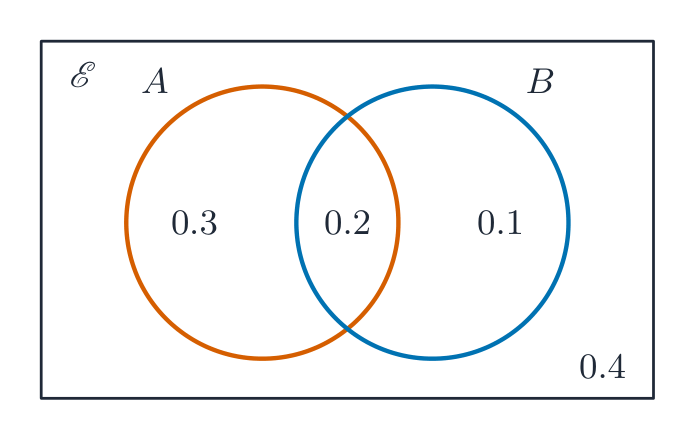
A Venn diagram sorts outcomes: the overlap is $\text{P}(A\text{ and }B)$, and everything inside either circle is $\text{P}(A\text{ or }B)$
Multiply along, add between. On a tree diagram: multiply probabilities along each branch (to get that path's probability), then add the paths you want (to get the total probability).
On the 6 by 6 grid of two dice (36 cells), how many cells give a total of 7? · Sur la grille 6 par 6 de deux dés (36 cases), combien de cases donnent un total de 7 ?
1+6, 2+5, 3+4, 4+3, 5+2, 6+1 — six cells, so P(7) = 6/36 = 1/6. · 1+6, 2+5, 3+4, 4+3, 5+2, 6+1 — six cases, donc P(7) = 6/36 = 1/6.
On a tree diagram, you ______ along branches and add between paths. · Sur un arbre de probabilité, vous ______ le long des branches et ajoutez entre les chemins.
Multiply along each branch to get that path probability, then add the wanted paths. · Multipliez le long de chaque branche pour obtenir la probabilité de ce chemin, puis ajoutez les chemins souhaités.
With and without replacement 放回
- With replacement: chances stay the same each time.
- Without replacement (Extended): the total and the count change after each draw.
- Bag of $3$ red, $5$ blue: P(red, red) with replacement $= \dfrac{3}{8} \times \dfrac{3}{8} = \dfrac{9}{64}$. Without replacement $= \dfrac{3}{8} \times \dfrac{2}{7} = \dfrac{3}{28}$.
Venn diagrams show combined events: the overlap (intersection) is AND, the whole region (union) is OR.
Bag of 3 red, 5 blue, two draws WITH replacement. P(red, red) = 9/b. What is b? · Sac de 3 rouges, 5 bleus, deux tirages AVEC remise. P(rouge, rouge) = 9/b. Quelle est b ?
(3/8) × (3/8) = 9/64, so b = 64. · (3/8) × (3/8) = 9/64, donc b = 64.
Same bag, WITHOUT replacement. After one red is taken, how many reds remain? · Même sac, SANS remise. Après qu'un rouge ait été pris, combien de rouges restent ?
Started with 3 red; one taken leaves 2 red (out of 7 counters). · A commencé avec 3 rouges ; un pris laisse 2 rouges (sur 7 jetons).
Exactly one means two paths
- Draw twice from 2 red and 3 blue counters with replacement. Each stage has red $2/5$ and blue $3/5$. Exactly one red includes RB and BR, so $p=(2/5)(3/5)+(3/5)(2/5)=12/25$.
- At least one red is easier by complement: $p=1-(3/5)^2=16/25$. This includes RR as well as the two mixed paths; do not confuse exactly one with at least one.

With replacement from 2 red and 3 blue counters, find the probability of exactly one red in two draws. · Avec remise parmi 2 jetons rouges et 3 jetons bleus, trouver la probabilité d'avoir exactement un jeton rouge en deux tirages.
RB and BR give 6/25 + 6/25 = 12/25 = 0.48. · RB et BR donnent 6/25 + 6/25 = 12/25 = 0.48.
You've got it
- AND → multiply (independent); OR → add (mutually exclusive)
- on a tree: multiply along branches, add the wanted paths
- without replacement, the second probability changes ($\dfrac{3}{8} \to \dfrac{2}{7}$)