Functions · Fonctions
| English | Français |
|---|---|
| function/ˈfʌŋkʃn/ | fonction |
| domain/dəˈmeɪn/ | domaine |
| range/reɪndʒ/ | range |
| inverse function/ɪnˈvɜːs ˈfʌŋkʃn/ | fonction réciproque |
| composite function/ˈkɒmpəzɪt ˈfʌŋkʃn/ | fonction composée |
A machine with an input and an output
- A vending machine: you put in a code (input), it gives you a snack (output). A function 函数 works the same way — each input produces exactly one output.
- $f(x) = 3x - 5$ is a function: put in $x = 2$, get out $f(2) = 1$.
Une machine avec une entrée et une sortie
- Un distributeur automatique : vous insérez un code (entrée), il vous donne un snack (sortie). Une fonction 函数 fonctionne de la même manière — chaque entrée produit exactement une sortie.
- $f(x) = 3x - 5$ est une fonction : mettre $x = 2$, obtenir $f(2) = 1$.
Evaluating functions
- $f(x) = 3x - 5$: $\;f(2) = 3(2) - 5 = 1$; $\;f(0) = -5$; $\;f(-1) = -8$.
- The domain 定义域 is the set of allowed inputs. The range 值域 is the set of possible outputs.
$f(x) = \sqrt{x}$ has domain $x \geq 0$ (can't square-root a negative) and range $f(x) \geq 0$.
Évaluer des fonctions
- $f(x) = 3x - 5$: $\;f(2) = 3(2) - 5 = 1$; $\;f(0) = -5$; $\;f(-1) = -8$.
- Le domaine 定义域 est l'ensemble des entrées autorisées. L'image 值域 est l'ensemble des sorties possibles.
$f(x) = \sqrt{x}$ a pour domaine $x \geq 0$ (on ne peut pas extraire la racine carrée d'un nombre négatif) et pour image $f(x) \geq 0$.
Functions · Fonctions
y = f(x)
A function turns each input · entrée into exactly one output · production — watch its shape. · Une fonction transforme chaque entrée en exactement une sortie — observez sa forme.
For f(x) = 3x − 5, what is f(2)? · Pour f(x) = 3x − 5, quelle est f(2) ?
f(2) = 3(2) − 5 = 6 − 5 = 1.
For f(x) = x² + 1, what is f(3)? · Pour f(x) = x² + 1, quelle est f(3) ?
f(3) = 3² + 1 = 9 + 1 = 10.
Inverse functions 反函数
- The inverse $f^{-1}$ undoes $f$: if $f$ turns $2$ into $1$, then $f^{-1}$ turns $1$ back into $2$.
- Method: write $y = f(x)$, swap $x$ and $y$, then make $y$ the subject.
- $f(x) = 3x - 5$: $y = 3x - 5$, swap: $x = 3y - 5$, solve: $y = \dfrac{x+5}{3}$.
- So $f^{-1}(x) = \dfrac{x+5}{3}$. Check: $f^{-1}(1) = \dfrac{6}{3} = 2$ ✓.
$f^{-1}$ is NOT $f$ to the power $-1$. The notation $f^{-1}(x)$ means "the inverse of $f$", not "$\dfrac{1}{f(x)}$". These are completely different.
Fonctions réciproques 反函数
- La réciproque $f^{-1}$ annule $f$ : si $f$ transforme $2$ en $1$, alors $f^{-1}$ retransforme $1$ en $2$.
- Méthode : écrire $y = f(x)$, inverser $x$ et $y$, puis isoler $y$.
- $f(x) = 3x - 5$ : $y = 3x - 5$, inverser : $x = 3y - 5$, résoudre : $y = \dfrac{x+5}{3}$.
- Donc $f^{-1}(x) = \dfrac{x+5}{3}$. Vérification : $f^{-1}(1) = \dfrac{6}{3} = 2$ ✓.
$f^{-1}$ n'est PAS $f$ à la puissance $-1$. La notation $f^{-1}(x)$ signifie "la réciproque de $f$", pas "$\dfrac{1}{f(x)}$". Ce sont deux choses totalement différentes.
The inverse of f(x) = 3x − 5 is f⁻¹(x) = (x + 5)/3. What is f⁻¹(1)? · L'inverse de f(x) = 3x − 5 est f⁻¹(x) = (x + 5)/3. Quelle est f⁻¹(1) ?
f⁻¹(1) = (1 + 5)/3 = 6/3 = 2.
To find the inverse of f(x), write y = f(x), swap x and y, then make ______ the subject. · Pour trouver l'inverse de f(x), écrivez y = f(x), échangez x et y, puis mettez ______ en évidence.
After swapping, solve for y — that gives you f⁻¹(x). · Après l'échange, résolvez pour y — cela vous donne f⁻¹(x).
Composite functions 复合函数
- $gf(x)$ means "do $f$ first, then apply $g$ to the result".
- $f(x) = 2x$, $g(x) = x + 3$: $gf(x) = g(2x) = 2x + 3$.
- $fg(x) = f(x+3) = 2(x+3) = 2x + 6$. Order matters!
Fonctions composées 复合函数
- $gf(x)$ signifie "faire $f$ d'abord, puis appliquer $g$ au résultat".
- $f(x) = 2x$, $g(x) = x + 3$: $gf(x) = g(2x) = 2x + 3$.
- $fg(x) = f(x+3) = 2(x+3) = 2x + 6$. L'ordre est important !
If f(x) = 2x and g(x) = x + 3, what is gf(x) at x = 5? (gf means do f first) · Si f(x) = 2x et g(x) = x + 3, quelle est gf(x) en x = 5 ? (gf signifie faire f d'abord)
gf(5) = g(f(5)) = g(10) = 10 + 3 = 13.
For f(x) = 2x and g(x) = x + 3, gf(x) and fg(x) give the same result. · Pour f(x) = 2x et g(x) = x + 3, gf(x) et fg(x) donnent le même résultat.
gf(x) = 2x + 3, but fg(x) = 2(x+3) = 2x + 6. The order matters. · gf(x) = 2x + 3, mais fg(x) = 2(x+3) = 2x + 6. L'ordre compte.
Fun fact
- The identity function $I(x) = x$ leaves everything unchanged. For any function, $f \circ f^{-1} = I$ — composing a function with its inverse gives back the original input.
Every curve here is a function: for each input $x$, there's exactly one output $y$.
Fait amusant
- La fonction identité $I(x) = x$ laisse tout inchangé. Pour toute fonction, $f \circ f^{-1} = I$ — composer une fonction avec sa réciproque redonne l'entrée originale.
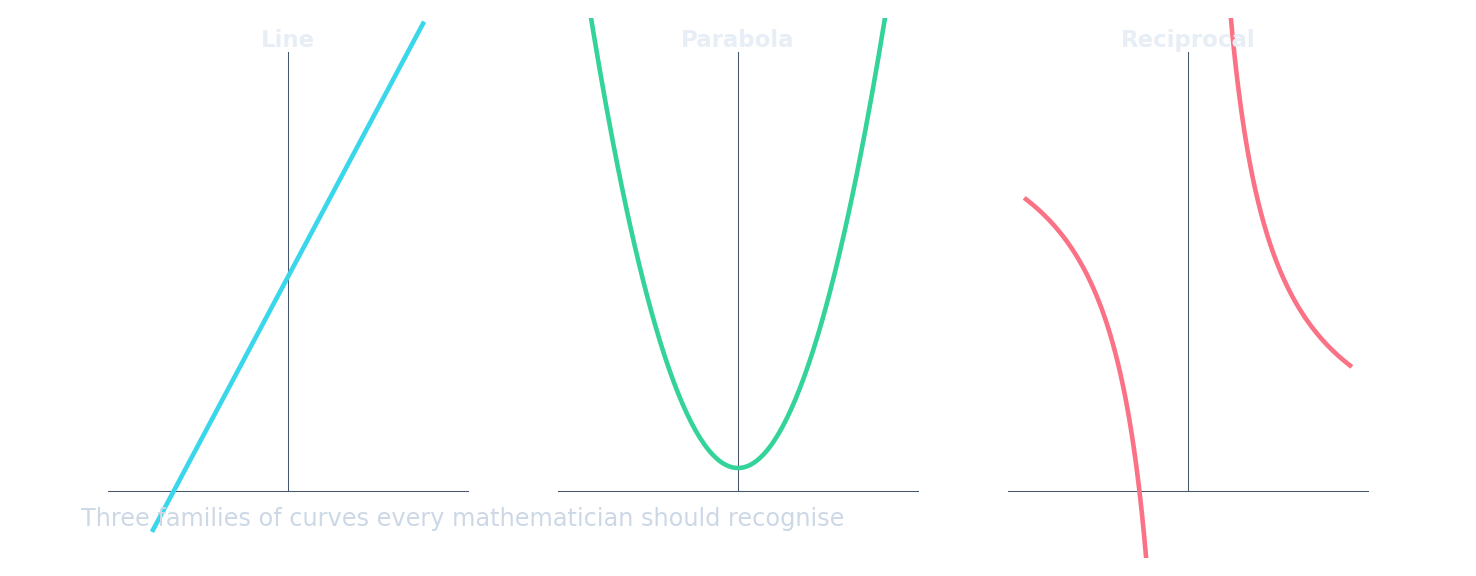
Toutes les courbes ici sont des fonctions : pour chaque entrée $x$, il y a exactement une sortie $y$.
You've got it
- $f(x) = 3x - 5 \Rightarrow f(2) = 1$; domain = inputs, range = outputs
- inverse $f^{-1}$ undoes $f$: swap $x$ and $y$, then solve for $y$
- composite $gf(x)$ = do $f$ first, then $g$; order matters ($gf \neq fg$)
Vous avez compris
- $f(x) = 3x - 5 \Rightarrow f(2) = 1$ ; domaine = entrées, image = sorties
- réciproque $f^{-1}$ annule $f$ : inverser $x$ et $y$, puis résoudre pour $y$
- composée $gf(x)$ = faire $f$ d'abord, puis $g$ ; l'ordre est important ($gf \neq fg$)