Differentiation · Dérivation
| English | Français |
|---|---|
| calculus/ˈkælkjʊləs/ | calcul différentiel et intégral |
| derivative/dɪˈrɪvətɪv/ | dérivée |
| differentiate/ˌdɪfəˈrenʃɪeɪt/ | différencier |
| stationary point/ˈsteɪʃənəri pɔɪnt/ | point stationnaire |
The gradient that changes
- A straight line has one gradient everywhere. A curve has a different gradient at every point.
- Newton and Leibniz invented calculus 微积分 to answer: "What is the gradient of a curve right here?" The answer is the derivative 导数.
La pente qui change
- Une droite a une seule pente partout. Une courbe a une pente différente à chaque point.
- Newton et Leibniz ont inventé le calcul différentiel pour répondre : « Quelle est la pente d'une courbe exactement ici ? » La réponse est la dérivée.
The power rule
- If $y = ax^n$, then $\dfrac{dy}{dx} = an\,x^{n-1}$.
- In words: bring the power down in front, then reduce it by one.
$y = x^3 + 2x^2 - 5x \Rightarrow \dfrac{dy}{dx} = 3x^2 + 4x - 5$. Differentiate 求导 term by term — each term is treated independently.
The gradient of a curve at a point is the gradient of the tangent there, which is what differentiation finds
La règle de la puissance
- Si $y = ax^n$, alors $\dfrac{dy}{dx} = an\,x^{n-1}$.
- En mots : descendre l'exposant devant, puis le réduire d'une unité.
$y = x^3 + 2x^2 - 5x \Rightarrow \dfrac{dy}{dx} = 3x^2 + 4x - 5$. Dérivez terme par terme — chaque terme est traité indépendamment.
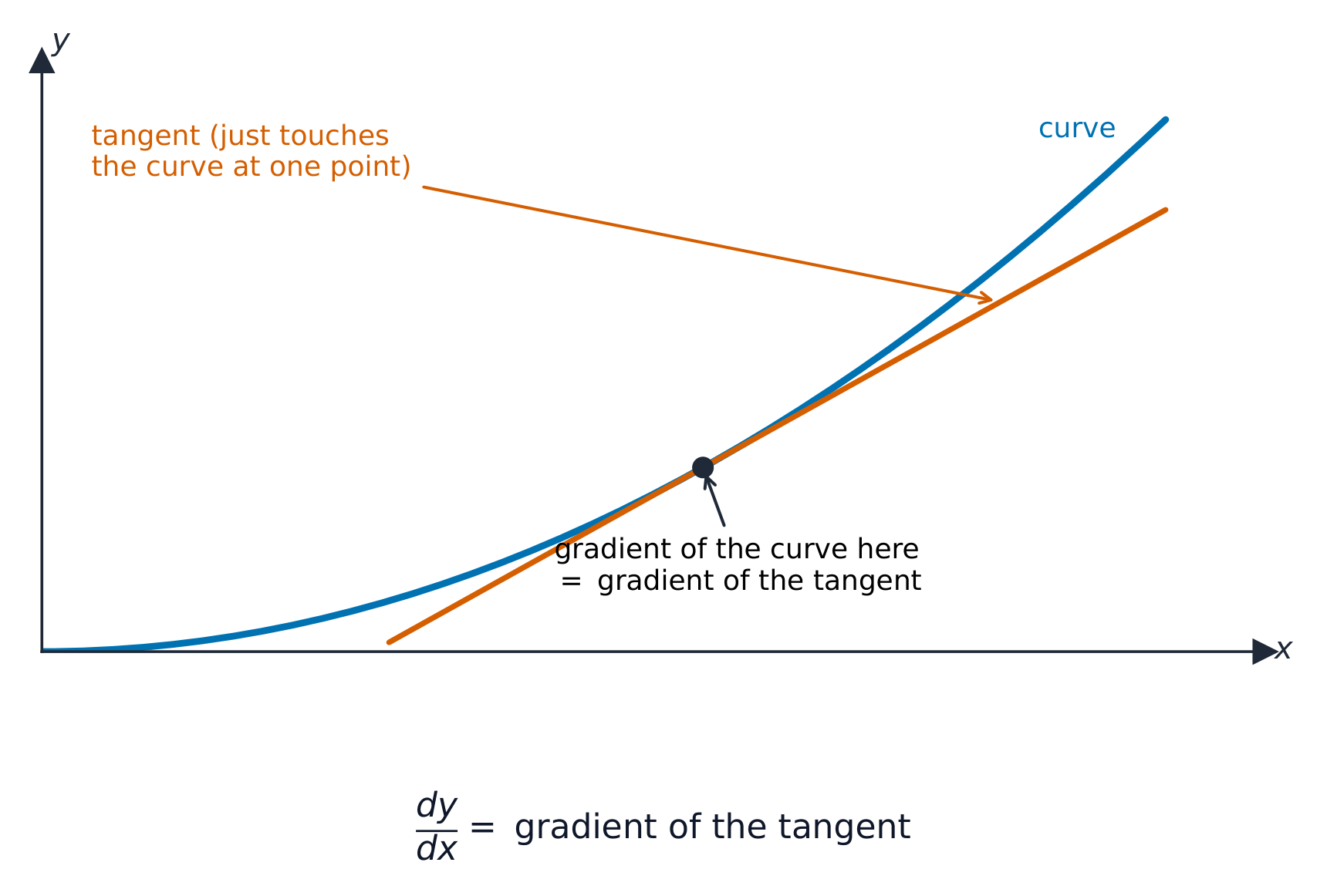
La pente d'une courbe en un point est la pente de la tangente à cet endroit, ce que la dérivation trouve
The gradient at a point · La pente en un point
gradient = dy/dx · pente = dy/dx
Slide the point — the tangent · tangente's slope is the gradient there. · Faites glisser le point — la pente de la tangente est le gradient à cet endroit.
If y = x³ + 2x² − 5x, then dy/dx = 3x² + 4x − 5. What is its value at x = 1? · Si y = x³ + 2x² − 5x, alors dy/dx = 3x² + 4x − 5. Quelle est sa valeur en x = 1 ?
3(1)² + 4(1) − 5 = 3 + 4 − 5 = 2.
For y = axⁿ, where n is a positive integer, differentiating gives: · Pour y = axⁿ, où n est un entier positif, la dérivation donne :
Bring the power down and reduce it by 1: a·n·xⁿ⁻¹. · Amener l'exposant vers le bas et le réduire de 1 : a·n·xⁿ⁻¹.
If y = 4x³, what is dy/dx at x = 2? · Si y = 4x³, quelle est dy/dx en x = 2 ?
dy/dx = 12x². At x = 2: 12(4) = 48. · dy/dx = 12x². En x = 2 : 12(4) = 48.
The derivative of y = x⁵ is dy/dx = ______. · La dérivée de y = x⁵ est dy/dx = ______.
Power rule: bring down the 5, reduce the power: 5x⁴. · Règle de puissance : amener le 5, réduire l'exposant : 5x⁴.
Special cases
- $y = c$ (a constant) → $\dfrac{dy}{dx} = 0$ (a horizontal line has zero gradient).
- $y = cx$ → $\dfrac{dy}{dx} = c$ (a straight line has constant gradient).
- The IGCSE power rule here uses nonnegative integer powers and sums of at most three terms; differentiating reciprocal functions is outside this syllabus.
Don't forget the constant term. The derivative of $x^2 + 7$ is $2x$, not $2x + 7$. The derivative of a constant is always zero.
Cas particuliers
- $y = c$ (une constante) → $\dfrac{dy}{dx} = 0$ (une ligne horizontale a une pente nulle).
- $y = cx$ → $\dfrac{dy}{dx} = c$ (une droite a une pente constante).
- La règle des puissances IGCSE ici utilise des puissances entières non négatives et des sommes d'au plus trois termes ; dériver des fonctions réciproques sort de ce programme.
N'oubliez pas le terme constant. La dérivée de $x^2 + 7$ est $2x$, pas $2x + 7$. La dérivée d'une constante est toujours zéro.
The derivative of y = x² + 7 is 2x + 7. · La dérivée de y = x² + 7 est 2x + 7.
The derivative of a constant is 0. So dy/dx = 2x, not 2x + 7. · La dérivée d'une constante est 0. Donc dy/dx = 2x, pas 2x + 7.
Stationary points 驻点
- A stationary point is where $\dfrac{dy}{dx} = 0$ — the curve is momentarily flat.
- $y = x^2 - 6x + 5 \Rightarrow \dfrac{dy}{dx} = 2x - 6 = 0 \Rightarrow x = 3$.
- At $x = 3$: $y = 9 - 18 + 5 = -4$. Turning point: $(3, -4)$.
A stationary point is where the curve is momentarily flat — the gradient (derivative) equals zero.
Points stationnaires
- Un point stationnaire est où $\dfrac{dy}{dx} = 0$ — la courbe est momentanément plate.
- $y = x^2 - 6x + 5 \Rightarrow \dfrac{dy}{dx} = 2x - 6 = 0 \Rightarrow x = 3$.
- En $x = 3$ : $y = 9 - 18 + 5 = -4$. Point de retournement : $(3, -4)$.
Un point stationnaire est là où la courbe est momentanément plate — la pente (la dérivée) est égale à zéro.
The curve y = x² − 6x + 5 has a turning point. At what x value (dy/dx = 0)? · La courbe y = x² − 6x + 5 admet un point d'inflexion. À quelle valeur de x (dy/dx = 0) ?
dy/dx = 2x − 6 = 0 gives x = 3. · dy/dx = 2x − 6 = 0 donne x = 3.
Why differentiation matters
- Physics: velocity is the derivative of position; acceleration is the derivative of velocity.
- Economics: marginal cost is the derivative of total cost — the cost of one more unit.
- Optimisation: to maximise profit or minimise cost, set the derivative to zero.
Pourquoi la dérivation est importante
- Physique : la vitesse est la dérivée de la position ; l'accélération est la dérivée de la vitesse.
- Économie : le coût marginal est la dérivée du coût total — le coût d'une unité supplémentaire.
- Optimisation : pour maximiser le profit ou minimiser le coût, poser la dérivée égale à zéro.
A tangent estimates a curve gradient
- Draw a tangent touching the curve at the required point, then choose two clear points on the tangent, not two arbitrary points on the curve. Calculate its rise divided by run.
- For $y=x^2$ at $(2,4)$, a tangent through $(1,0)$ and $(3,8)$ has $m=(8-0)/(3-1)=4$. Differentiation confirms $dy/dx=2x=4$ at $x=2$.
Une tangente estime la pente d'une courbe
- Tracez une tangente touchant la courbe au point requis, puis choisissez deux points clairs sur la tangente, pas deux points arbitraires sur la courbe. Calculez sa hauteur divisée par son horizontalité.
- Pour $y=x^2$ à $(2,4)$, une tangente passant par $(1,0)$ et $(3,8)$ a $m=(8-0)/(3-1)=4$. La dérivation confirme $dy/dx=2x=4$ à $x=2$.
A tangent passes through (1,0) and (3,8). Find its gradient. · Une tangente passe par (1,0) et (3,8). Trouvez sa pente.
Rise 8 divided by run 2 gives 4. · La montée 8 divisée par la course 2 donne 4.
Minimum or maximum?
- For $y=x^2-6x+5$, the derivative is $2x-6$. It is negative at $x=2$, zero at 3 and positive at 4: falling then rising means a minimum at $(3,-4)$.
- For $y=-x^2+4x+1$, $dy/dx=-2x+4$. Positive at 1 and negative at 3 means a maximum at $x=2$, where $y=5$.
Minimum ou maximum ?
- Pour $y=x^2-6x+5$, la dérivée est $2x-6$. Elle est négative à $x=2$, nulle à 3 et positive à 4 : descendre puis monter signifie un minimum à $(3,-4)$.
- Pour $y=-x^2+4x+1$, $dy/dx=-2x+4$. Positif en 1 et négatif en 3 indique un maximum en $x=2$, où $y=5$.
For y = −x² + 4x + 1, find the y-coordinate of its maximum. · Pour y = −x² + 4x + 1, trouvez l'ordonnée du maximum.
dy/dx = −2x + 4 is zero at x = 2; y = −4 + 8 + 1 = 5. · dy/dx = −2x + 4 est nul en x = 2 ; y = −4 + 8 + 1 = 5.
You've got it
- power rule: $y = ax^n \Rightarrow \dfrac{dy}{dx} = an\,x^{n-1}$
- differentiate a sum term by term; the derivative of a constant is zero
- a stationary point is where $\dfrac{dy}{dx} = 0$
- $y = x^3 + 2x^2 - 5x \Rightarrow \dfrac{dy}{dx} = 3x^2 + 4x - 5$
Vous avez compris
- règle de la puissance : $y = ax^n \Rightarrow \dfrac{dy}{dx} = an\,x^{n-1}$
- dériver une somme terme par terme ; la dérivée d'une constante est zéro
- un point stationnaire est là où $\dfrac{dy}{dx} = 0$
- $y = x^3 + 2x^2 - 5x \Rightarrow \dfrac{dy}{dx} = 3x^2 + 4x - 5$