Types of number · Types de nombres
| English | Français |
|---|---|
| rational/ˈræʃənl/ | rationnel |
| irrational/ɪˈræʃənl/ | irrationnel |
| natural numbers/ˈnætʃərəl ˈnʌmbəz/ | nombres naturels |
| integers/ˈɪntɪdʒəz/ | entiers |
| factor/ˈfæktə/ | facteur |
| multiple/ˈmʌltɪpl/ | multiple |
| prime/praɪm/ | prime |
| prime factorisation/praɪm ˌfæktəraɪˈzeɪʃn/ | factorisation en facteurs premiers |
| HCF/ˌeɪtʃ siː ˈef/ | PGCD |
| LCM/ˌel siː ˈem/ | PPCM |
| reciprocal/rɪˈsɪprəkl/ | réciproque |
A question that stumped the ancient Greeks
- Is every number a fraction? The Greeks thought yes — until someone proved $\sqrt{2}$ cannot be written as $\dfrac{a}{b}$.
- Legend says the discoverer was thrown overboard for revealing this uncomfortable truth.
- Today we sort numbers into families, and that split — rational 有理数 vs irrational 无理数 — is still the big one.
The number families
- Natural numbers 自然数 $\mathbb{N} = \{1, 2, 3, \dots\}$ — the counting numbers (some definitions include $0$).
- Integers 整数 $\mathbb{Z} = \{\dots, -2, -1, 0, 1, 2, \dots\}$ — whole numbers, positive, negative and zero.
- Rational numbers $\mathbb{Q}$ — anything that can be written $\dfrac{a}{b}$ where $a, b$ are integers and $b \neq 0$.
- Irrational numbers — everything else ($\pi$, $\sqrt{2}$, $e$): they cannot be expressed as a fraction.
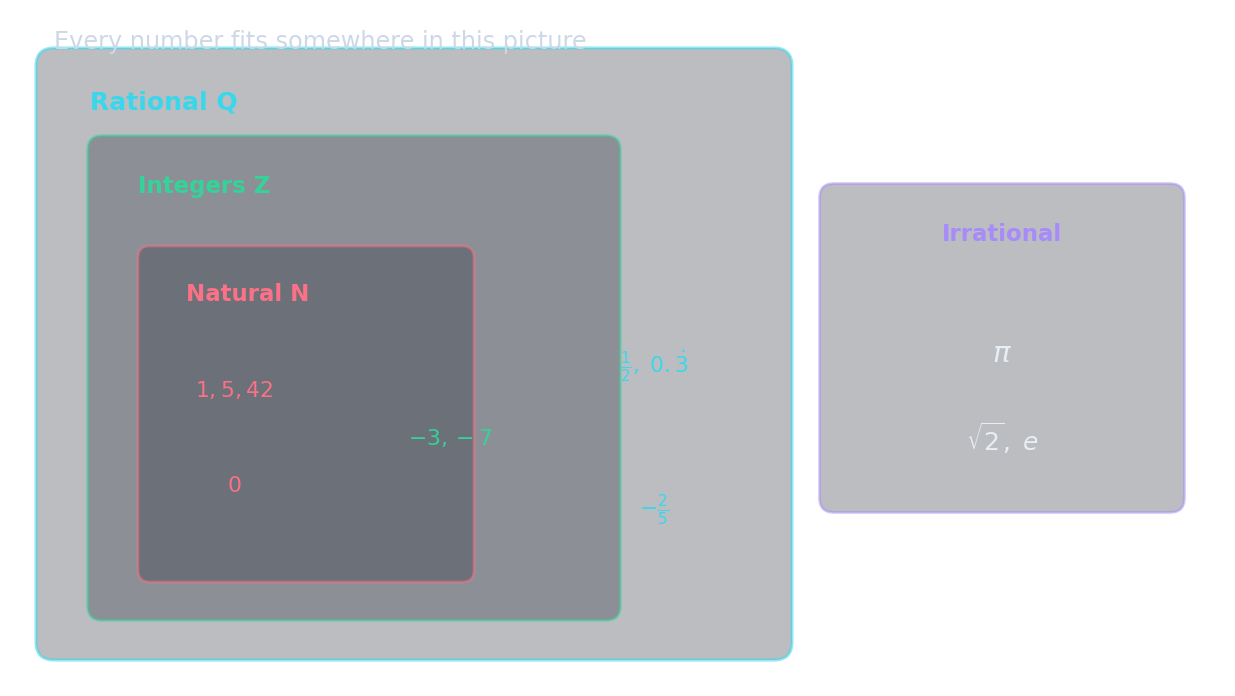
Natural → Integer → Rational, each a bigger family. Irrational numbers live outside.
Sets of numbers · Ensembles de nombres
Every counting number is also an integer, every integer a rational — see how the number sets nest, and how union and intersection combine them. · Chaque nombre de comptage est aussi un entier, chaque entier est rationnel — voyez comment les ensembles de nombres s'emboîtent, et comment l'union et l'intersection les combinent.
Match each number to its smallest number family. · Reliez chaque nombre à sa famille numérique la plus petite.
−5 and 0 are integers (whole numbers, including negatives). 3/7 is rational (a fraction of integers). √3 is irrational (cannot be written as a/b). · −5 et 0 sont des entiers (nombres entiers, y compris négatifs). 3/7 est rationnel (une fraction d'entiers). √3 est irrationnel (ne peut pas s'écrire sous forme a/b).
Factors 因数, multiples 倍数 and primes 质数
- A factor of $n$ divides into $n$ exactly. Factors of $12$: $1, 2, 3, 4, 6, 12$.
- A multiple of $n$ is $n \times$ an integer. Multiples of $5$: $5, 10, 15, 20, \dots$.
- A prime has exactly two factors: $1$ and itself.
- $2, 3, 5, 7, 11, 13, \dots$ are prime. $1$ is not prime (only one factor).
1 is NOT prime. A prime must have exactly two distinct factors. $1$ has only one factor (itself), so it fails the definition.

Every natural number is an integer, every integer is rational, and every rational is real; irrational numbers like $\pi$ and · et $\sqrt{2}$ are real but not rational
Which of these is a prime number? · Lequel de ceux-ci est un nombre premier ?
13 has exactly two factors (1 and 13). 1 is not prime; 9 = 3×3; 15 = 3×5. · 13 a exactement deux facteurs (1 et 13). 1 n'est pas premier ; 9 = 3×3 ; 15 = 3×5.
The number 1 is a prime number. · Le nombre 1 est un nombre premier.
1 has only one factor (itself). A prime must have exactly two distinct factors. · 1 n'a qu'un seul facteur (lui-même). Un nombre premier doit avoir exactement deux facteurs distincts.
The smallest prime number is ______. · Le plus petit nombre premier est ______.
2 is the smallest (and only even) prime number. · 2 est le plus petit (et seul pair) nombre premier.
Prime factorisation 质因数分解, HCF 最大公因数 and LCM 最小公倍数
- Write any number as a product of primes: $72 = 2^3 \times 3^2$, $120 = 2^3 \times 3 \times 5$.
- HCF (highest common factor): take the lowest power of each shared · partagé prime.
- HCF of $72$ and · et $120$ $= 2^3 \times 3 = 24$.
- LCM (lowest common multiple): take the highest power of every prime that appears.
- LCM of $72$ and · et $120$ $= 2^3 \times 3^2 \times 5 = 360$.

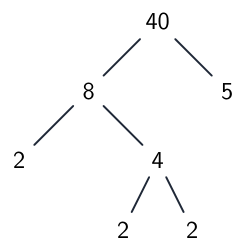
Keep splitting until every branch ends on a prime (circled); collecting them gives $72 = 2^3 \times 3^2$
Quick check. HCF × LCM should equal the product of the two numbers: $24 \times 360 = 8640$ and · et $72 \times 120 = 8640$. ✓
Find the HCF of 72 and 120. (72 = 2³×3², 120 = 2³×3×5) · Trouvez le PPCM de 72 et 120. (72 = 2³×3², 120 = 2³×3×5)
Take the lowest shared powers: 2³ × 3 = 8 × 3 = 24. · Prenez les puissances partagées les plus basses : 2³ × 3 = 8 × 3 = 24.
Find the LCM of 72 and 120. · Trouvez le PPM de 72 et 120.
Take the highest powers: 2³ × 3² × 5 = 8 × 9 × 5 = 360. · Prenez les puissances les plus hautes : 2³ × 3² × 5 = 8 × 9 × 5 = 360.
Fun fact
- There are infinitely many primes (Euclid proved this around 300 BC).
- The largest known prime (as of 2024) has over 41 million digits — it's $2^{136{,}279{,}841} - 1$, a Mersenne prime.
Reciprocals and place value
- The reciprocal 倒数 of a nonzero number multiplies it to 1: for $3/7$ it is $7/3$, since $(3/7)(7/3)=1$. Zero has no reciprocal.
- Group large numbers into thousands: 6000042 is six million and forty-two. $6\,000\,042=6(1\,000\,000)+42$; the zeros hold the missing place values.
Find the reciprocal of 5/9. · Trouvez le reciprocal de 5/9.
The reciprocal is 9/5 = 1.8; multiplying by 5/9 gives 1. · Le reciprocal est 9/5 = 1.8 ; multiplier par 5/9 donne 1.
You've got it
- natural $\mathbb{N}$ → integer $\mathbb{Z}$ → rational $\mathbb{Q}$; irrational numbers live outside
- prime = exactly two factors ($1$ is not · non prime)
- HCF = lowest shared prime powers; LCM = highest prime powers of every prime
- $72 = 2^3 \times 3^2$, $120 = 2^3 \times 3 \times 5$ → HCF $24$, LCM $360$