Writing an article · Rédiger un article
What an article is for
- An article is for a magazine, a newspaper or a website.
- It informs or entertains a general reader.
- You usually give your own view, with reasons.
An article title is a front door, not the whole building.
À quoi sert un article
- Un article est destiné à un magazine, un journal ou un site web.
- Il informe ou divertit un lecteur grand public.
- Vous donnez généralement votre propre avis, avec des raisons.
Le titre d'un article est une entrée principale, pas tout le bâtiment.
Who reads an article?
An article is written for many general readers.
Catch the reader
- A strong title and first line catch the reader's interest.
- Ask a question, or start with a surprising fact.
- Keep the reader wanting to read more.
Three ways to catch the reader's interest in your first lines
Accrochez le lecteur
- Un titre fort et une première phrase captent l'intérêt du lecteur.
- Posez une question, ou commencez par un fait surprenant.
- Gardez le lecteur curieux de lire la suite.
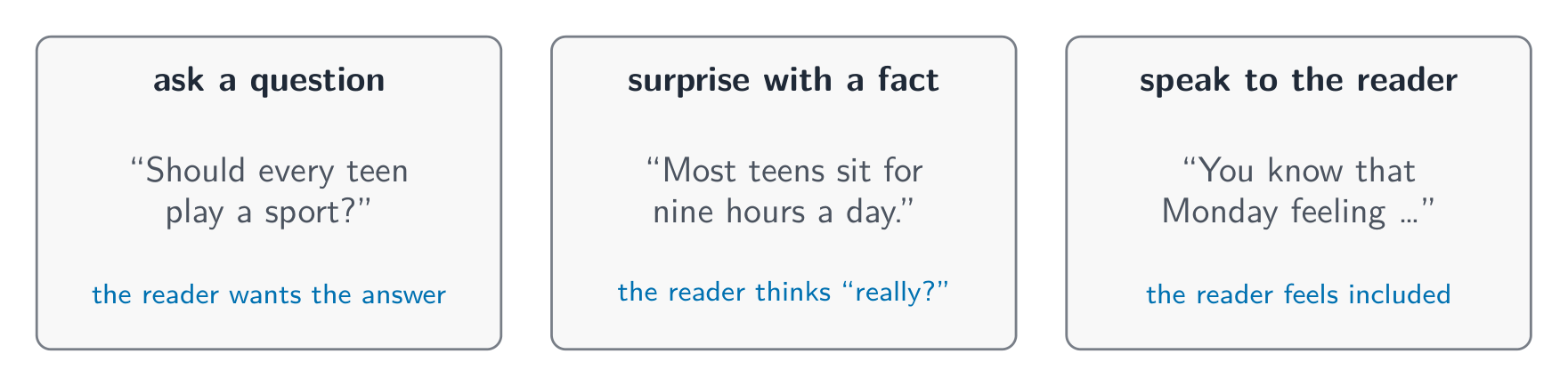
Trois façons d'accrocher l'intérêt du lecteur dès les premières lignes
Hook or snooze? · Accroche ou ennui mortel ?
A hook makes the reader need line two; a snooze announces the topic and loses them.
A dull title is fine for an article.
A catchy title is needed to grab interest.
Write a catchy first line for an article about your favourite hobby.
Example: 'Could one small hobby change your whole week?'
Lively language
- Shape: introduction → middle → short conclusion.
- Use varied words and sentence lengths.
- You can speak to the reader directly with 'you'.
Langage vif
- Structure : introduction → milieu → courte conclusion.
- Utilisez des mots variés et des longueurs de phrases différentes.
- Vous pouvez vous adresser directement au lecteur avec « you ».
Put the parts of an article in order.
Title and opening first, then the points, then a conclusion.
An article has an introduction, a developed middle and a short ____.
The conclusion draws the ideas together and leaves the reader with a clear final thought.
Hook, then deliver
- Task: an article for the school magazine about learning an instrument.
- Headline: "The Ten-Minute Musician" — short, curious, no full stop.
- Hook: "Did you know ten minutes of practice a day beats a two-hour cram on Sunday?"
- Then deliver: your view plus reasons, and an ending that echoes the hook: "Ten minutes. Every day. That's the whole secret."
Accroche, puis contenu
- Tâche : un article pour le magazine scolaire sur l'apprentissage d'un instrument.
- Titre : « The Ten-Minute Musician » — court, curieux, pas de point final.
- Accroche : « Did you know ten minutes of practice a day beats a two-hour cram on Sunday? »
- Ensuite, livrez votre contenu : votre avis plus des raisons, et une fin qui fait écho à l'accroche : « Ten minutes. Every day. That's the whole secret. »
Match the hook technique to its example.
Four reliable hooks — pick the one that fits your topic and audience.
An article for a school magazine argues for a quiet reading room. Which sentence best addresses its readers?
Direct address suits a magazine article for students. The alternatives belong to a formal letter or report.
An interesting opening is enough; the article does not need reasons or development.
The opening attracts attention, but the middle must deliver useful ideas and supporting reasons.
- An article is for many readers; it informs or entertains.
- A catchy title and opening grab interest.
- Lively, varied language keeps energy up.
- Un article s'adresse à de nombreux lecteurs ; il informe ou divertit.
- Un titre accrocheur et une ouverture captent l'intérêt.
- Un langage vif et varié maintient l'énergie.