Headings, facts and recommendations
Introduit| English | Sens |
|---|---|
| report/rɪˈpɔːt/ | A structured account of findings, events or information for a particular purpose and audience. |
| heading/ˈhedɪŋ/ | A title identifying a section of content, represented in HTML by elements such as h1 through h6. |
| recommendation/ˌrekəmenˈdeɪʃn/ | One suggested course of action. |
The Broad Street pump, 1854
- In late August 1854 cholera killed hundreds of people in Soho, London, within about ten days. The doctor John Snow collected facts: where each victim lived and where they got their water. Most had drunk from one pump on Broad Street.
- He reported the facts to local officials and recommended one action: remove the pump's handle. They did. A report 报告 gives facts under clear headings 标题 and ends with a recommendation 建议.
Layout of a report
A report is scannable: header line, introduction, findings under headings, one recommendation.
What did John Snow recommend?
Difficulté 1/5 · 100 pièces + un petit bonus lors de la première réussite aujourd'hui
It followed from his facts.
Use headings
- Begin with a title and a short introduction: who the report is for and why it was written.
- Use a heading for each section: Introduction, Current situation, Problems, Recommendations.
Which are suitable report headings?
Difficulté 2/5 · 140 pièces + un petit bonus lors de la première réussite aujourd'hui
Headings organise facts.
Facts first
- Give facts, numbers and results from what you found: Sixty per cent of students said...
- Use a neutral, formal tone. Avoid I think in the fact sections.
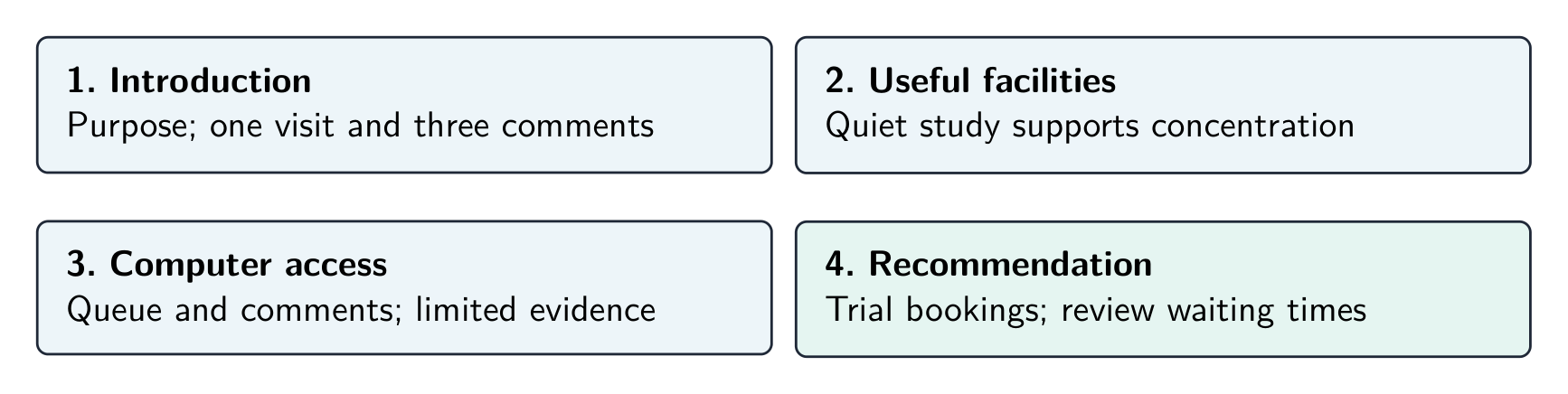
Which sentence suits the findings section?
Difficulté 1/5 · 100 pièces + un petit bonus lors de la première réussite aujourd'hui
Neutral, factual.
End with a recommendation
- Use phrases like I recommend that..., It would be helpful to..., The school should consider...
- Each recommendation should follow from a fact in the report.
Which phrase introduces a recommendation?
Difficulté 1/5 · 100 pièces + un petit bonus lors de la première réussite aujourd'hui
Recommendations come at the end.
Worked example: a report on the school canteen
- Introduction: "This report, written for the head teacher, looks at students' views of the school canteen."
- Findings: "In a survey of 120 students, 70 per cent said the queue was too long. Only a quarter thought the food was healthy."
- Recommendations: "I recommend opening a second serving point to shorten the queue, and adding a daily salad bar."
Which problem does "a second serving point" answer?
Difficulté 1/5 · 100 pièces + un petit bonus lors de la première réussite aujourd'hui
70 per cent said the queue was too long.
Facts lead to action
- John Snow's recommendation worked because it came from his evidence. Yours should too.
- Check: does every recommendation answer a problem you reported?
Every recommendation should answer a problem in the report.
Difficulté 1/5 · 100 pièces + un petit bonus lors de la première réussite aujourd'hui
Facts lead to action.
A report is not a story. Do not write "One day I went to the canteen and..." Use headings, facts and a neutral tone.
A report can begin "One day I went to the canteen".
Difficulté 1/5 · 100 pièces + un petit bonus lors de la première réussite aujourd'hui
A report is not a story.
A report has a title, a short introduction, headed sections with facts and numbers in a neutral formal tone, and recommendations that follow from the facts.
Write the findings and recommendation sections of a report on your school's sports facilities, using these facts: 40 per cent of students cannot get a court at lunch; the changing rooms are old.
Facts, then action.