Price changes
Introduit| English | Sens |
|---|---|
| shifts/ʃɪfts/ | se déplace |
| demand/dɪˈmænd/ | demande |
| supply/səˈplaɪ/ | offre |
| equilibrium/ˌiːkwɪˈlɪbrɪəm/ | équilibre |
| shortage/ˈʃɔːtɪdʒ/ | pénurie |
When the whole market moves
- A heatwave empties the shops of ice cream; a health scare empties them of a food. Prices jump or slump.
- These are shifts 移动 in demand 需求 or supply 供给 — and they move the equilibrium 均衡 to a new place.
A demand shift
- More demand (right shift) → at the old price there's a shortage 短缺 → price rises, quantity rises.
- Less demand (left shift) → price falls, quantity falls.
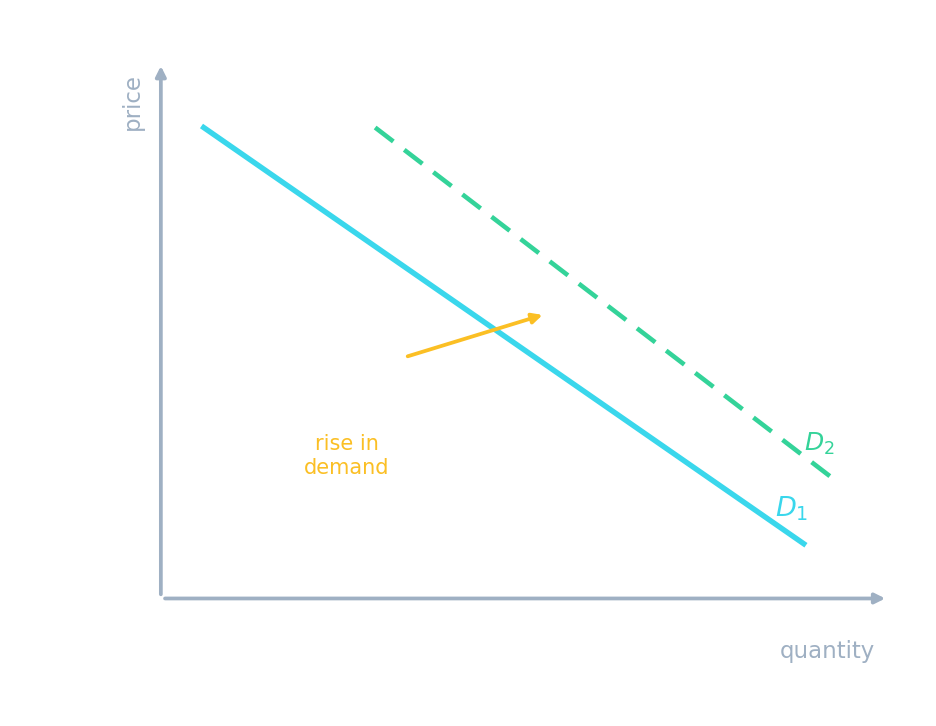
A rise in demand shifts the curve right: the new equilibrium has a higher price and quantity.
Demande & offre
A un déplacement in demand or supply moves the equilibrium.
A rise in demand (the demand curve shifts right) leads to:
Difficulté 1/5 · 100 pièces + un petit bonus lors de la première réussite aujourd'hui
More demand raises both equilibrium price and quantity.
A heatwave raises demand for ice cream. In that market:
Difficulté 1/5 · 100 pièces + un petit bonus lors de la première réussite aujourd'hui
Demand shifts right → higher price and quantity.
A supply shift
- More supply (right shift) → price falls, quantity rises.
- Less supply (left shift) → price rises, quantity falls.
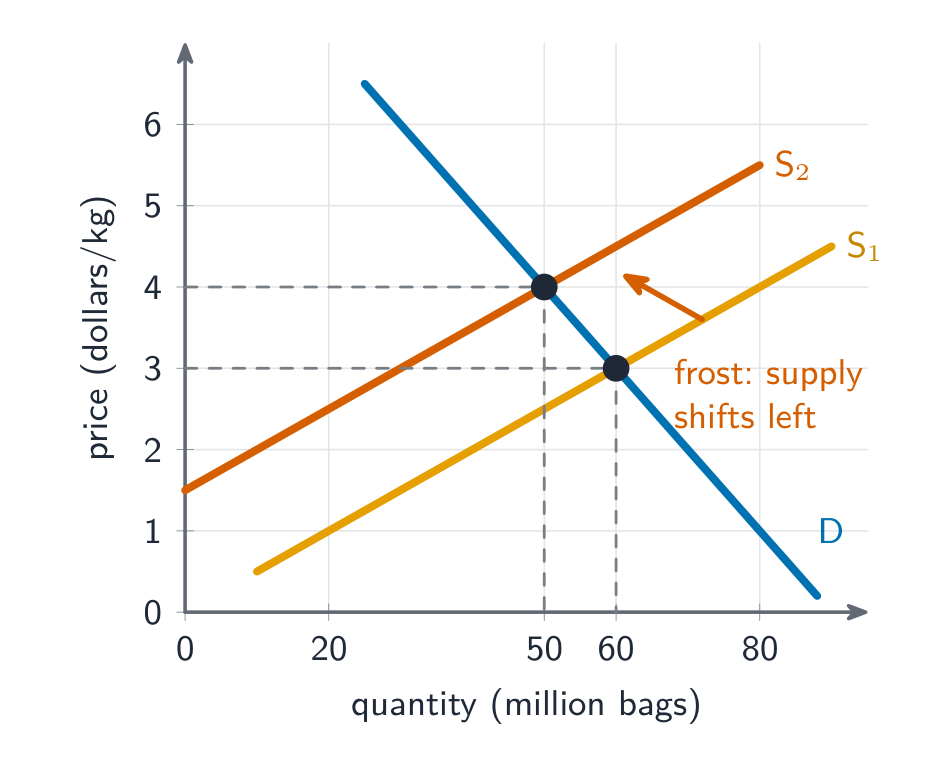
Exam question. A frost destroys part of Brazil's coffee crop. Explain, using the diagram, how this affects the price and quantity of coffee. [4]
- Model answer: The frost reduces the amount of coffee farmers can sell, so supply shifts left from S1 to S2 (1). At the old price of 3 dollars there is now a shortage: buyers still want 60 million bags, but much less is offered (1). Buyers compete for the coffee, so the price rises to 4 dollars (1). The higher price makes some buyers buy less, so the equilibrium quantity falls from 60 to 50 million bags (1).
- Mark-scheme reasoning: name the curve that shifts and the direction, then link it to a shortage or surplus, then to price, then to quantity. The diagram needs labelled axes, both supply curves and the old and new price and quantity.
A rise in supply (the supply curve shifts right) leads to:
Difficulté 1/5 · 100 pièces + un petit bonus lors de la première réussite aujourd'hui
More supply lowers the price and raises the quantity traded.
A fall in supply causes the equilibrium price to ______.
Difficulté 1/5 · 100 pièces + un petit bonus lors de la première réussite aujourd'hui
Less supply → higher price, lower quantity.
In the coffee diagram, by how many million bags does the equilibrium quantity fall after the frost?
Difficulté 2/5 · 140 pièces + un petit bonus lors de la première réussite aujourd'hui
Equilibrium moves from 60 million bags (where D meets S1) to 50 million bags (where D meets S2): a fall of 10 million bags.
A method that always works
-
- Decide which curve moves and which way.
-
- Mark the new crossing point.
-
- Read off the new price and quantity.
Two things move, not one. A shift changes both the equilibrium price and the quantity. Always state what happens to each.
A shift in one curve changes both the equilibrium price and quantity.
Difficulté 1/5 · 100 pièces + un petit bonus lors de la première réussite aujourd'hui
Both move — always state the change in each.
Worked example: a heatwave and ice cream
Ice cream sells at £2 and 500 cones a day are bought. A heatwave arrives. Use the method to find the new price and quantity.
- Step 1: the heatwave changes tastes, not the price or costs, so demand shifts right. Step 2: at the old price of £2 buyers now want, say, 800 cones, but sellers offer only 500: a shortage.
- Step 3: the shortage pushes the price up, and higher prices lead sellers to supply more. The new equilibrium is, for example, £2.50 and 650 cones: both price and quantity rise.
A frost destroys much of the orange crop. What happens to the equilibrium price and quantity of oranges?
Difficulté 1/5 · 100 pièces + un petit bonus lors de la première réussite aujourd'hui
Supply shifts left: a shortage at the old price pushes the price up, and less is bought.
When demand falls, there is a surplus at the old price, so the price tends to fall.
Difficulté 1/5 · 100 pièces + un petit bonus lors de la première réussite aujourd'hui
Sellers cut prices to sell the unsold stock.
You've got it
- a demand rise → price up, quantity up; a demand fall → both down
- a supply rise → price down, quantity up; a supply fall → price up, quantity down
- always report the change in both price and quantity
Write from a new price of 6 and quantity of 260
- Bus tickets started at price 4 and quantity 200.
- A festival shifts demand. The new equilibrium is price 6 and quantity 260.
Bus tickets were price 4 and quantity 200. After a festival shifts demand, equilibrium is price 6 and quantity 260. Which curve shifted, and what happened to price and quantity?
More demand raises both the price and the quantity sold.
What fits the move from 4 and 200 to 6 and 260?
Difficulté 1/5 · 100 pièces + un petit bonus lors de la première réussite aujourd'hui
Both price and quantity rose, which a rightward demand shift produces.