The nature of the basic economic problem
Introduit| English | Sens |
|---|---|
| scarcity/ˈskeəsɪti/ | rareté |
| wants/wɒnts/ | besoins |
| resources/rɪˈzɔːsɪz/ | ressources |
| finite/ˈfaɪnaɪt/ | fini |
| opportunity cost/ɒpəˈtjuːnɪti kɒst/ | coût d'opportunité |
| free good/friː ɡʊd/ | bien libre |
| economic good/ˌiːkəˈnɒmɪk ɡʊd/ | bien économique |
| consumers/kənˈsuːməz/ | consommateurs |
| producers/prəˈdjuːsəz/ | producteurs |
You can't have it all
- There is never enough — enough money, time, or stuff — for everyone to have everything they want.
- That simple fact, scarcity 稀缺性, is where economics begins. It forces everyone to choose.
The basic economic problem
- Wants 欲望 are unlimited; resources 资源 are finite 有限的 (limited).
- So every society must decide: what to produce, how to produce it, and for whom.
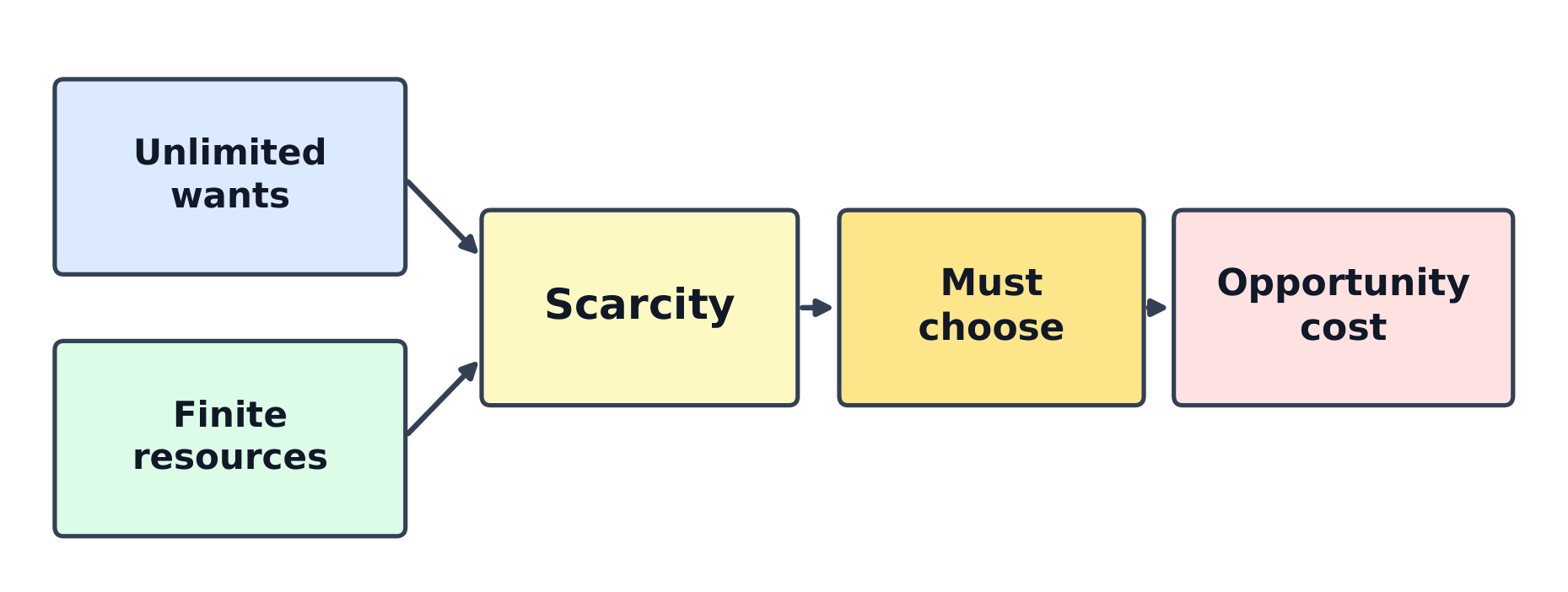
- Choosing one thing means giving up the next best alternative. That is the opportunity cost 机会成本 of the choice.
Rareté et choix
Limited resources mean producing more of one good costs some of the other — the opportunity cost, shown by the frontier.
The basic economic problem exists because:
Difficulté 1/5 · 100 pièces + un petit bonus lors de la première réussite aujourd'hui
Scarcity = unlimited wants meeting finite resources.
Every economy must decide what to produce, how to produce it, and for whom.
Difficulté 1/5 · 100 pièces + un petit bonus lors de la première réussite aujourd'hui
These three questions follow from scarcity.
Economic vs free goods 自由物品
- An economic good 经济物品 is scarce, so it has an opportunity cost and a price (a phone, a sandwich).
- A free good is not scarce — using it costs nothing (air, sunlight). Almost everything is an economic good.
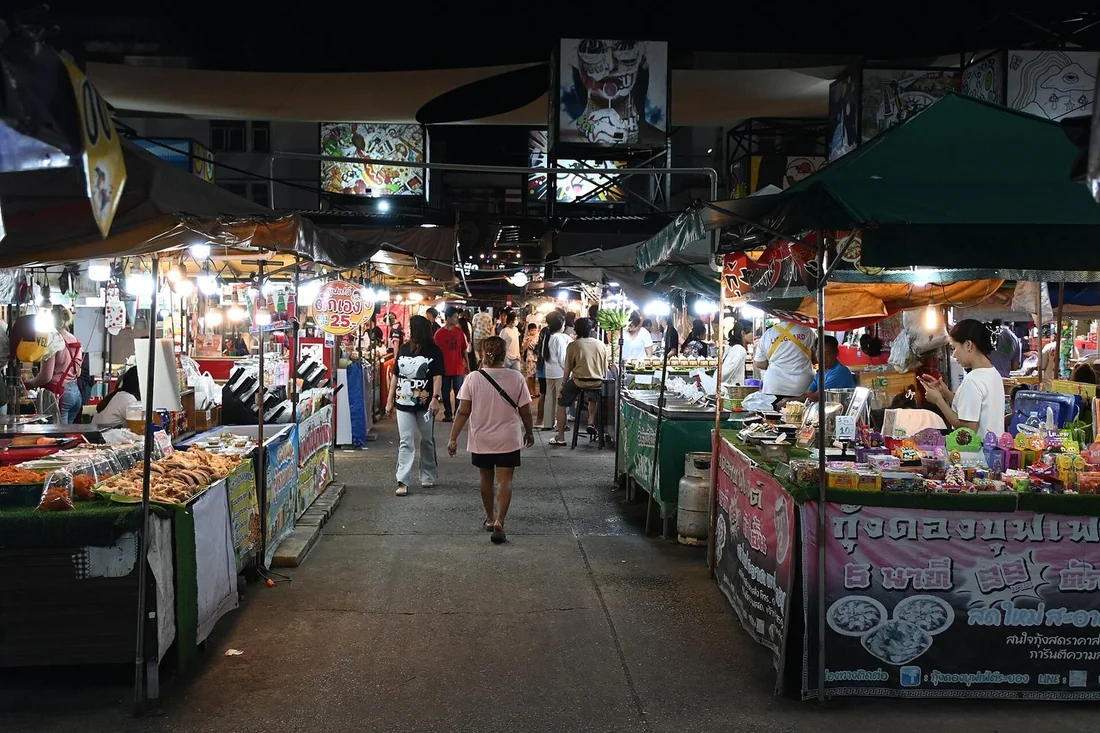
Consumers 消费者 choosing what to buy at a busy market — scarcity forces everyone to make choices
Which is a free good?
Difficulté 1/5 · 100 pièces + un petit bonus lors de la première réussite aujourd'hui
Air is not scarce, so it has no opportunity cost — a free good.
A good that is scarce and so has an opportunity cost is an ______ good.
Difficulté 1/5 · 100 pièces + un petit bonus lors de la première réussite aujourd'hui
Economic goods are scarce; free goods are not.
Who faces the problem?
| Who (what is scarce) | A choice → its opportunity cost |
|---|---|
| consumers (income) | spend 50 dollars on a jacket → the shoes they could have bought |
| workers (time and skills) | take a job as a nurse → the wage from the next best job |
| producers (land, workers, machines) | a farm grows rice → the vegetables it could have grown |
| governments (tax revenue) | build a new hospital → the school it could have built instead |
Scarcity is not poverty. Even a rich country faces scarcity: its resources are still limited compared with everything its people want. Scarcity is universal.
Exam question. Explain why the basic economic problem means that governments have to make choices. [4]
- Model answer: Governments have finite resources, such as tax revenue, but there are unlimited wants for things like healthcare, education and roads (1). They cannot provide everything, so resources are scarce (1). They must choose how to use them, for example spending more on hospitals (1). Every choice has an opportunity cost: the next best alternative given up, such as a new school (1).
- Mark-scheme reasoning: one mark each for finite resources, unlimited wants, the need to choose, and opportunity cost applied to a government. A general answer about "people" without the government example loses the application mark.
Match each decision-maker to its choice.
Difficulté 2/5 · 140 pièces + un petit bonus lors de la première réussite aujourd'hui
Scarcity forces choice at every level.
Mei can work as a teacher (35 000 dollars), a bank clerk (30 000 dollars) or a shop assistant (22 000 dollars). She chooses teaching. What is her opportunity cost?
Difficulté 1/5 · 100 pièces + un petit bonus lors de la première réussite aujourd'hui
Opportunity cost is only the next best alternative given up: the bank job. You never add up all the options, and a best choice still has an opportunity cost.
A government spends 2 billion dollars on a new airport. Explain the opportunity cost of this decision.
Name one specific alternative. 'Other things' is too vague to earn the mark.
Worked example: one Saturday, three choices
Li has £20 and one free Saturday. She can go to a concert (£20), buy a book (£12) and see a film (£8), or work in a café and earn £30. She ranks the concert first and the café second. What is her opportunity cost?
- Time and money are scarce, so she cannot do everything. If she chooses the concert, her opportunity cost is the next best alternative given up: the £30 she could have earned in the café, not every option she missed.
- The air she breathes at the concert is a free good: using it costs nothing and no one else has less. The concert ticket is an economic good: it is scarce and has a price.
Which is a free good?
Difficulté 1/5 · 100 pièces + un petit bonus lors de la première réussite aujourd'hui
Sunlight is not scarce, so using it has no opportunity cost.
A government that spends more on hospitals may have less to spend on schools: this is an opportunity cost.
Difficulté 1/5 · 100 pièces + un petit bonus lors de la première réussite aujourd'hui
Tax revenue is limited, so spending more in one area means giving up spending elsewhere.
You've got it
- the basic economic problem: finite (scarce) resources vs unlimited wants → scarcity
- scarcity forces consumers, workers, producers and governments to choose: what, how and for whom to produce
- opportunity cost = the next best alternative given up (only one, not every option)
- an economic good is scarce and has an opportunity cost; a free good (air, sunlight) is not scarce and has none
An orchard can grow 60 apples or 15 pears. What is the opportunity cost of one pear, in apples?
60 divided by 15 is 4.
What is the opportunity cost of one pear?
Difficulté 1/5 · 100 pièces + un petit bonus lors de la première réussite aujourd'hui
60 divided by 15 is 4 apples. Other options — 60 apples (the whole crop); Nothing (as if pears were a free good).