Identification of ions and gases
Introduit| English | Sens |
|---|---|
| chemical tests/ˈkemɪkl tests/ | tests chimiques |
| flame tests/fleɪm tests/ | essais de flamme |
| limewater/ˈlaɪmwɔːtə/ | eau de chaux |
| sodium hydroxide/ˈsəʊdɪəm haɪˈdrɒksaɪd/ | hydroxyde de sodium |
Identifying unknowns
- Given an unknown chemical, how do you find out what it is?
- A set of chemical tests 化学测试 identifies the ions and gases present.
Travail pratique : test des ions et des gaz
Match test observations to the ion or gas present.
A sodium ion gives which flame colour?
Difficulté 1/5 · 100 pièces + un petit bonus lors de la première réussite aujourd'hui
Sodium burns with a yellow flame.
A potassium ion gives a ______ flame colour.
Difficulté 1/5 · 100 pièces + un petit bonus lors de la première réussite aujourd'hui
Potassium burns lilac.
Flame tests 焰色测试 for metal ions
- Some metal ions give a characteristic flame colour.
- Lithium = red, sodium = yellow, potassium = lilac, copper = blue-green.
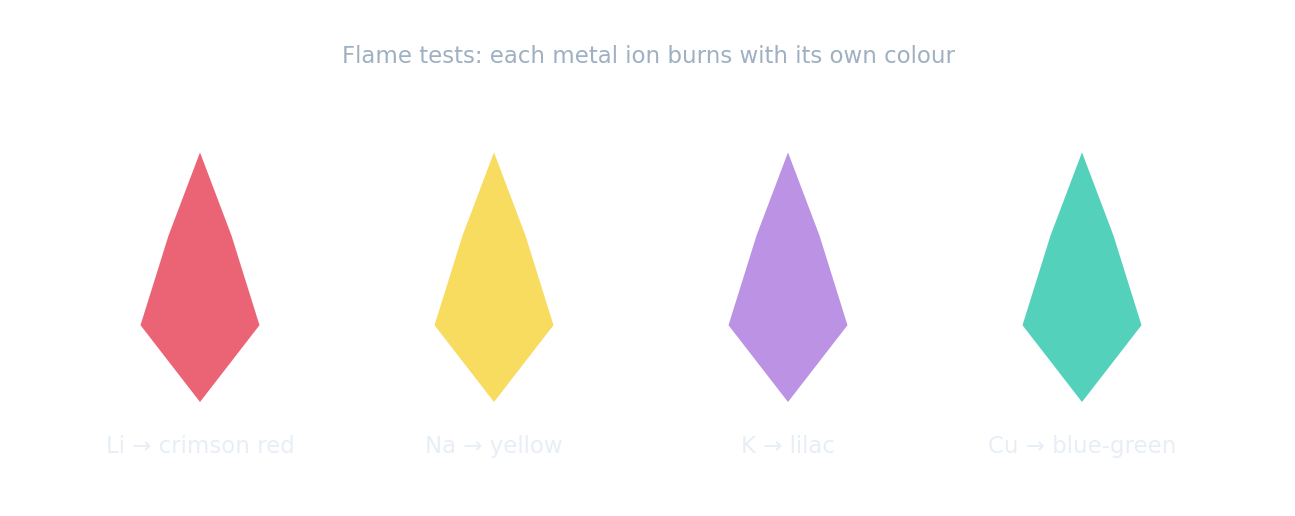
Flame tests: each metal ion burns with its own colour
The test for hydrogen gas is:
Difficulté 1/5 · 100 pièces + un petit bonus lors de la première réussite aujourd'hui
Hydrogen gives a squeaky pop.
Oxygen is identified because it:
Difficulté 1/5 · 100 pièces + un petit bonus lors de la première réussite aujourd'hui
Oxygen relights a glowing splint.
Carbon dioxide is identified because it:
Difficulté 1/5 · 100 pièces + un petit bonus lors de la première réussite aujourd'hui
CO₂ turns limewater milky.
Match each test to its result.
Difficulté 2/5 · 140 pièces + un petit bonus lors de la première réussite aujourd'hui
Flame colours identify metal ions; gas tests use a splint.
Tests for gases
- Hydrogen: a lit splint gives a squeaky pop.
- Oxygen: relights a glowing splint.
- Carbon dioxide: turns limewater 石灰水 milky.
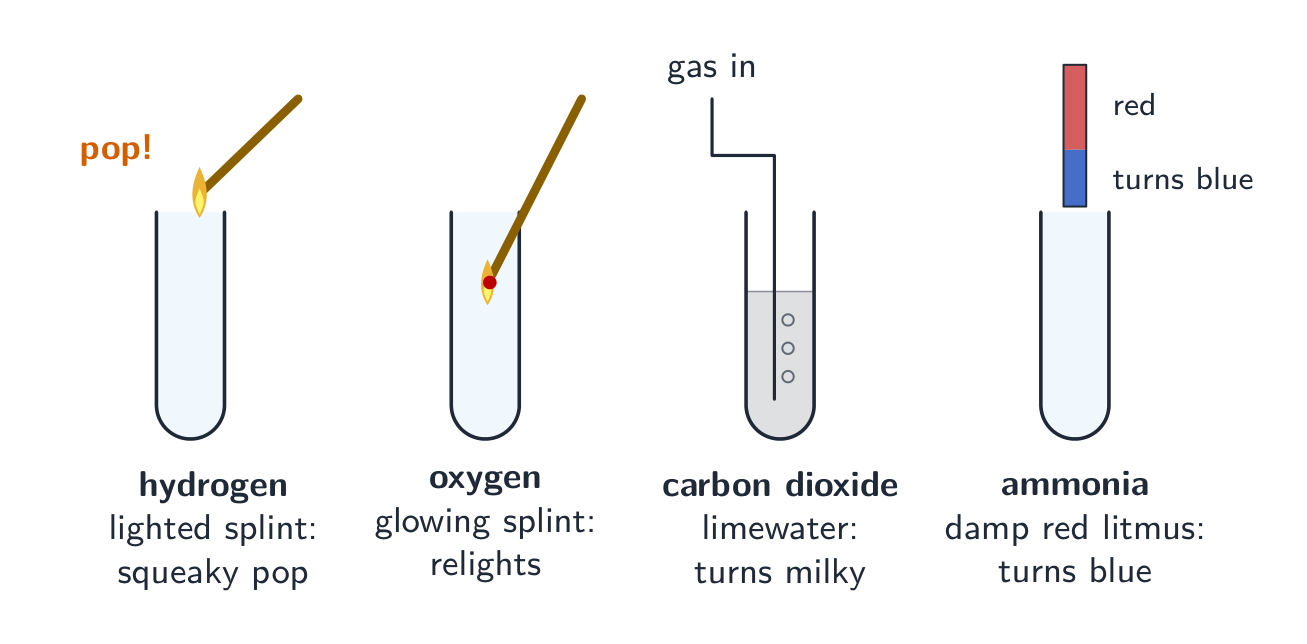
Testing gases: hydrogen pops, oxygen relights a glowing splint
Tests for ions in solution
- Adding sodium hydroxide 氢氧化钠 gives coloured precipitates that identify metal ions.
- For example, copper(II) gives a blue precipitate; iron(III) gives a brown one.
Worked example. An unknown gas relights a glowing splint → it is oxygen. A solution gives a blue precipitate with sodium hydroxide → it contains copper(II) ions. Each test points to one answer.
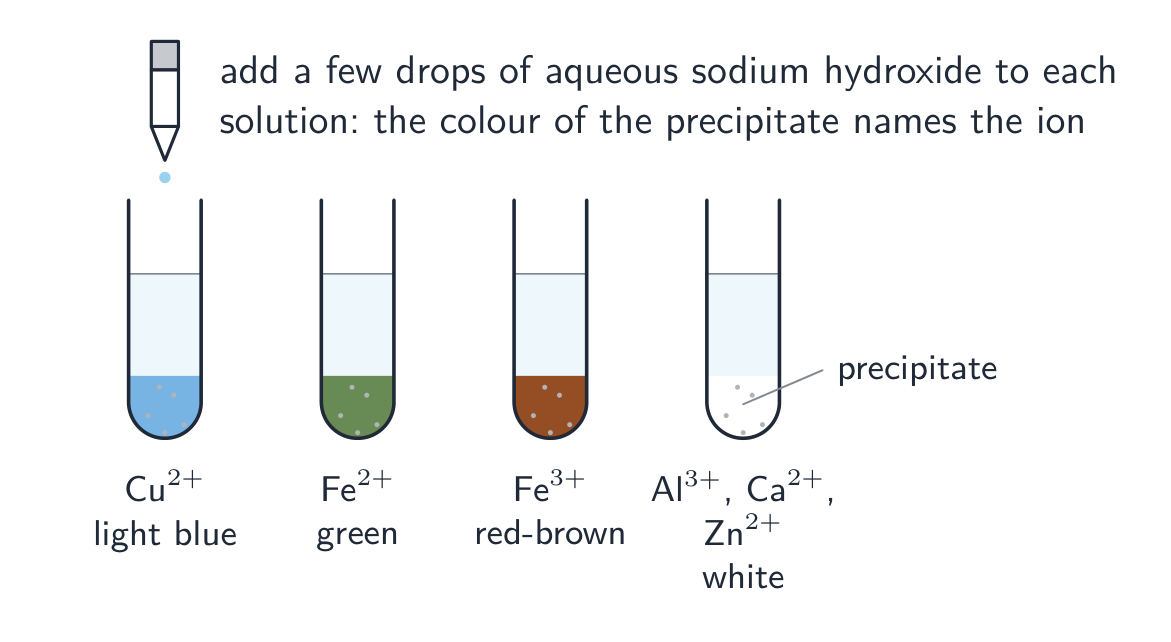
Adding sodium hydroxide forms a coloured precipitate for some metal ions
Metal ions: sodium hydroxide and ammonia
Add a few drops, then excess, of each solution.
| Ion | Aqueous sodium hydroxide | Aqueous ammonia |
|---|---|---|
| Al³⁺ | white ppt, dissolves in excess | white ppt, does not dissolve |
| Zn²⁺ | white ppt, dissolves in excess | white ppt, dissolves in excess |
| Ca²⁺ | white ppt, does not dissolve | no ppt (or very slight) |
| Cu²⁺ | light blue ppt | light blue ppt, dissolves in excess to give a dark blue solution |
| Fe²⁺ | green ppt | green ppt |
| Fe³⁺ | red-brown ppt | red-brown ppt |
| Cr³⁺ | green ppt, dissolves in excess | green ppt |
| NH₄⁺ | ammonia gas given off on warming | — |
ppt = precipitate
A solution gives a white precipitate with both NaOH and ammonia. The precipitate dissolves in excess NaOH but NOT in excess ammonia. Which ion is present?
Difficulté 1/5 · 100 pièces + un petit bonus lors de la première réussite aujourd'hui
Both Al³⁺ and Zn²⁺ dissolve in excess NaOH, but only the zinc precipitate dissolves in excess ammonia.
Which ion gives a red-brown precipitate with aqueous sodium hydroxide?
Difficulté 1/5 · 100 pièces + un petit bonus lors de la première réussite aujourd'hui
Iron(III) hydroxide is red-brown; iron(II) hydroxide is green; copper(II) hydroxide is light blue.
Negative ions and more gases
| Ion | Test | Positive result |
|---|---|---|
| carbonate CO₃²⁻ | add dilute acid; bubble gas through limewater | fizzes; limewater turns milky |
| chloride Cl⁻ | acidify with nitric acid, add silver nitrate | white ppt |
| bromide Br⁻ | acidify with nitric acid, add silver nitrate | cream ppt |
| iodide I⁻ | acidify with nitric acid, add silver nitrate | yellow ppt |
| sulfate SO₄²⁻ | acidify with nitric acid, add barium nitrate | white ppt |
| sulfite SO₃²⁻ | add acidified potassium manganate(VII) | purple → colourless |
| nitrate NO₃⁻ | add NaOH and aluminium foil, warm | ammonia given off |
- Ammonia turns damp red litmus blue; chlorine bleaches damp litmus; sulfur dioxide turns acidified potassium manganate(VII) colourless.
A solution is acidified with nitric acid and silver nitrate is added. A yellow precipitate forms. Which ion is present?
Difficulté 1/5 · 100 pièces + un petit bonus lors de la première réussite aujourd'hui
Silver halides: chloride white, bromide cream, iodide yellow.
Which reagent is added (after acidifying) to test for sulfate ions?
Difficulté 1/5 · 100 pièces + un petit bonus lors de la première réussite aujourd'hui
Sulfate ions form a white precipitate of barium sulfate.
You've got it
- flame tests: lithium red, sodium yellow, potassium lilac, copper blue-green
- gas tests: hydrogen squeaky pop, oxygen relights a splint, CO₂ limewater milky
- sodium hydroxide gives coloured precipitates that identify metal ions
Write from this case
- A colourless gas relights a glowing splint.
- A potassium flame test is lilac, which is a different test and not this gas.
What is the gas?
Oxygen relights a glowing splint.
Which gas relights a glowing splint?
Difficulté 1/5 · 100 pièces + un petit bonus lors de la première réussite aujourd'hui
The relit splint is the oxygen test.