Extraction of metals
Introduit| English | Sens |
|---|---|
| ores/ɔːz/ | minerais |
| extraction/ekˈstrækʃn/ | extraction |
| reduction/rɪˈdʌkʃn/ | réduction |
| electrolysis/ɪlekˈtrɒləsɪs/ | électrolyse |
| blast furnace/blæst ˈfɜːnɪs/ | four à creuset |
Getting metals out of rocks
- Most metals are found combined with other elements in ores 矿石, not as pure metal.
- Extraction 提取 is the process of getting the metal out — and the method depends on reactivity.
A rock containing enough of a metal compound to extract is called an:
Difficulté 1/5 · 100 pièces + un petit bonus lors de la première réussite aujourd'hui
Metals are extracted from their ores.
Reactivity decides the method
- Less reactive metals (below carbon) can be extracted by heating with carbon (reduction 还原).
- More reactive metals (above carbon) must be extracted by electrolysis 电解.
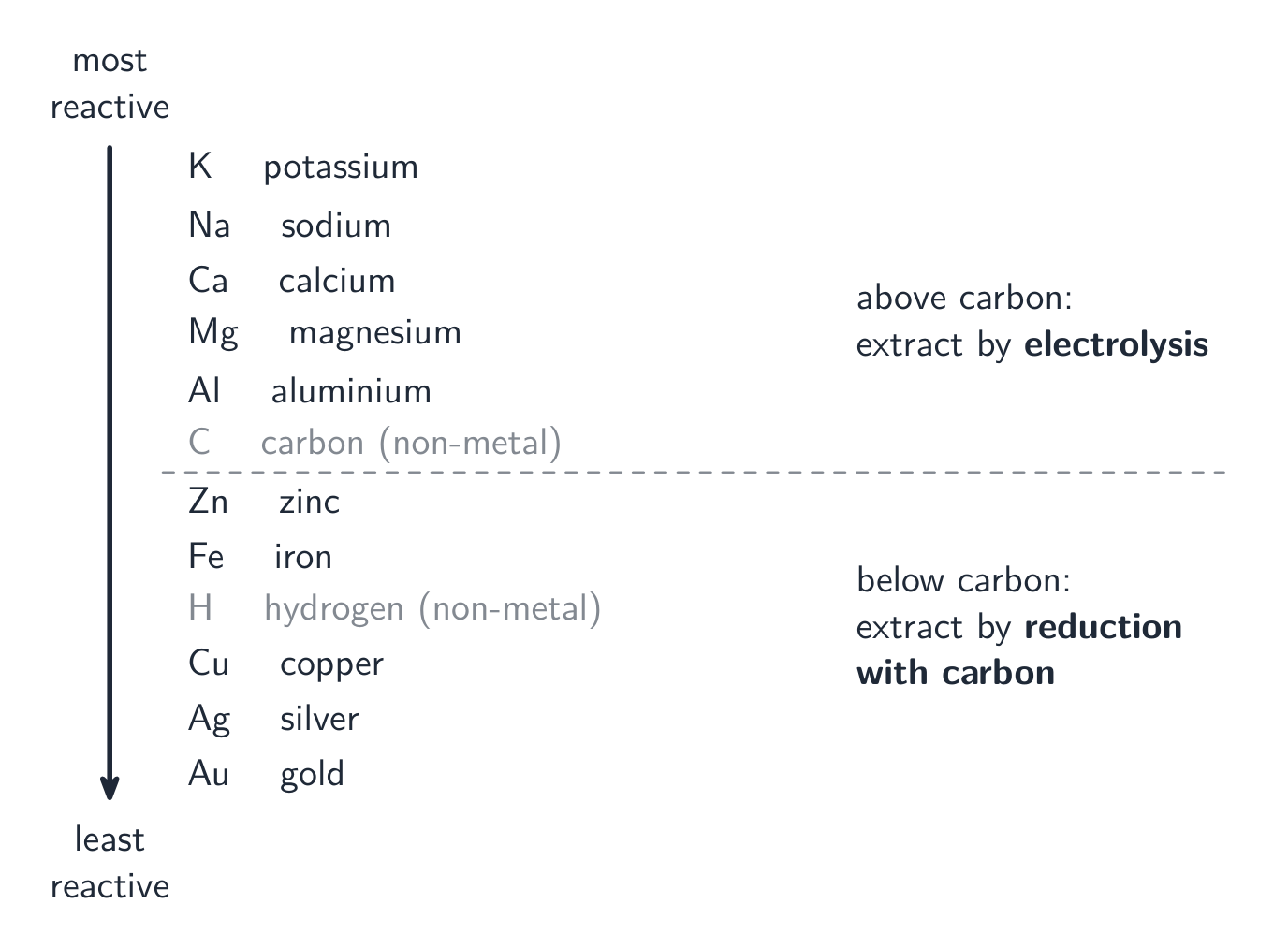
The reactivity series, and how a metal's position decides its extraction method
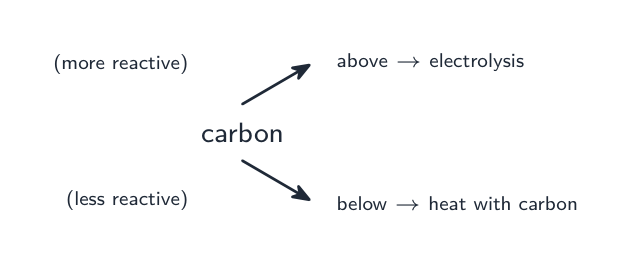
Metals above carbon need electrolysis; those below are heated with carbon
Extracting iron in the blast furnace
Iron is below carbon in reactivity, so carbon can reduce its ore to the metal.
Iron is extracted by heating its ore with:
Difficulté 1/5 · 100 pièces + un petit bonus lors de la première réussite aujourd'hui
Iron is below carbon, so carbon reduces it.
Removing oxygen from a metal oxide using carbon is an example of ______.
Difficulté 1/5 · 100 pièces + un petit bonus lors de la première réussite aujourd'hui
Reduction is loss of oxygen.
Extracting iron
- Iron is extracted in a blast furnace 高炉 by reduction with carbon.
- The carbon (from coke) removes the oxygen from iron oxide, leaving iron.
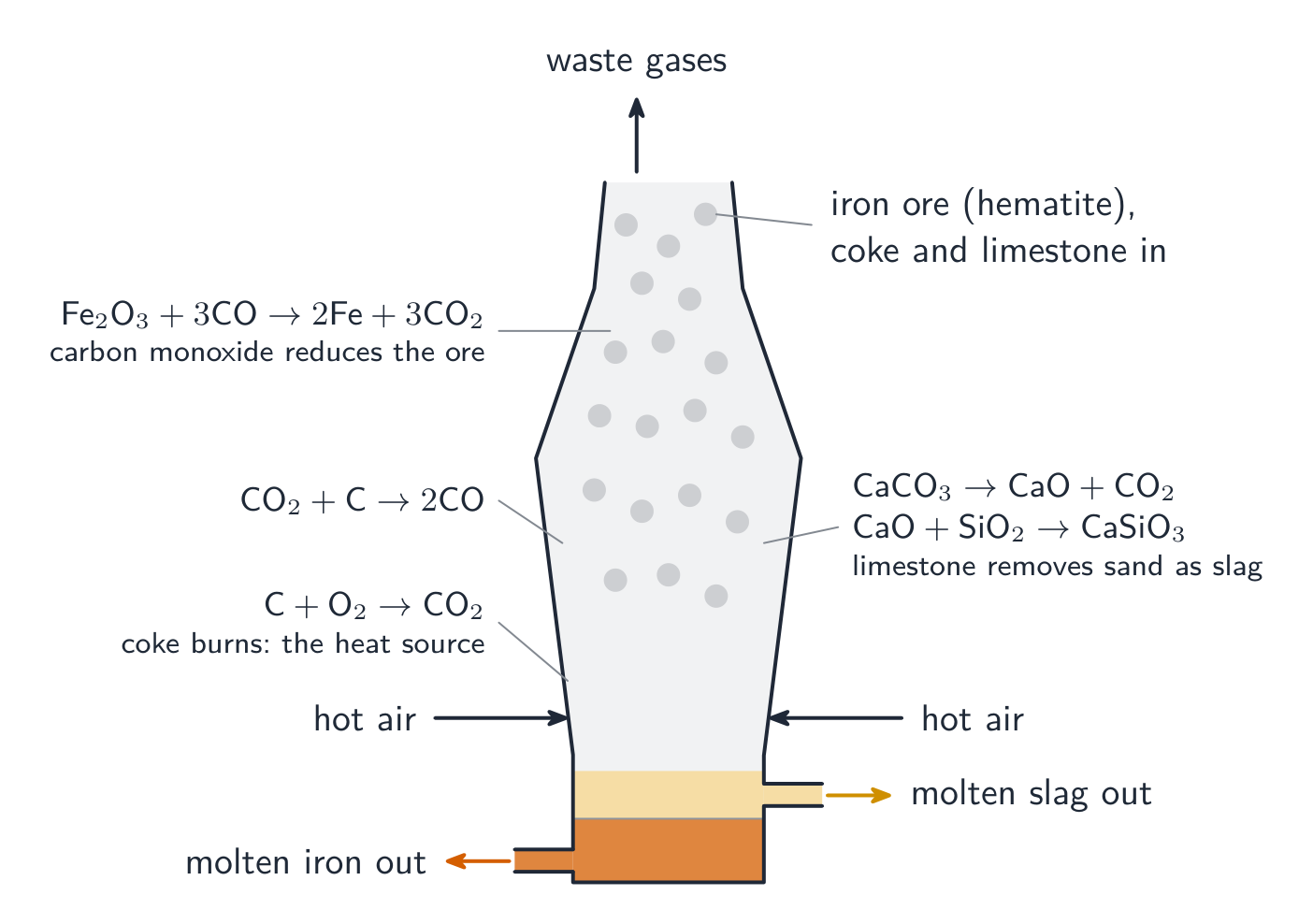
In the blast furnace, carbon monoxide reduces the iron ore and limestone removes sandy impurities as slag
Aluminium is extracted by electrolysis because it is:
Difficulté 1/5 · 100 pièces + un petit bonus lors de la première réussite aujourd'hui
Metals above carbon need electrolysis.
The method used to extract a metal depends on its reactivity.
Difficulté 1/5 · 100 pièces + un petit bonus lors de la première réussite aujourd'hui
Reactive metals need electrolysis; less reactive ones use carbon.
Extracting aluminium
- Aluminium is too reactive for carbon, so it is extracted by electrolysis of molten aluminium oxide.
- This uses a lot of electricity, making aluminium expensive to extract.
Reactivity decides the extraction method. Metals more reactive than carbon (like aluminium) need electrolysis; those less reactive (like iron) can be reduced by carbon. Very unreactive metals (gold) are found native.
Worked example: choose the method
Decide how each metal is extracted from its ore: zinc (ore ZnO), magnesium (from magnesium chloride in sea water), and iron (ore $\text{Fe}_2\text{O}_3$, haematite).
- Zinc and iron are below carbon in the reactivity series, so carbon can take the oxygen: $\text{ZnO} + \text{C} \rightarrow \text{Zn} + \text{CO}$. In the blast furnace, $\text{Fe}_2\text{O}_3 + 3\text{CO} \rightarrow 2\text{Fe} + 3\text{CO}_2$: the iron oxide is reduced (loses oxygen).
- Magnesium is above carbon, so carbon cannot reduce its compound: it is extracted by electrolysis of molten magnesium chloride.
How is potassium extracted from its compounds?
Difficulté 1/5 · 100 pièces + un petit bonus lors de la première réussite aujourd'hui
Potassium is far more reactive than carbon, so only electrolysis can extract it.
In $\text{Fe}_2\text{O}_3 + 3\text{CO} \rightarrow 2\text{Fe} + 3\text{CO}_2$, which substance is reduced?
Difficulté 1/5 · 100 pièces + un petit bonus lors de la première réussite aujourd'hui
Reduction is loss of oxygen; the CO gains oxygen, so it is oxidised.
You've got it
- metals are found in ores; extraction gets the pure metal out
- less reactive than carbon → reduced by carbon (e.g. iron in a blast furnace)
- more reactive than carbon → extracted by electrolysis (e.g. aluminium)
Write from carbon monoxide reducing the ore
- Iron oxide is heated in a blast furnace with coke and limestone.
- Hot air is blown in and carbon monoxide forms.
Which gas reduces the iron oxide?
Carbon monoxide takes oxygen from iron oxide.
What reduces the iron oxide in the furnace?
Difficulté 1/5 · 100 pièces + un petit bonus lors de la première réussite aujourd'hui
The monoxide is the reducing agent.