The reactivity series
Introduit| English | Sens |
|---|---|
| reactivity series/rɪəkˈtɪvɪti ˈsɪəriːz/ | série de réactivité |
| displace/dɪˈspleɪs/ | déplacer |
Ranking the metals
- Some metals react violently; others barely react at all.
- The reactivity series 金属活动性顺序 ranks metals from most to least reactive.
Which of these metals is the most reactive?
Difficulté 1/5 · 100 pièces + un petit bonus lors de la première réussite aujourd'hui
Potassium is near the top of the reactivity series.
Put these metals in order from most reactive to least reactive.
Difficulté 3/5 · 200 pièces + un petit bonus lors de la première réussite aujourd'hui
Potassium > magnesium > iron > gold.
Being very unreactive, ______ is found near the bottom of the reactivity series.
Difficulté 1/5 · 100 pièces + un petit bonus lors de la première réussite aujourd'hui
Gold is one of the least reactive metals.
The reactivity series
- Metals are listed from most reactive (potassium) to least reactive (gold).
- The order: potassium, sodium, calcium, magnesium, zinc, iron, copper, gold (and more).
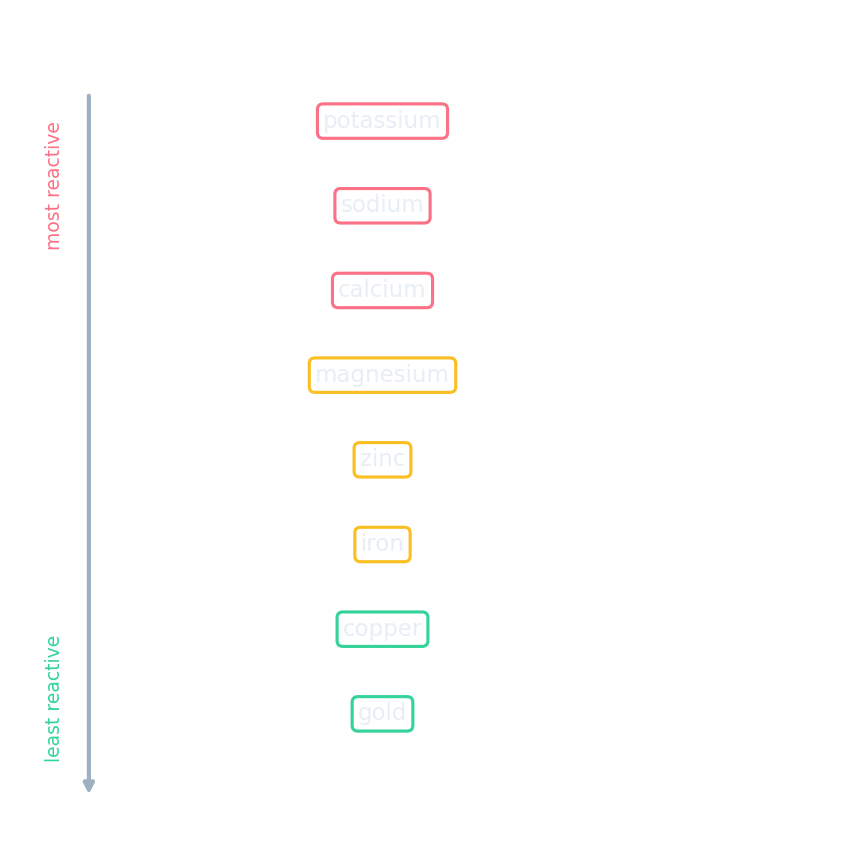
The reactivity series ranks metals from most reactive at the top to least reactive at the bottom.
Déplacement et série de réactivité
Step through a displacement. A more reactive metal pushes a less reactive one out of its compound — which is exactly what the reactivity series predicts.
A more reactive metal can:
Difficulté 1/5 · 100 pièces + un petit bonus lors de la première réussite aujourd'hui
More reactive metals displace less reactive ones.
Displacement reactions
- A more reactive metal will displace 置换 a less reactive one from its compound.
- For example, iron displaces copper from copper sulfate solution.
An iron nail placed in copper sulfate solution will:
Difficulté 1/5 · 100 pièces + un petit bonus lors de la première réussite aujourd'hui
Iron is more reactive than copper, so it displaces it.
Reactions with water and acid
- The most reactive metals react with cold water; less reactive ones only with acid; the least don't react.
- The series predicts how vigorously a metal will react.
Worked example. Put an iron nail in copper sulfate solution. Iron is more reactive than copper, so it displaces it: the nail gets a copper coating and the blue solution fades. The series predicts the result.
How metals react with water and acid
| Metal | With cold water | With dilute acid |
|---|---|---|
| potassium, sodium | react violently; hydrogen and hydroxide form | dangerously violent (never done) |
| calcium | reacts steadily, fizzing | vigorous |
| magnesium | very slowly (reacts with steam) | fast fizzing |
| zinc, iron | no reaction (react with steam when hot) | steady fizzing |
| copper, silver, gold | no reaction | no reaction |
- Metals that react with water or acid give off hydrogen: it burns with a squeaky pop when lit.
Which mixture reacts?
Difficulté 1/5 · 100 pièces + un petit bonus lors de la première réussite aujourd'hui
Magnesium is above zinc in the series, so it displaces zinc. In the others the metal is less reactive than the one in the compound.
Which metal does NOT react with dilute hydrochloric acid?
Difficulté 1/5 · 100 pièces + un petit bonus lors de la première réussite aujourd'hui
Copper is below hydrogen in the series, so it cannot displace hydrogen from the acid.
You've got it
- the reactivity series ranks metals from most (potassium) to least (gold) reactive
- a more reactive metal displaces a less reactive one from its compound
- the series predicts reactions with water and acid
Write from this case
- Magnesium is above carbon in the reactivity series.
- Gold is near the bottom and is found as the element.
How is magnesium extracted from its ore?
Metals more reactive than carbon are extracted by electrolysis.
How is magnesium obtained from its compounds?
Difficulté 1/5 · 100 pièces + un petit bonus lors de la première réussite aujourd'hui
Carbon cannot take the oxygen from magnesium oxide.