Preparing soluble salts
Introduit| English | Sens |
|---|---|
| salt/sɒlt/ | sel |
| filter/ˈfɪltə/ | filtration |
| evaporate/ɪˈvæpəreɪt/ | évaporation |
| crystallise/ˈkrɪstəlaɪz/ | cristallisation |
The bitter spring at Epsom, 1618
- According to local accounts, in 1618 a farmer named Henry Wicker found that his cows would not drink from a spring on Epsom Common, south of London. The water tasted bitter. Its dissolved solid, magnesium sulfate, became famous as "Epsom salts".
- A salt 盐 is a compound formed when the hydrogen of an acid is replaced by a metal or ammonium. Many salts are soluble and can be made pure in the lab.
Which salt are "Epsom salts"?
Difficulté 1/5 · 100 pièces + un petit bonus lors de la première réussite aujourd'hui
From the bitter spring.
Choose an acid and a base
- The acid sets the salt's ending: sulfuric acid → sulfates, hydrochloric acid → chlorides, nitric acid → nitrates.
- The metal comes from an insoluble base, a carbonate or a metal: copper(II) oxide + sulfuric acid → copper(II) sulfate + water.
Preparing a soluble salt
Step through the method. React an acid with excess insoluble base, filter off what's left over, then evaporate and crystallise to get pure salt crystals.
Match each acid to the salts it makes.
Difficulté 2/5 · 140 pièces + un petit bonus lors de la première réussite aujourd'hui
The acid sets the ending.
The excess-solid method
-
- Warm the acid and add the insoluble solid a little at a time until no more reacts — some solid is left over (excess), so all the acid is used up.
-
- Filter 过滤 to remove the excess solid. 3. Evaporate 蒸发 some water, then leave the solution to cool and crystallise 结晶. 4. Filter off the crystals and dry them between filter papers.
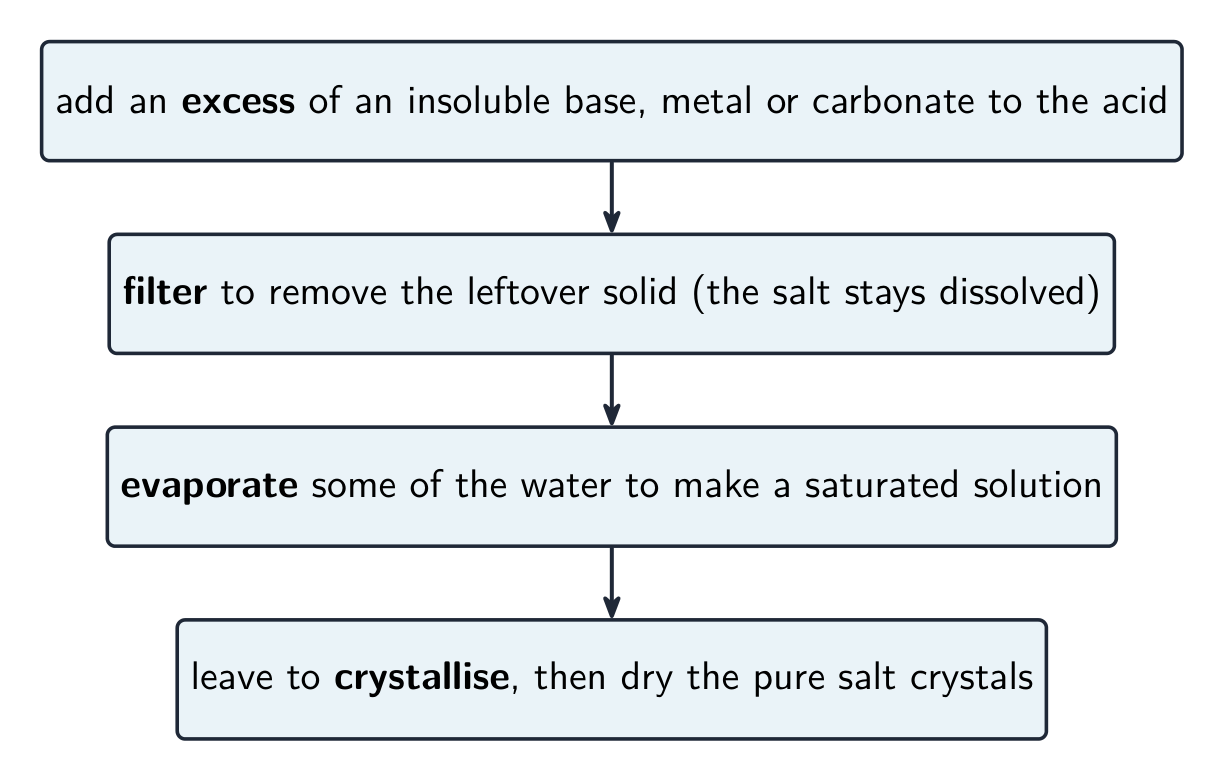
Put the steps in order.
Difficulté 3/5 · 200 pièces + un petit bonus lors de la première réussite aujourd'hui
React, filter, evaporate, crystallise.
Why is the solid added in excess?
Difficulté 1/5 · 100 pièces + un petit bonus lors de la première réussite aujourd'hui
No acid left in the salt.
When the base is soluble: titration
- Sodium, potassium and ammonium salts are made from soluble alkalis, so no excess solid can be seen. Use a titration with an indicator to find the exact volumes, then repeat without the indicator.
- Insoluble salts, such as barium sulfate, are made differently: mix two solutions, and filter off the precipitate.
Which salt should be made by titration?
Difficulté 1/5 · 100 pièces + un petit bonus lors de la première réussite aujourd'hui
Sodium hydroxide is soluble.
Worked example: pure copper(II) sulfate crystals
- Reaction: CuO(s) + H₂SO₄(aq) → CuSO₄(aq) + H₂O(l). Add black copper(II) oxide to warm acid until some black solid remains.
- Filter: the filtrate is a clear blue solution; the black excess stays in the filter paper.
- Crystallise: heat until a drop on a cold glass rod forms crystals, then cool slowly; blue crystals form and are filtered and dried.
After filtering, the copper(II) sulfate solution is in the filtrate.
Difficulté 1/5 · 100 pièces + un petit bonus lors de la première réussite aujourd'hui
The black excess stays in the filter paper.
Why not boil it dry?
- Heating to dryness gives a powder, can spatter, and can drive off the water that is part of hydrated crystals such as CuSO₄·5H₂O.
- Slow cooling of a saturated solution gives larger, purer crystals.
Boiling the solution to dryness gives the best hydrated crystals.
Difficulté 1/5 · 100 pièces + un petit bonus lors de la première réussite aujourd'hui
It removes water of crystallisation.
The excess solid is there on purpose. It guarantees all the acid has reacted, so the salt is not contaminated with acid. Remove it by filtering before evaporating.
Make a soluble salt by adding excess insoluble base, carbonate or metal to acid, filtering, evaporating to the crystallisation point and cooling. Use titration for sodium, potassium and ammonium salts, and precipitation for insoluble salts.
Describe how to make pure, dry crystals of zinc chloride from zinc carbonate. Include a word equation.
The full method.