The Haber and Contact processes
Introduit| English | Sens |
|---|---|
| ammonia/æˈməʊnɪə/ | A compound of nitrogen and hydrogen with the formula NH₃. |
| Haber process/ˈheɪbə ˈprəʊses/ | procédé Haber |
| Contact process/ˈkɒntækt ˈprəʊses/ | procédé de contact |
| sulfuric acid/sʌlˈfjʊərɪk ˈæsɪd/ | acide sulfurique |
| iron catalyst/ˈaɪən ˈkætəlɪst/ | catalyseur au fer |
| yield/jiːld/ | rendement |
The first ammonia factory, 1913
- In September 1913 the company BASF opened a plant at Oppau, Germany, run by the engineer Carl Bosch. It used Fritz Haber's reaction to make ammonia 氨 from nitrogen in the air, in steel vessels built to hold hot gas at high pressure. Fertiliser made from ammonia now helps feed about half the world's population.
- The Haber process 哈伯法 makes ammonia; the Contact process 接触法 makes sulfuric acid 硫酸. Both are reversible reactions run as compromises.
What did the Oppau plant make from 1913?
Difficulté 1/5 · 100 pièces + un petit bonus lors de la première réussite aujourd'hui
Using Haber's reaction.
The Haber process
- N₂ + 3H₂ ⇌ 2NH₃ (forward reaction exothermic). Nitrogen comes from the air; hydrogen from methane (natural gas).
- Conditions: 450 °C, 200 atm (20,000 kPa), an iron catalyst 铁催化剂. Ammonia is cooled to a liquid and removed; unreacted gases are recycled.
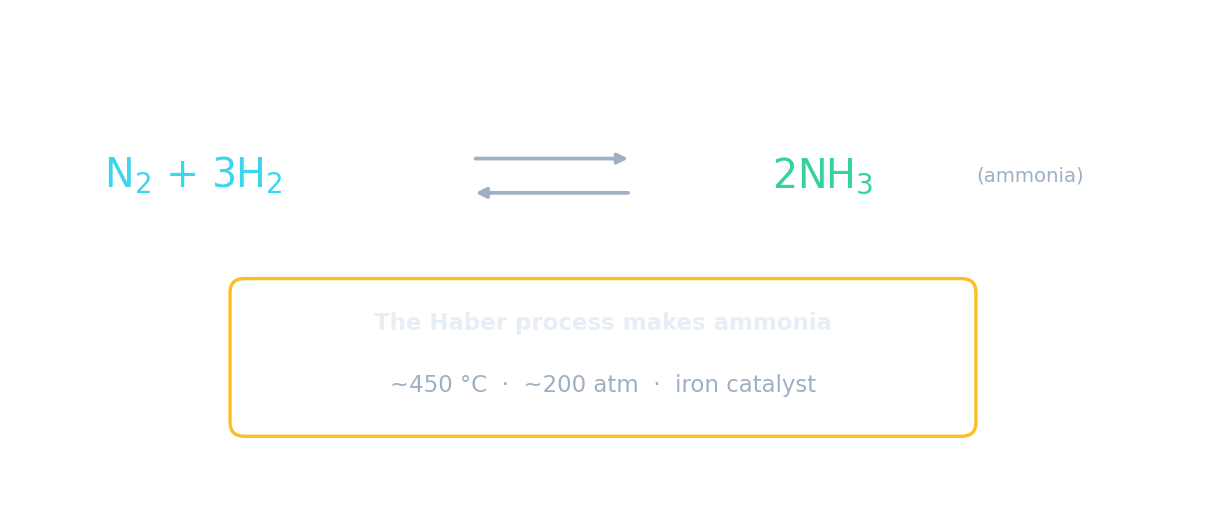
The Haber & Contact processes
compromise: yield vs rate
Pressure raises yield; temperature is a compromise between yield and rate.
Match each Haber condition to its value.
Difficulté 2/5 · 140 pièces + un petit bonus lors de la première réussite aujourd'hui
The standard conditions.
Where does the hydrogen for the Haber process come from?
Difficulté 1/5 · 100 pièces + un petit bonus lors de la première réussite aujourd'hui
Nitrogen comes from the air.
Why those conditions?
- Pressure: 4 molecules of gas become 2, so high pressure moves the equilibrium right and increases the yield 产率. Higher still costs too much and is dangerous.
- Temperature: the forward reaction is exothermic, so low temperature gives a higher yield — but the rate is too slow. 450 °C is a compromise; the catalyst speeds up both directions.
High pressure increases the yield of ammonia because there are fewer gas molecules on the right.
Difficulté 1/5 · 100 pièces + un petit bonus lors de la première réussite aujourd'hui
4 molecules become 2.
The Contact process
- Sulfur is burned to SO₂; then 2SO₂ + O₂ ⇌ 2SO₃ (exothermic), over a vanadium(V) oxide catalyst, V₂O₅, at 450 °C and 1–2 atm (200 kPa).
- A low pressure is used because the equilibrium already lies far to the right. SO₃ is then turned into sulfuric acid.
Which catalyst is used in the Contact process?
Difficulté 1/5 · 100 pièces + un petit bonus lors de la première réussite aujourd'hui
V₂O₅.
Worked example: predict the effect of a change
What happens to the yield of ammonia if the temperature is raised from 450 °C to 550 °C?
- Direction: the forward reaction is exothermic, so higher temperature favours the endothermic reverse reaction.
- Yield: the equilibrium moves left; the yield of NH₃ falls.
- Rate: the reaction becomes faster, so equilibrium is reached sooner — but with less ammonia.
Raising the temperature of the Haber process does what to the yield?
Difficulté 1/5 · 100 pièces + un petit bonus lors de la première réussite aujourd'hui
The forward reaction is exothermic.
Uses
- Ammonia: fertilisers such as ammonium nitrate and ammonium sulfate, which give plants nitrogen.
- Sulfuric acid: fertilisers, detergents, car batteries and many other chemicals.
A catalyst does not increase the yield. It makes equilibrium arrive sooner by speeding up forward and reverse reactions equally; only temperature and pressure move the position.
The iron catalyst increases the yield of ammonia.
Difficulté 1/5 · 100 pièces + un petit bonus lors de la première réussite aujourd'hui
It only speeds up reaching equilibrium.
Haber: N₂ + 3H₂ ⇌ 2NH₃, 450 °C, 200 atm, iron. Contact: 2SO₂ + O₂ ⇌ 2SO₃, 450 °C, 1–2 atm, V₂O₅. Each temperature is a compromise between yield and rate; high pressure favours fewer gas molecules.
Explain why the Haber process uses 450 °C rather than a lower temperature, in three sentences.
Yield versus rate.