Exothermic and endothermic reactions · Réactions exothermiques et endothermiques
| English | Français |
|---|---|
| exothermic/eɡzəˈðɜːmɪk/ | exothermique |
| endothermic/ˌendəʊˈθɜːmɪk/ | endothermique |
| combustion/kəmˈbʌstʃn/ | combustion |
| neutralisation/ˌnjuːtrəlaɪˈzeɪʃn/ | neutralisation |
| thermal decomposition/ˈθɜːml ˌdiːkɒmpəˈzɪʃn/ | décomposition thermique |
Reactions that heat or cool
- Strike a match and it gives out heat; dissolve some salts and the beaker turns cold.
- Reactions either release or absorb energy. These are exothermic 放热反应 and endothermic 吸热反应.
Réactions qui chauffent ou refroidissent
- Allumer une allumette dégage de la chaleur ; dissoudre certains sels rend le bécher froid.
- Les réactions libèrent ou absorbent de l'énergie. Ce sont les réactions exothermiques 放热反应 et endothermiques 吸热反应.
An exothermic reaction: · Une réaction exothermique :
Exothermic reactions release energy. · Les réactions exothermiques libèrent de l'énergie.
Burning (combustion) is an example of a(n): · La combustion (incinération) est un exemple de :()
Combustion releases heat — exothermic. · La combustion libère de la chaleur — exothermique.
In an exothermic reaction, the products are at a lower energy than the reactants. · Dans une réaction exothermique, les produits sont à une énergie inférieure à celle des réactifs.
The drop in energy is released to the surroundings. · La baisse d'énergie est libérée vers l'environnement.
Exothermic reactions
- An exothermic reaction releases energy to the surroundings (they get hotter).
- Examples: combustion 燃烧 (burning), neutralisation 中和, most everyday reactions.
In an exothermic reaction, the products are at lower energy than the reactants — energy is released.
Réactions exothermiques
- Une réaction exothermique libère de l'énergie vers l'environnement (qui devient plus chaud).
- Exemples : combustion 燃烧 (brûler), neutralisation 中和, la plupart des réactions quotidiennes.
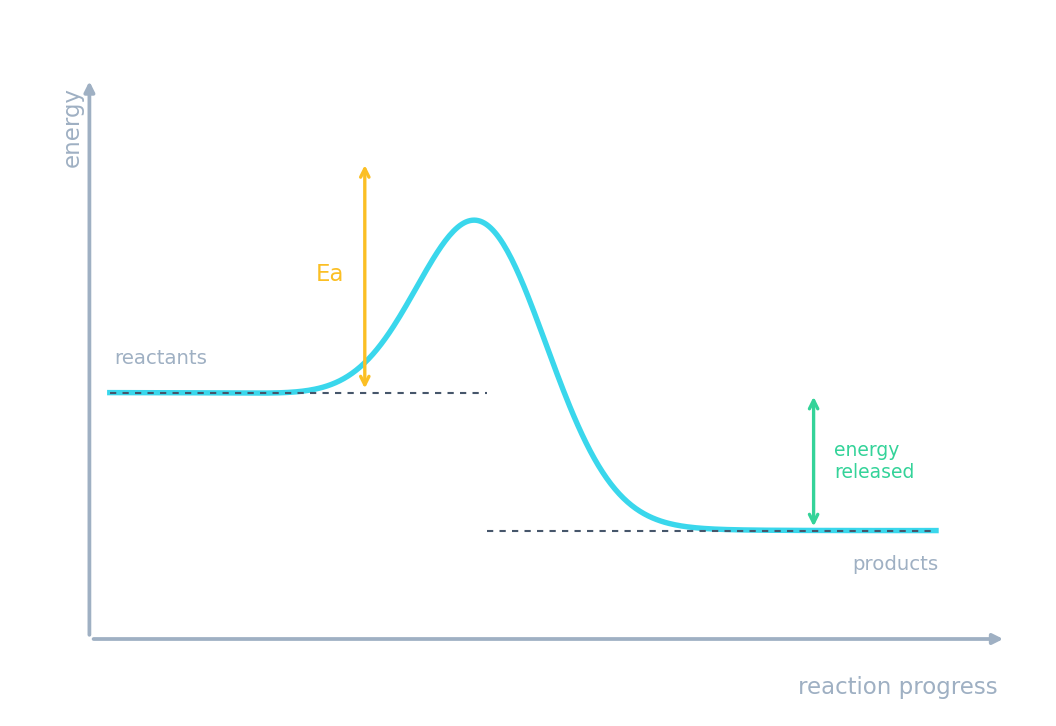
Dans une réaction exothermique, les produits ont une énergie inférieure à celle des réactifs — l'énergie est libérée.
Exothermic & endothermic · Exothermique & endothermique
ΔH = products − reactants · ΔH = produits − réactifs
Exothermic drops to lower-energy products (releases heat); endothermic · endothermique climbs to higher. · Exothermic descend vers des produits à basse énergie (libère de la chaleur) ; endothermic · endothermique monte vers des produits à haute énergie.
An endothermic reaction makes the surroundings: · Une réaction endothermique rend l'environnement :
It absorbs energy, cooling the surroundings. · Elle absorbe de l'énergie, refroidissant l'environnement.
A reaction that absorbs energy and cools its surroundings is ______. · Une réaction qui absorbe de l'énergie et refroidit son environnement est ______.
Endothermic reactions take in energy. · Les réactions endothermiques captent de l'énergie.
Endothermic reactions
- An endothermic reaction absorbs energy from the surroundings (they get colder).
- Examples: thermal decomposition 热分解, photosynthesis, some dissolving.
Burning wood is exothermic, releasing heat to the surroundings
Réactions endothermiques
- Une réaction endothermique absorbe de l'énergie depuis l'environnement (qui devient plus froid).
- Exemples : décomposition thermique 热分解, photosynthèse, certaines dissolutions.

Le bois qui brûle est exothermique, libérant de la chaleur vers l'environnement
Telling them apart
- Exothermic: surroundings warm up; products at lower energy than reactants.
- Endothermic: surroundings cool down; products at higher energy than reactants.
Exothermic = exits (releases) energy; endothermic = enters (absorbs). A quick check: if the beaker gets hot, energy is leaving the reaction (exothermic); if it gets cold, energy is being taken in (endothermic).
An exothermic reaction warms the surroundings; an endothermic reaction cools them
Les distinguer
- Exothermique : l'environnement se réchauffe ; les produits ont une énergie inférieure à celle des réactifs.
- Endothermique : l'environnement se refroidit ; les produits ont une énergie supérieure à celle des réactifs.
Exothermique = sort (libère) de l'énergie ; endothermique = entre (absorbe). Un test rapide : si le bécher devient chaud, l'énergie quitte la réaction (exothermique) ; si elle devient froide, l'énergie est absorbée (endothermique).

Une réaction exothermique réchauffe l'environnement ; une réaction endothermique le refroidit
You've got it
- exothermic reactions release energy (surroundings get hotter; products lower energy)
- endothermic reactions absorb energy (surroundings get colder; products higher energy)
- combustion is exothermic; thermal decomposition is endothermic
Vous avez compris
- réactions exothermiques qui libèrent de l'énergie (l'environnement devient plus chaud ; produits à énergie plus basse)
- réactions endothermiques qui absorbent de l'énergie (l'environnement devient plus froid ; produits à énergie plus haute)
- la combustion est exothermique ; la décomposition thermique est endothermique