| English | Français |
|---|---|
| population/ˌpɒpjʊˈleɪʃn/ | population |
| exponential/ˌekspəˈnenʃl/ | exponentielle |
| carrying capacity/ˈkæriɪŋ kəˈpæsɪti/ | capacité porteuse |
| limiting factors/ˈlɪmɪtɪŋ ˈfæktəz/ | facteurs limitants |
Booming, then balancing
- Put a few organisms in a good habitat and their numbers grow — but not forever.
- A population 种群 follows a characteristic growth curve.
Boom, puis équilibre
- On place quelques organismes dans un bon habitat et leur nombre augmente — mais pas indéfiniment.
- Une population 种群 suit une courbe de croissance caractéristique.
Put the phases of population growth in order. · Mettez les phases de croissance de la population dans l'ordre.
Slow start, rapid growth, then a plateau. · Début lent, croissance rapide, puis un plateau.
Population growth levels off at the ______ capacity. · La croissance de la population se stabilise à la capacité de ______.
The carrying capacity is the habitat's maximum. · La capacité de charge est le maximum de l'habitat.
The population growth curve
- At first, slow growth (lag phase) while numbers are small.
- Then rapid (exponential 指数的) growth as there's plenty of food and space.
- Finally growth levels off at the carrying capacity 环境容纳量.
Numbers rise rapidly, then level off at the carrying capacity the habitat can support.
La courbe de croissance démographique
- Au début, croissance lente (phase de latence) alors que les effectifs sont faibles.
- Puis croissance rapide (exponentielle 指数的) grâce à l'abondance de nourriture et d'espace.
- Enfin, la croissance stabilise à la capacité de charge 环境容纳量.

Les effectifs augmentent rapidement, puis se stabilisent à la capacité de charge que l'habitat peut soutenir.
Populations
logistic growth → capacity K · croissance logistique → capacité K
Growth is exponential at first, then levels off at the carrying capacity as resources run low. · La croissance est d'abord exponentielle, puis se stabilise à la capacité de charge lorsque les ressources deviennent rares.
The carrying capacity is: · La capacité de charge est :
It is the maximum the habitat can sustain. · C'est le maximum que l'habitat peut soutenir.
Which are limiting factors on a population? (Select all that apply.) · Quels sont les facteurs limitants d'une population ? (Sélectionnez toutes les réponses applicables.)
Food, space and predators limit growth. · La nourriture, l'espace et les prédateurs limitent la croissance.
Limiting factors 限制因素
- Growth slows because of limiting factors: food, space, water, predators and disease.
- These set the carrying capacity — the maximum the habitat can support.
A population in a limited space grows in four phases: lag, exponential, stationary, death
Facteurs limitants 限制因素
- La croissance ralentit à cause de facteurs limitants : nourriture, espace, eau, prédateurs et maladies.
- Ces facteurs définissent la capacité de charge — le maximum que l'habitat peut soutenir.
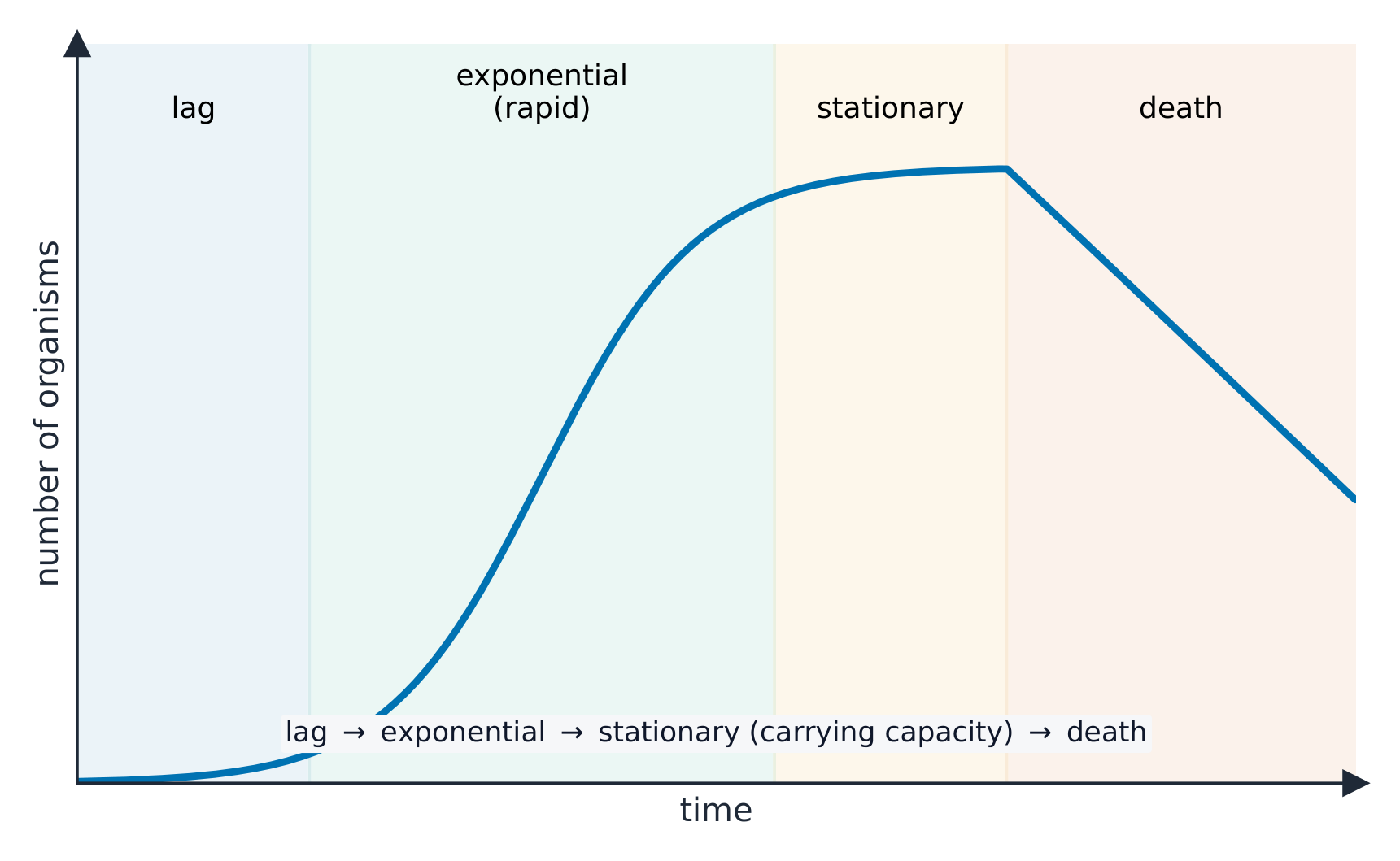
Une population dans un espace limité croît en quatre phases : latence, exponentielle, stationnaire, mortalité
A population increases through: · Une population augmente par :
Births and immigration add to a population. · Les naissances et l'immigration augmentent une population.
What changes a population
- A population rises with births and immigration; it falls with deaths and emigration.
- Predators, disease and competition keep most populations near their carrying capacity.
Populations don't grow forever. The exponential phase can't last — food and space run out, and limiting factors bring the population to a plateau at the carrying capacity.
Ce qui modifie une population
- Une population augmente par naissances et immigration ; elle diminue par décès et émigration.
- Les prédateurs, les maladies et la concurrence maintiennent la plupart des populations près de leur capacité de charge.
Les populations ne croissent pas indéfiniment. La phase exponentielle ne dure pas — la nourriture et l'espace s'épuisent, et les facteurs limitants amènent la population à un plateau à la capacité de charge.
You've got it
- a population grows: lag → rapid (exponential) growth → plateau at the carrying capacity
- limiting factors (food, space, predators, disease) slow growth
- populations rise with births/immigration, fall with deaths/emigration
Vous avez compris
- une population croît : latence → croissance rapide (exponentielle) → plateau à la capacité de charge
- les facteurs limitants (nourriture, espace, prédateurs, maladies) ralentissent la croissance
- les populations augmentent par naissances/immigration, diminuent par décès/émigration