Mitose
Introduit| English | Sens |
|---|---|
| mitosis/maɪˈtəʊsɪs/ | mitose |
| daughter cells/ˈdɔːtə selz/ | cellules filles |
| meiosis/meɪˈəʊsɪs/ | méiose |
Making identical copies
- To grow and repair itself, your body must make new cells that are exact copies.
- This copying division is mitosis 有丝分裂.
Mitosis produces daughter cells that are:
Difficulté 1/5 · 100 pièces + un petit bonus lors de la première réussite aujourd'hui
Mitosis makes identical copies.
After mitosis, each daughter cell has:
Difficulté 1/5 · 100 pièces + un petit bonus lors de la première réussite aujourd'hui
The number stays the same (46 in humans).
Cell division that produces two identical cells for growth and repair is ______.
Difficulté 1/5 · 100 pièces + un petit bonus lors de la première réussite aujourd'hui
Mitosis keeps the chromosome number the same.
What mitosis is
- Mitosis produces two genetically identical daughter cells 子细胞 from one parent cell.
- Each has the same number of chromosomes as the parent (46 in humans).
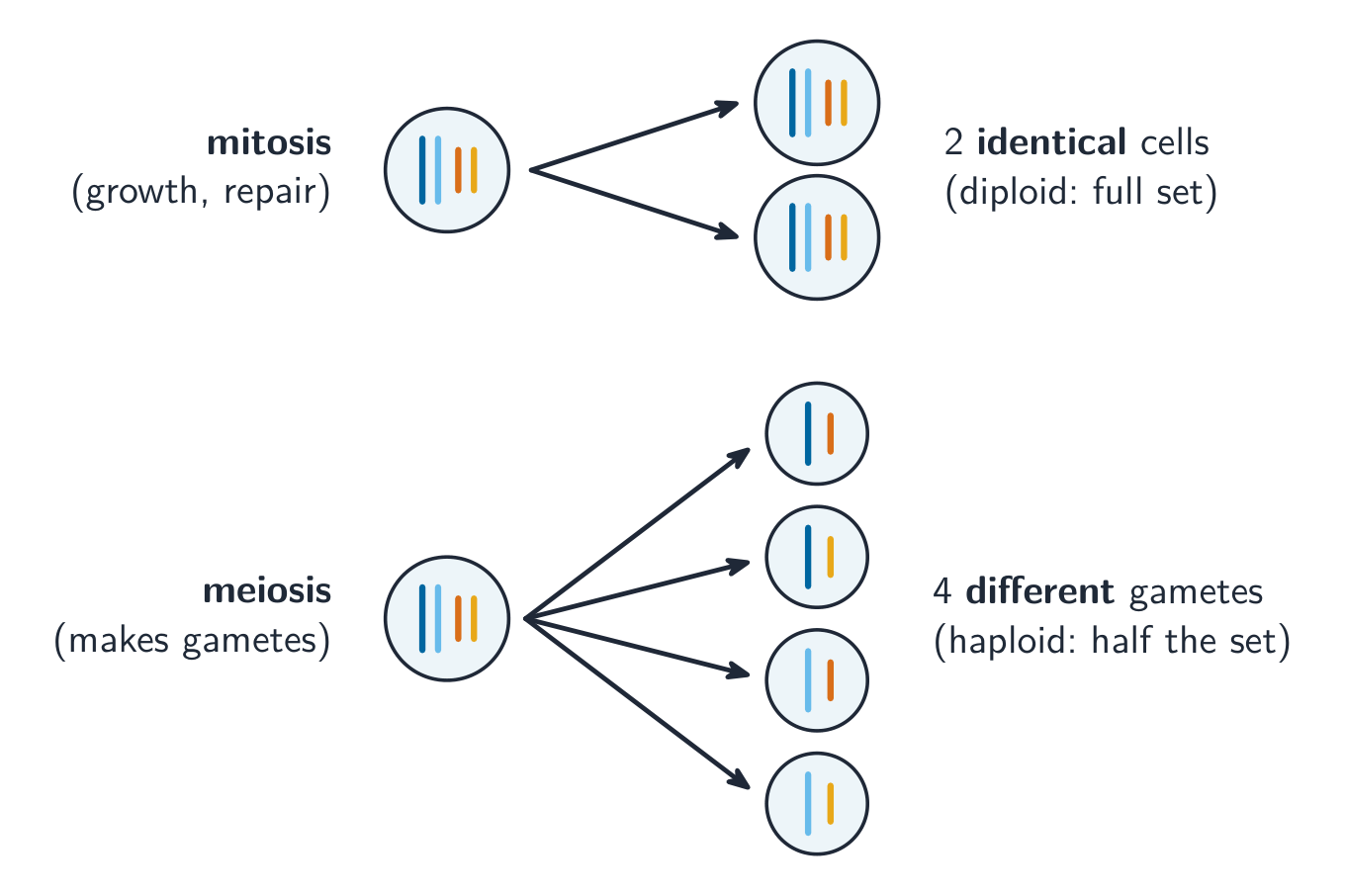
Mitosis makes two identical diploid cells; meiosis 减数分裂 makes four different haploid gametes
Mitose
Mitosis makes two genetically identical cells — for growth, repair and asexual reproduction.
Mitosis is used for: (Select all that apply.)
Difficulté 2/5 · 140 pièces + un petit bonus lors de la première réussite aujourd'hui
Gametes are made by meiosis, not mitosis.
Why it matters
- Mitosis is used for growth, repair of damaged tissue, and asexual reproduction.
- Because the cells are identical, the new tissue matches the old.
Before mitosis, the cell copies all its chromosomes.
Difficulté 1/5 · 100 pièces + un petit bonus lors de la première réussite aujourd'hui
The copies are then shared equally.
The key idea
- Before dividing, the cell copies all its chromosomes.
- The copies are shared equally, so each daughter cell gets a full, identical set.
Mitosis keeps the chromosome number the same. Both daughter cells get the full 46. This is different from meiosis, which halves the number to make gametes.
Worked example: count the cells
A single cell divides by mitosis, and each new cell divides again every 24 hours. How many cells are there after 4 days, and how many chromosomes does each have if the first cell had 46?
- Each division doubles the number: $1 \to 2 \to 4 \to 8 \to 16$, so 16 cells after 4 divisions ($2^4$).
- Mitosis copies every chromosome before the cell divides, so each new cell gets a full set: all 16 cells have 46 chromosomes and are genetically identical.
Starting from one cell, how many cells are there after 5 rounds of mitosis?
Difficulté 2/5 · 140 pièces + un petit bonus lors de la première réussite aujourd'hui
$2^5 = 32$.
Before a cell divides by mitosis, each chromosome is copied.
Difficulté 1/5 · 100 pièces + un petit bonus lors de la première réussite aujourd'hui
Copying first means each daughter cell receives a complete, identical set.
You've got it
- mitosis makes two genetically identical daughter cells
- each has the same chromosome number as the parent (46 in humans)
- it is used for growth, repair and asexual reproduction
Write from this case
- A body cell divides.
- Both daughter cells can replace worn tissue.
Which division is this, and what is it used for besides repair?
Identical full sets are what growth and repair need.
Which division makes two genetically identical cells?
Difficulté 1/5 · 100 pièces + un petit bonus lors de la première réussite aujourd'hui
Mitosis copies the parent cell.