Votre plan d'apprentissage · Continuer · Réviser →
Complément de direction 来 / 去 (vers / loin)
IntroduitVotre position enregistrée reste dans ce navigateur. Reprendre ne termine pas la leçon ni ne répond à ses questions.
Come in, go out
- A friend knocks at your door; later your little brother runs off to play outside.
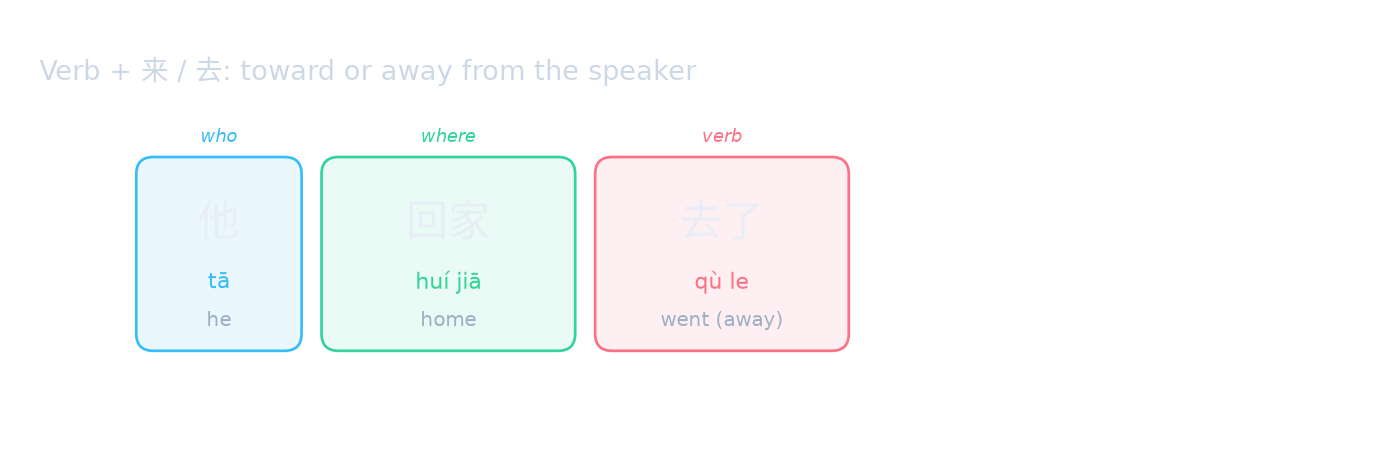
- please请to enter; to come in进(here)来! — "Please come in!" he他to go out出去(completed / change)了。 — "He's gone out." (here)来 is towards the speaker, (away)去 is away.
Verb + (here)来 / (away)去
- (here)来 = movement towards the speaker; (away)去 = movement away from the speaker.
- Combine with direction verbs: to come in进来/to go in进去, (after a verb, indicates…出来/to go out出去, to come up上来/to go up上去, come down下来/to go down下去, to return回来/to return回去, see 过来过来/past过去.
you你quickly快come down下来吧!
You are inside the room and call to your friend at the door: “Come in!” 进____!
Difficulté 1/5 · 100 pièces + un petit bonus lors de la première réussite aujourd'hui
Movement towards the speaker takes 来.
A place goes before (here)来 / (away)去
- Verb + place + (here)来/(away)去: he他to return home回家(away)去(completed / change)了。 — "He has gone back home." fast-forward (media player)快进classroom教室(here)来! — "Come into the classroom, quick!"
- A thing you carry can come after: he他to bring带来(completed / change)了one / a一measure word for books本the book书 / he他to bring带(completed / change)了one / a一measure word for books本the book书(here)来.
he他return回home家(away)去了。
Build: “Come into the classroom, quick!”
Difficulté 3/5 · 200 pièces + un petit bonus lors de la première réussite aujourd'hui
Verb + place + 来.
The speaker decides (here)来 or (away)去
- Choose by where the speaker is: you are upstairs → to come up上来 (come up); you are downstairs → to go up上去 (go up).
- A place word never comes after (here)来/(away)去: to enter; to come in进classroom教室(here)来, not to come in进来classroom教室.
You are on the ground floor talking about your friend upstairs: “He went up.” Which fits?
Difficulté 1/5 · 100 pièces + un petit bonus lors de la première réussite aujourd'hui
He moved away from you (upwards), so 上去.
他进来教室了 is correct.
Difficulté 1/5 · 100 pièces + un petit bonus lors de la première réussite aujourd'hui
The place goes before 来: 他进教室来了.
to bring拿来, to bring带(away)去, to give (as a gift); to see off送(here)来
- Bringing and taking work the same way: please请(把: marks the object)把the book书to bring拿来。 — "Please bring the book (here)."
- I / me我to / for / give给he他to give (as a gift); to see off送(away)去(completed / change)了some一些fruit水果。 — "I took some fruit over to him."
please请把the book书bring拿(here)来。
Recap
- Verb + (here)来 = towards the speaker; Verb + (away)去 = away from the speaker.
- A place goes before (here)来/(away)去 (to return home回家(away)去, to enter; to come in进classroom教室(here)来); to bring拿来/to bring带(away)去 work the same way.
Read the full reference: HSK 3 grammar — Complements.
A friend knocks at your door; later your little brother runs off to play outside. Close the examples. Say a Mandarin response, then write it in Chinese. Explain briefly in English what the lesson’s pattern adds. Compare with the model, then change one detail and try again.
This is supported productive practice. Compare meaning and structure; your answer need not copy the model. A partner or teacher must hear the spoken response to comment on pronunciation.