Votre plan d'apprentissage · Continuer · Réviser →
Complément potentiel 得 / 不 (pouvoir / ne pas pouvoir)
IntroduitVotre position enregistrée reste dans ce navigateur. Reprendre ne termine pas la leçon ni ne répond à ses questions.
Comprenez-vous ce qu'il dit ?
- Votre professeur parle vite au début d'un nouveau cours, et votre ami se demande si vous suivez.
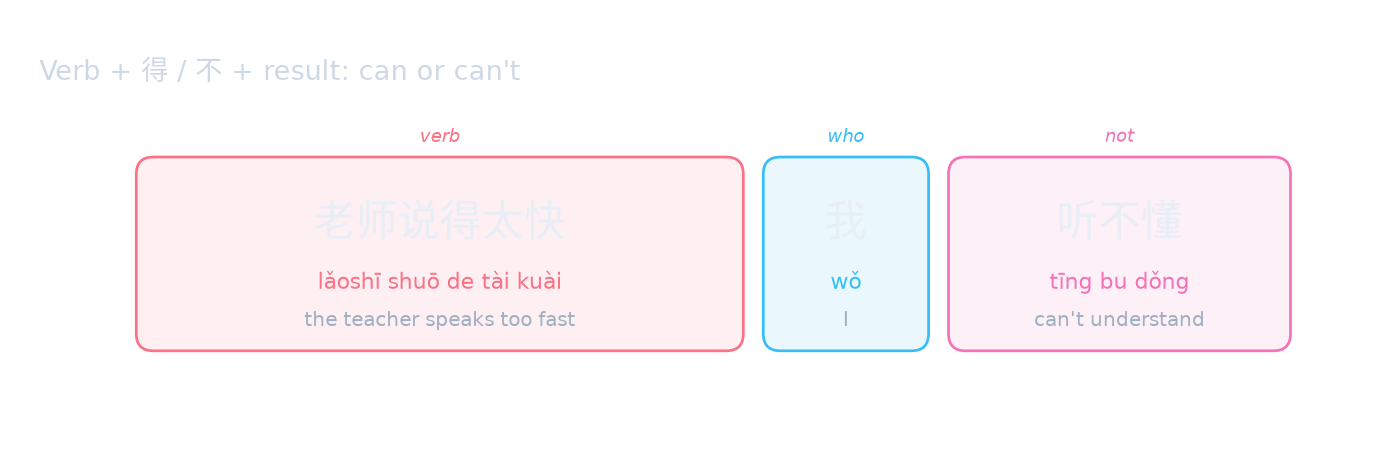
- teacher老师variant of 说说(can)得太快,I我unable to make sense of…听不懂。 — « Le professeur parle trop vite ; je ne comprends pas. »
Verbe + (can)得 / (cannot)不 + complément de résultat
- Verbe + (can)得 + complément = pouvoir (parvenir à) faire ; Verbe + (cannot)不 + complément = ne pas pouvoir : to understand (by hearing)听得懂 / unable to make sense of…听不懂 (comprendre/ne pas comprendre), can see看得见 / cannot see看不见 (voir/ne pas voir).
- Cela indique si le résultat est possible, et non si vous avez l'autorisation de le faire.
I我listen听(can)得understand懂Chinese中文。
The words on the board are too small: “I can't see clearly.” 我看____清楚。
Difficulté 1/5 · 100 pièces + un petit bonus lors de la première réussite aujourd'hui
Verb + 不 + result = can't. 看不清楚 = can't see clearly.
Paires courantes
- cannot see看不见 (ne pas pouvoir voir), to buy买(cannot)不to / arrive到 (ne pas pouvoir obtenir), eat吃(cannot)不finish完 (ne pas pouvoir finir de manger), to have enough time来得及 (il y a encore du temps).
- so这么much多food菜,we我们eat吃(cannot)不finish完。 — « Tant de nourriture — nous ne pouvons pas tout manger. »
so这么much多food菜,we我们eat吃(cannot)不finish完。
Match each form to its meaning.
Difficulté 2/5 · 140 pièces + un petit bonus lors de la première réussite aujourd'hui
Verb + 得/不 + result says whether the result is possible.
Build: “This much food — we can't finish it.”
Difficulté 3/5 · 200 pièces + un petit bonus lors de la première réussite aujourd'hui
Verb + 不 + 完 = can't finish.
Position de (cannot)不
- (cannot)不 se place entre le verbe et le résultat : unable to make sense of…听不懂, et non (cannot)不understand听懂.
- On pose la question avec les deux formes : you你to understand (by hearing)听得懂unable to make sense of…听不懂 ? ou you你to understand (by hearing)听得懂(yes/no ?)吗 ?
Which says “I can't understand Cantonese.”?
Difficulté 1/5 · 100 pièces + un petit bonus lors de la première réussite aujourd'hui
不 goes between the verb and the result.
unable to make sense of…听不懂 versus did not没understand听懂
- unable to make sense of…听不懂 = ne pas comprendre (c'est au-delà de mes capacités) : he / him他(modifier / structural particle)的Shanghai municipality…上海old variant of 话话I我unable to make sense of…听不懂.
- did not没understand听懂 = n'avoir pas compris (cette fois-ci) : sorry对不起,I我did not没understand听懂,please; to invite请to say again再说one time (all the way…一遍。
sorry对不起,I我did not没understand听懂。
Résumé
- Verbe + (can)得 + résultat = pouvoir ; Verbe + (cannot)不 + résultat = ne pas pouvoir (can see看得见 / cannot see看不见).
- (cannot)不 se place entre le verbe et le résultat. did not没 + verbe + résultat = cela ne s'est pas produit cette fois-ci.
Read the full reference: HSK 3 grammar — Complements.
Your teacher speaks quickly at the start of a new course, and your friend wonders if you follow. Close the examples. Say a Mandarin response, then write it in Chinese. Explain briefly in English what the lesson’s pattern adds. Compare with the model, then change one detail and try again.
This is supported productive practice. Compare meaning and structure; your answer need not copy the model. A partner or teacher must hear the spoken response to comment on pronunciation.