Planifier et animer un séminaire de classe basé sur les preuves
IntroduitA seminar is more than several speeches in a row
- A fictional class explores whether a campus should trial a shared equipment booking system. A formal seminar needs a focused question, prepared evidence, interaction and a record of what remains unresolved. Speakers must connect their contributions.
- This GAC014-aligned lesson supplies an original seminar brief and rehearsal process. The evidence is invented, and no actual system rollout is authorised. Printed role preparation does not replace reviewed audio for recorded listening assessment.
Define the question and preparation roles
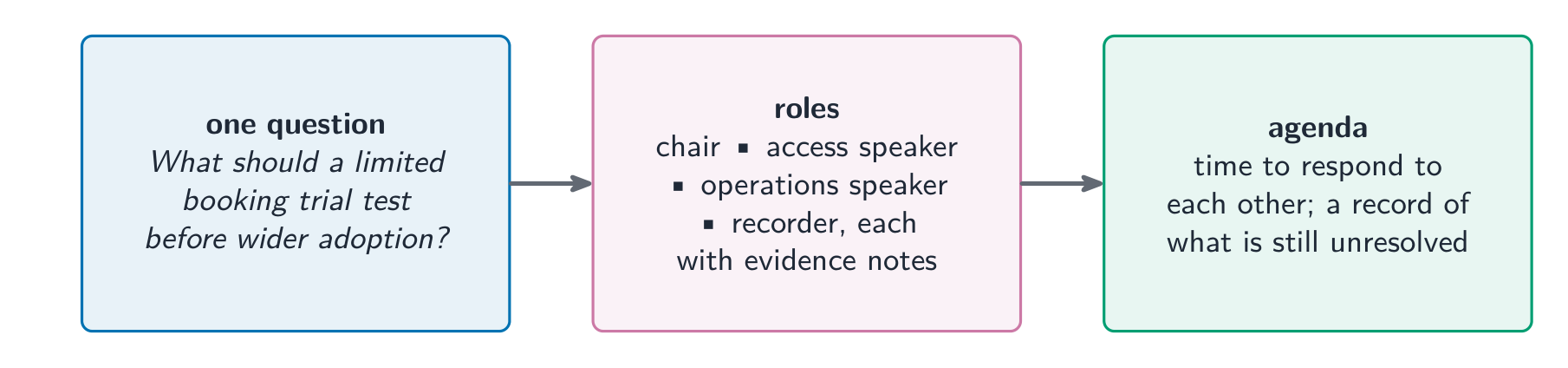
- Use the question “What should a limited booking trial test before wider adoption?” Assign a chair, an access speaker, an operations speaker and a recorder. Participants prepare evidence notes, not just opinions; every role should anticipate a relevant question.
- The fictional brief reports six double bookings in forty requests over two weeks. It records no waiting times and no requests from people who gave up before submitting. A booking interface is proposed, but its impact has not been measured.
Seminar brief: Over two fictional weeks, forty equipment requests were logged and six double bookings occurred. Waiting time and abandoned requests were not recorded. A proposed interface might make availability clearer, but no trial has been conducted. Discuss what a limited trial should measure, how participants could report difficulties, and what evidence would justify changing the system.
Combien de doubles réservations apparaissent dans le brief fictif ?
Difficulté 2/5 · 140 pièces + un petit bonus lors de la première réussite aujourd'hui
Six doubles réservations ont été enregistrées parmi quarante demandes sur deux semaines.
Publish an agenda with room for interaction
- For a twelve-minute seminar, allow two minutes for the chair’s framing, four for two prepared contributions, four for discussion, and two for summary. Tell participants the question and materials before the session. Keeping time should protect discussion, not eliminate it.
- The chair states the evidence limits and invites contributions on access and operations. Agree on respectful turns and a way to ask for clarification. Let participants distinguish a factual correction from disagreement about priorities.
Combien de minutes l'ordre du jour proposé alloue-t-il à la discussion ?
Difficulté 2/5 · 140 pièces + un petit bonus lors de la première réussite aujourd'hui
L'ordre du jour de douze minutes donne deux pour le cadrage, quatre pour les contributions, quatre pour la discussion et deux pour le résumé.
Advance the discussion with evidence and questions
- An operations contribution may propose counting double bookings; an access contribution may ask about abandoned attempts. Connect them: a system that records fewer conflicts could still discourage users. Neither success nor failure has yet been observed.
- Ask “What would count as a usable improvement?” and “Whose experience could be missing?” These questions develop evaluation criteria. Avoid claiming that a new interface will automatically solve the problem or selecting a success threshold after seeing the results.
Une baisse des conflits enregistrés montrerait nécessairement que l'accès de chaque utilisateur s'est amélioré.
Difficulté 1/5 · 100 pièces + un petit bonus lors de la première réussite aujourd'hui
Les tentatives abandonnées et autres difficultés d'accès pourraient rester non enregistrées.
Chair a synthesis rather than announce invented consensus
- Near the end, summarise areas of agreement and remaining differences: participants favour measuring conflicts and access difficulties; the trial length may remain undecided. Invite corrections before treating the summary as the seminar record.
- A recorder separates suggestions, agreed next steps and unresolved questions. If nobody agreed a rollout, do not write “approved for everyone.” Seminar facilitation should help a group reach a clear account even when it cannot reach a final decision.
Quelles DEUX catégories le recordeur doit-il distinguer ?
Difficulté 2/5 · 140 pièces + un petit bonus lors de la première réussite aujourd'hui
Le registre sépare l'accord réel des questions encore ouvertes ; il ne doit pas inventer de résultats ou de consensus.
Evaluate the seminar against explicit criteria
- After a rehearsal, check focused question, preparation, evidence use, interaction, balanced time and accurate synthesis. Have participants name one point another speaker made and one question it raised. That checks engagement beyond merely delivering a speech.
- Write an action record naming proposed measurements and unresolved planning decisions. If this becomes a real class project, obtain the required teacher approval and use genuine evidence. The fictional brief is a practice starting point, not a completed trial.
The seminar identified double bookings and missing access information as trial measures. Participants discussed a limited trial, but its duration and rollout decision remain open.
Silence is not consensus, and a proposed trial is not a measured result. Preserve disagreements and unanswered questions in the record.
A formal seminar connects preparation, evidence-based interaction and an accurate synthesis under a focused question.
Quoi indique le mieux un séminaire interactif ?
Difficulté 1/5 · 100 pièces + un petit bonus lors de la première réussite aujourd'hui
Un séminaire développe un argument collaborativement plutôt qu'en empilant des discours isolés.