Lire un argument éducatif de manière critique et rédiger une réponse
IntroduitAn attractive conclusion can outrun its evidence
- A fictional college report says a practice workshop should become compulsory because its attendees scored higher. Before agreeing, ask who attended and what was compared. A critical reader examines the path from evidence to conclusion.
- This original GAC015-aligned lesson teaches analytical reading and a balanced written response. Its report is invented practice material, not educational research. You will acknowledge the result while testing whether the recommendation follows.
Map the argument in the source
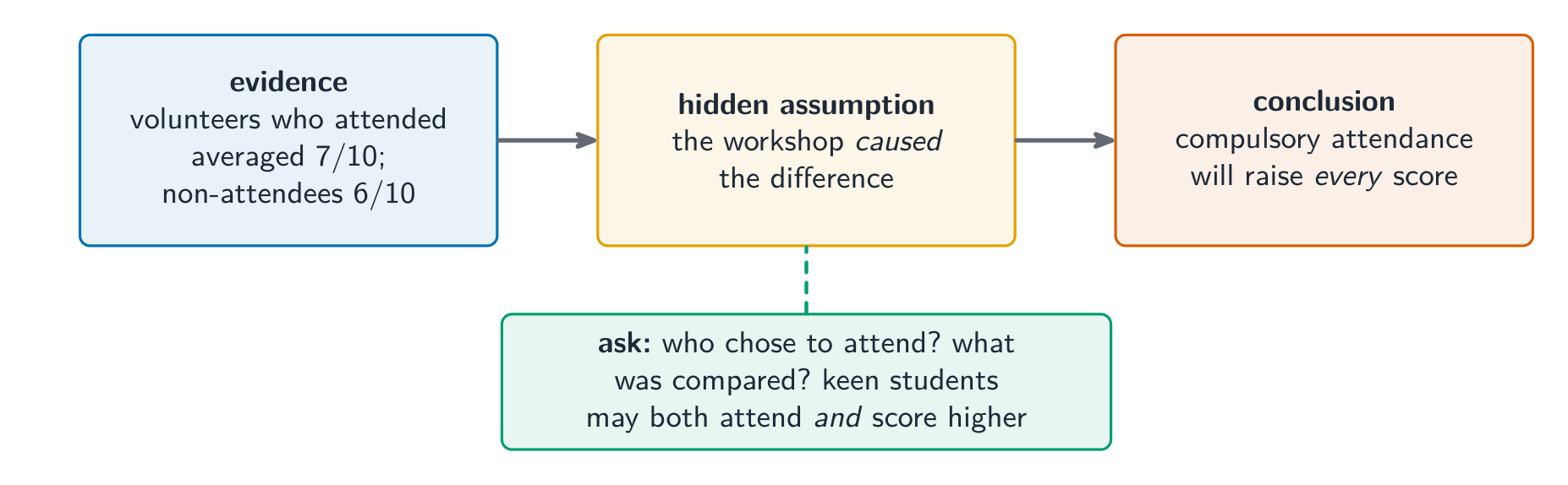
- Read for four parts: issue, conclusion, evidence and assumption. The report’s issue is workshop access; its conclusion is compulsory attendance. Its evidence compares volunteers with non-attendees. A key assumption is that the workshop caused the difference.
- An assumption may be plausible without being established. Mark exactly where the report moves from “scored higher” to “will raise every score.” That move introduces causation and a universal prediction beyond the stated observation.
Fictional report E: Thirty students chose an optional revision workshop. Their average later quiz score was seven out of ten, compared with six among thirty students who did not attend. Earlier quiz scores were not compared. The workshop group also reported spending more time revising. Since workshop attendees scored higher, compulsory attendance will raise every student’s score.
Quelle est la différence entre les deux moyennes des scores de quiz ?
Difficulté 2/5 · 140 pièces + un petit bonus lors de la première réussite aujourd'hui
7 − 6 = 1 point sur une échelle de dix points.
Quelle hypothèse est nécessaire pour la prédiction causale du rapport ?
Difficulté 1/5 · 100 pièces + un petit bonus lors de la première réussite aujourd'hui
Les deux derniers sont des faits donnés ; le rôle causal est supposé plutôt qu'isolé.
Check alternative explanations and scope
- Earlier attainment and revision time could help explain the difference; the report did not control them. You cannot say which explanation is true from this text. It is enough to show that the evidence does not isolate the workshop’s contribution.
- Both averages are measured on the same ten-point scale, but an average hides individual variation. It does not show that every attendee improved. Keep group comparison, individual change and causal effect separate in your notes.
Quels DEUX facteurs restent pertinents pour interpréter la différence ?
Difficulté 2/5 · 140 pièces + un petit bonus lors de la première réussite aujourd'hui
Les deux sont des problèmes de conception explicites. L'amélioration individuelle et l'assignation aléatoire ne sont pas déclarées.
Construct a response that engages the actual claim
- Start with a bounded thesis: the comparison supports further investigation, but not the stated universal prediction. Give the observed difference, then explain one or two reasons the inference is weak. Avoid replacing the report with an unrelated opinion about exams.
- Address a fair counterargument: the workshop might still be useful and accessible. That possibility can support a better-designed evaluation or continued optional provision, not an invented guarantee. Your response should say what further evidence would inform the decision.
Critiquer la prédiction universelle nécessite de prouver que l'atelier est inutile.
Difficulté 1/5 · 100 pièces + un petit bonus lors de la première réussite aujourd'hui
L'atelier peut aider ; le point est que ces preuves n'établissent pas la prédiction plus forte.
Draft an analytical paragraph
- Write 150–180 words acknowledging fictional report E. Include the claim, observed comparison, alternative explanations, counterargument and a qualified recommendation. Use “could,” “does not establish” and “would help evaluate” where those phrases express the actual uncertainty.
- A partner labels evidence and interpretation in your draft. If the reason for your conclusion is only “I disagree,” return to the passage. Analysis explains why the evidence supports a narrower conclusion than the source claims.
Check that criticism is fair and specific
- Audit your draft for accurate averages, group sizes and design limits. Do not accuse the author of inventing data: the practice report contains a reasoning problem, not evidence of dishonesty. Critique the inference you can demonstrate.
- Finally, identify one change that would strengthen the evaluation, such as measuring earlier attainment and using a suitable comparison design. No single added measure automatically proves causation. Keep the next study as a proposal, not a completed result.
Report E shows a one-point difference between two group averages. Since workshop participation was voluntary, earlier attainment was not compared and revision time differed, it cannot establish that compulsory attendance will improve every student’s score.
A higher group average is neither evidence that every individual improved nor proof that the workshop caused the difference.
Critical analysis identifies the conclusion, tests its assumptions against the evidence and develops a narrower, reasoned response.
Quelle réponse est la plus analytique ?
Difficulté 1/5 · 100 pièces + un petit bonus lors de la première réussite aujourd'hui
Il relie le résultat observé à une limitation démontrable sans préférence ou accusation non pertinente.