Three ways to read
Introduit| English | Sens |
|---|---|
| skimming/ˈskɪmɪŋ/ | lecture rapide |
| scanning/ˈskænɪŋ/ | reading quickly to find one specific detail such as a date or name |
| close reading/kləʊs ˈriːdɪŋ/ | lecture attentive |
| topic sentence/ˈtɒpɪk ˈsentəns/ | phrase d'introduction |
A promise of super-fast reading, 1959
- In 1959 Evelyn Wood, a teacher from Utah, opened her "Reading Dynamics" course and promised readers speeds of thousands of words a minute. In 2016 a review of the research led by Keith Rayner found that most skilled readers read about 200–400 words a minute, and that speed-reading methods trade away understanding.
- No single speed is best. Good readers change their method with their purpose: skimming 略读, scanning 寻读 or close reading 精读.
The 2016 research review found that very fast reading keeps full understanding.
Difficulté 1/5 · 100 pièces + un petit bonus lors de la première réussite aujourd'hui
Speed trades away understanding.
Skimming for the main idea
- Read the title, headings, first and last paragraphs, and the first sentence of each paragraph.
- That first sentence is often the topic sentence 主题句: it states what the paragraph is about.
Where is the topic sentence most often found?
Difficulté 1/5 · 100 pièces + un petit bonus lors de la première réussite aujourd'hui
It states what the paragraph is about.
Scanning for one detail
- Decide exactly what you need — a date, a name, a number — and move your eyes quickly until you find it.
- Then stop and read the sentence around it, so you know what the detail refers to.
After scanning finds a detail, you should read the sentence around it.
Difficulté 1/5 · 100 pièces + un petit bonus lors de la première réussite aujourd'hui
To know what it refers to.
Close reading
- Read every word, slowly, when the detail matters: instructions, exam questions, rules, contracts.
- Underline what each sentence asks you to do, and check words you do not know.
Match each purpose to the reading method.
Difficulté 2/5 · 140 pièces + un petit bonus lors de la première réussite aujourd'hui
Purpose decides method.
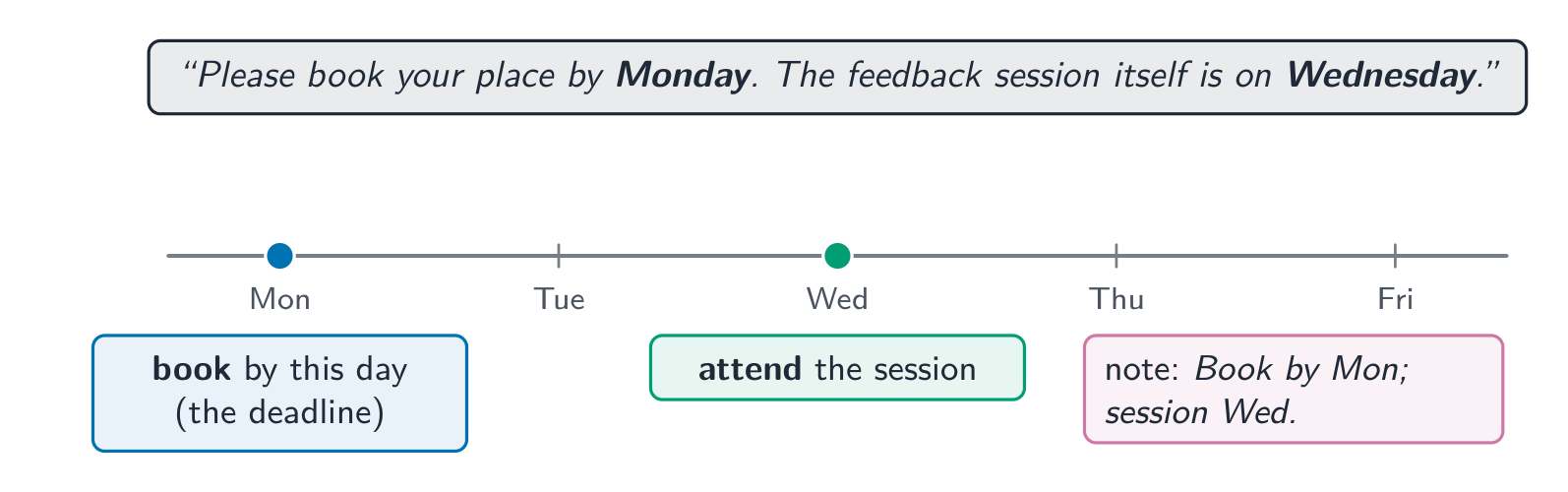
Worked example: two dates in one email
"Please book your place by Monday. The feedback session itself is on Wednesday."
- Scanning for "date" finds Monday first — but Monday is the booking deadline.
- Close reading links each date with its action: book → Monday; attend → Wednesday.
- Correct note: "Book by Mon; session Wed."
In the example email, what happens on Wednesday?
Difficulté 1/5 · 100 pièces + un petit bonus lors de la première réussite aujourd'hui
Monday is the deadline.
Combine the methods
- For an exam text: skim for the main idea (1–2 minutes), scan for the line a question points to, then close-read that part.
- Underline key words in the question before scanning.
Put the exam reading steps in order.
Difficulté 3/5 · 200 pièces + un petit bonus lors de la première réussite aujourd'hui
Broad, then narrow.
A date without its action is a trap. Copying "Monday" alone can send you, or a classmate, to the wrong event. Always note what happens on that date.
Writing down a date without its action is enough.
Difficulté 1/5 · 100 pièces + un petit bonus lors de la première réussite aujourd'hui
It can send you to the wrong event.
Skim headings and topic sentences for the main idea, scan for a specific detail, and close-read when detail matters. Always link a found detail with the words around it.
Read: "Essays must be submitted online by Friday 17:00. Late essays lose 5% per day. Feedback will be returned on 3 March." Write a three-line note with each date or time and its action.
Action with date.