Past perfect — the past before the past · Past perfect — le passé avant le passé
Which happened first?
- The past perfect is for an action that happened before another past action.
- When I arrived, the train had already left.
- It puts two past events in order.
By the time I reached the station, the train had started its own adventure.
Which happened first ? Lequel est arrivé en premier ?
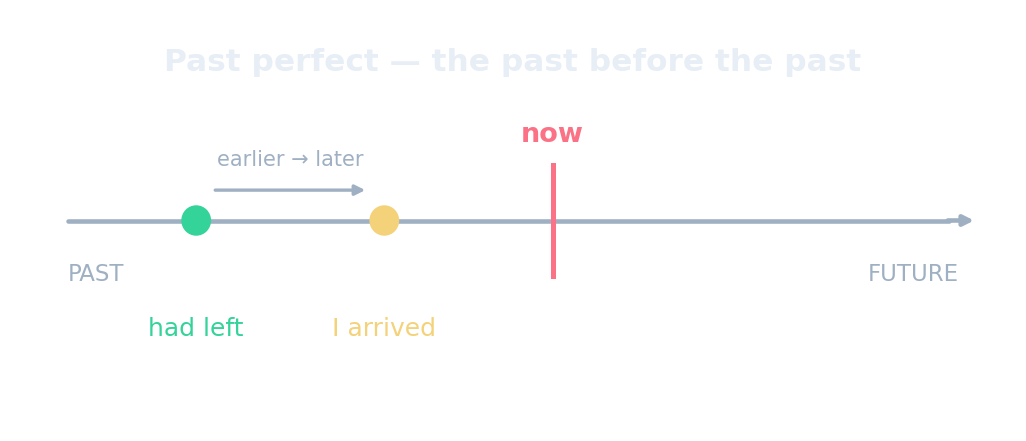
- Le past perfect sert pour une action qui est arrivée avant une autre action passée.
- When I arrived, the train had already left.
- Il place deux événements passés dans l'ordre.
By the time I reached the station, the train had started its own adventure.
Form: had + past participle
- had + past participle, the same for every subject.
- I had finished. She had gone. They had eaten.
- Short form: I'd, she'd, they'd.
Forme : had + participe passé
- had + participe passé, identique pour tous les sujets.
- I had finished. She had gone. They had eaten.
- Forme abrégée : I'd, she'd, they'd.
Complete: When we got home, the guests had already ___ (leave). · Complétez : When we got home, the guests had already ___ (leave).
had + past participle: leave → left. · had + participe passé : leave → left.
Which happened first?
- The earlier action → past perfect (had done).
- The later action → past simple (did).
- The film had started when we arrived. (started first)
Which happened first ? Lequel est arrivé en premier ?
- L'action la plus ancienne → past perfect (had done).
- L'action la plus récente → past simple (did).
- The film had started when we arrived. (commencé en premier)
Two past events, in order · Deux événements passés, dans l'ordre
The earlier action takes the past perfect; the later one takes the past simple. · L'action la plus ancienne prend le past perfect ; la plus récente prend le past simple.
Which happened FIRST? “When I arrived, the train had left.” · Lequel est arrivé EN PREMIER ? “When I arrived, the train had left.”
“had left” (past perfect) is the earlier action — it happened first. · “had left” (past perfect) est l'action la plus ancienne — elle est arrivée en premier.
Does the past perfect show the EARLIER of two past actions? · Le past perfect indique-t-il l'action LA PLUS ANCIENNE de deux actions passées ?
Yes — past perfect (had + p.p.) = the action that happened first. · Oui — past perfect (had + p.p.) = l'action qui s'est déroulée en premier.
Translate into English: 我到的时候,火车已经开走了。 · Traduisez en anglais : 我到的时候,火车已经开走了。
Earlier action → past perfect: “When I arrived, the train had left.” · Action antérieure → past perfect : “When I arrived, the train had left.”
When you need it
- Use it when the order matters or could be confusing.
- A simple story in order can stay in the past simple.
Quand vous avez besoin de le faire
- Utilisez-le lorsque l'ordre est important ou pourrait être confus.
- Une histoire simple dans l'ordre peut rester au past simple.
Common mistakes
- ❌ After he had left, I had cleaned the room. → only the earlier action takes had.
- ❌ I had seen this film. (no other past event) → ✓ I have seen this film.
- by the time + past simple → the other action usually takes the past perfect.
Erreurs courantes
- ❌ After he had left, I had cleaned the room. → seule l'action la plus ancienne prend had.
- ❌ I had seen this film. (pas d'autre événement passé) → ✓ I have seen this film.
- by the time + past simple → l'autre action prend généralement le past perfect.
By the time we arrived, the film ___ .
The start came before our arrival — earlier of two past events → past perfect. · Le début a eu lieu avant notre arrivée — antérieur à deux événements passés → past perfect.
Two past actions told in the order they happened — do you NEED the past perfect? · Deux actions passées racontées dans l'ordre où elles se sont produites — AVEZ-VOUS BESOIN du past perfect ?
No — in-order stories use the past simple. The past perfect is for jumping back. · Non — les histoires ordonnées utilisent le past simple. Le past perfect sert à remonter dans le temps.
- Past perfect = had + past participle = the past before the past.
- Earlier action → past perfect; later action → past simple.
- Use it when the order of two past events matters.
- Past perfect = had + participe passé = le passé avant le passé.
- Action la plus ancienne → past perfect ; action la plus récente → past simple.
- Utilisez-le lorsque l'ordre de deux événements passés est important.
Write one sentence about two past events, using the past perfect for the one that happened first. · Écrivez une phrase sur deux événements passés, en utilisant le past perfect pour celui qui est arrivé en premier.
Example: “The class had started when I arrived.” · Exemple : “The class had started when I arrived.”