Your learning plan · Continue · Review →
used to — past habits
IntroducedYour saved position stays in this browser. Resuming does not complete the lesson or answer its questions.
How things used to be
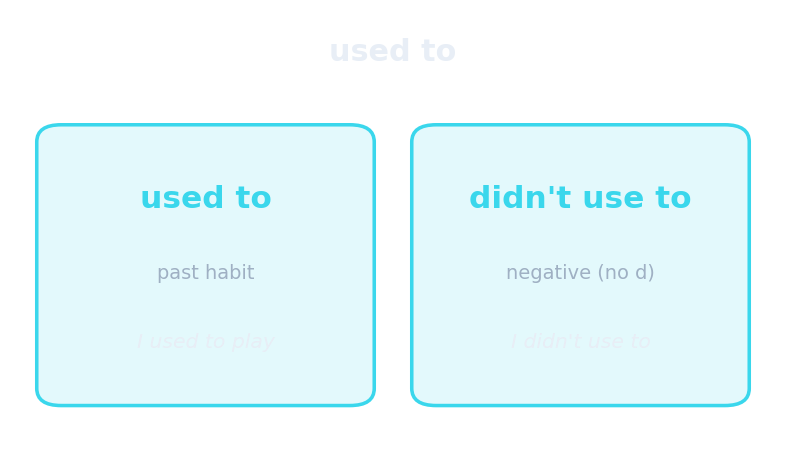
- used to + base verb describes a former habit or state, often contrasted with now.
- I used to play football. There used to be a shop here.
- It presents the situation as belonging to an earlier period. A former regular habit does not mean the person can never do that activity again.
I used to wake early; my alarm clock misses that version of me.
Form: used to + base verb
- used to + base verb, the same for every subject.
- She used to live in Paris. We used to walk to school.
- Not used to played — the verb stays in its base form.
Which sentence is correct?
Difficulty 1/5 · 100 coins + a small bonus on first completion today
used to + base verb: “I used to play football.”
Translate into English: 我过去常踢足球。
Difficulty 3/5 · 200 coins + a small bonus on first completion today
Past habit → used to + base verb: “I used to play football.”
Negatives & questions: didn't use to
- Negative: didn't use to + base verb.
- Question: Did … use to …?
- Careful: here it's use to (no "d") after did.
used to — correct or wrong?
used to + base verb; the negative/question is 'use to' (no d).
Make it negative: I ___ use to like coffee. (didn't / wasn't)
Difficulty 1/5 · 100 coins + a small bonus on first completion today
Negative = didn't use to (no “d” on use).
Only the past
- used to is only for the past.
- For a habit you have now, use the present simple.
- I used to swim a lot. → now: I swim sometimes.
Can used to + base verb itself describe a current habit rather than a former one?
Difficulty 1/5 · 100 coins + a small bonus on first completion today
No. Used to + base verb presents a former habit or state. For a current habit use present simple; be used to + noun/-ing is a different pattern meaning accustomed to.
Common mistakes
- ❌ I am used to play football. → two different patterns: used to play (past habit) vs am used to playing (accustomed to).
- ❌ I use to get up early. (about now) → ✓ I usually get up early. — no present form of used to.
- ❌ She used to living here. → ✓ She used to live here.
Match each sentence to its meaning.
Difficulty 2/5 · 140 coins + a small bonus on first completion today
used to + base = past habit; be used to + noun/-ing = accustomed; usually = present habit.
Complete with didn't or wasn't: I ___ use to like coffee, but now I love it.
Difficulty 1/5 · 100 coins + a small bonus on first completion today
Negative: didn't use to (no d on use).
- used to + base verb presents a former habit or state; be used to + noun/-ing means being accustomed to something and can describe the present.
- Negative / question: didn't use to / Did … use to …? (no "d").
- Only for the past — present habits use the present simple.
Write one sentence about something that was different in the past, using “used to”.
Difficulty 3/5 · 200 coins + a small bonus on first completion today
Example: “I used to be afraid of dogs.”