used to — past habits · used to — habitudes passées
How things used to be
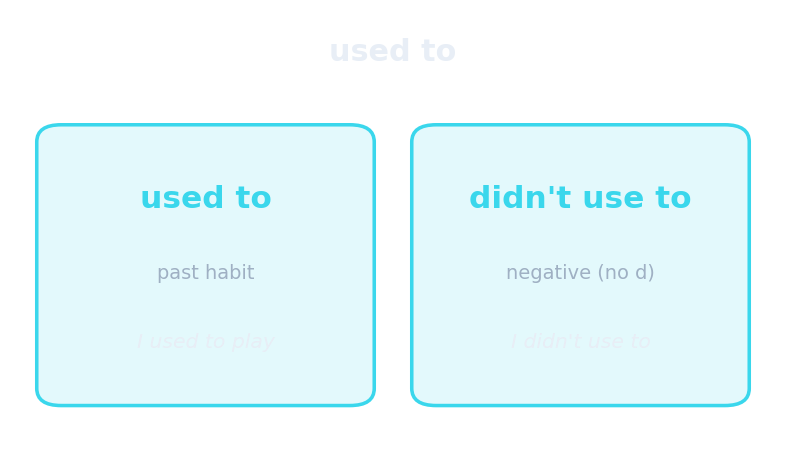
- used to describes a past habit or state that is now over.
- I used to play football. There used to be a shop here.
- It tells us "before, but not now".
I used to wake early; my alarm clock misses that version of me.
Comment les choses étaient autrefois
- used to décrit une habitude ou un état passé qui est maintenant révolu.
- I used to play football. There used to be a shop here.
- Cela nous dit « avant, mais pas maintenant ».
I used to wake early; my alarm clock misses that version of me.
Form: used to + base verb
- used to + base verb, the same for every subject.
- She used to live in Paris. We used to walk to school.
- Not used to played — the verb stays in its base form.
Forme : used to + verbe à l'infinitif
- used to + verbe à l'infinitif, identique pour tous les sujets.
- She used to live in Paris. We used to walk to school.
- Pas used to played — le verbe reste à sa forme infinitive.
Which sentence is correct? · Quelle phrase est correcte ?
used to + base verb: “I used to play football.” · used to + verbe infinitif : “I used to play football.”
Translate into English: 我过去常踢足球。 · Traduisez en anglais : 我过去常踢足球。
Past habit → used to + base verb: “I used to play football.” · Habitude passée → used to + verbe infinitif : “I used to play football.”
Negatives & questions: didn't use to
- Negative: didn't use to + base verb.
- Question: Did … use to …?
- Careful: here it's use to (no "d") after did.
Négations & questions : didn't use to
- Négatif : didn't use to + verbe à l'infinitif.
- Question : Did … use to … ?
- Attention : ici c'est use to (sans « d ») après did.
used to — correct or wrong? · used to — correct ou incorrect ?
used to + base verb; the negative/question is 'use to' (no d). · used to + verbe infinitif ; la négation/interrogation est 'use to' (sans d).
Make it negative: I ___ use to like coffee. (didn't / wasn't) · Rendez-le négatif : I ___ use to like coffee. (didn't / wasn't)
Negative = didn't use to (no “d” on use). · Négatif = didn't use to (pas de “d” à use).
Only the past
- used to is only for the past.
- For a habit you have now, use the present simple.
- I used to swim a lot. → now: I swim sometimes.
Uniquement le passé
- used to s'emploie uniquement pour le passé.
- Pour une habitude que vous avez maintenant, utilisez le présent simple.
- I used to swim a lot. → maintenant : I swim sometimes.
Can “used to” describe a habit you have NOW? · Peut-on utiliser “used to” pour décrire une habitude que vous avez MAINTENANT ?
No — used to is only for the past. For now, use the present simple. · Non — used to concerne uniquement le passé. Pour maintenant, utilisez le present simple.
Common mistakes
- ❌ I am used to play football. → two different patterns: used to play (past habit) vs am used to playing (accustomed to).
- ❌ I use to get up early. (about now) → ✓ I usually get up early. — no present form of used to.
- ❌ She used to living here. → ✓ She used to live here.
Erreurs courantes
- ❌ I am used to play football. → deux structures différentes : used to play (habitude passée) vs am used to playing (accoutumé à).
- ❌ I use to get up early. (à propos du présent) → ✓ Je me lève habituellement tôt. — pas de forme présente de used to.
- ❌ She used to living here. → ✓ Elle avait l'habitude d'habiter ici.
Match each sentence to its meaning. · Associez chaque phrase à sa signification.
used to + base = past habit; be used to + noun/-ing = accustomed; usually = present habit. · used to + infinitif = habitude passée ; be used to + nom/-ing = habitué ; usually = habitude présente.
Complete: I ___ use to like coffee, but now I love it. · Complétez : I ___ use to like coffee, but now I love it.
Negative: didn't use to (no d on use). · Négatif : didn't use to (pas de d à use).
- used to + base verb = a past habit or state, now finished.
- Negative / question: didn't use to / Did … use to …? (no "d").
- Only for the past — present habits use the present simple.
- used to + verbe infinitif = habitude ou état passé, désormais terminé.
- Négatif / question : didn't use to / Did … use to … ? (sans « d »).
- Uniquement pour le passé — les habitudes présentes utilisent le présent simple.
Write one sentence about something that was different in the past, using “used to”. · Écrivez une phrase sur quelque chose qui était différent dans le passé, en utilisant “used to”.
Example: “I used to be afraid of dogs.” · Exemple : “I used to be afraid of dogs.”