have got
Saying what you have
- have got means "have" — it shows what you own or what you're like.
- I have got a bike. She has got brown hair.
- It's very common in everyday British English.
I have got a bike. My dog has got my shoe.
Dire ce que vous avez
- have got signifie "avoir" — cela montre ce que vous possédez ou ce que vous êtes.
- J'ai une vélo. Elle a les cheveux bruns.
- C'est très courant dans l'anglais britannique quotidien.
J'ai un vélo. Mon chien a pris ma chaussure.
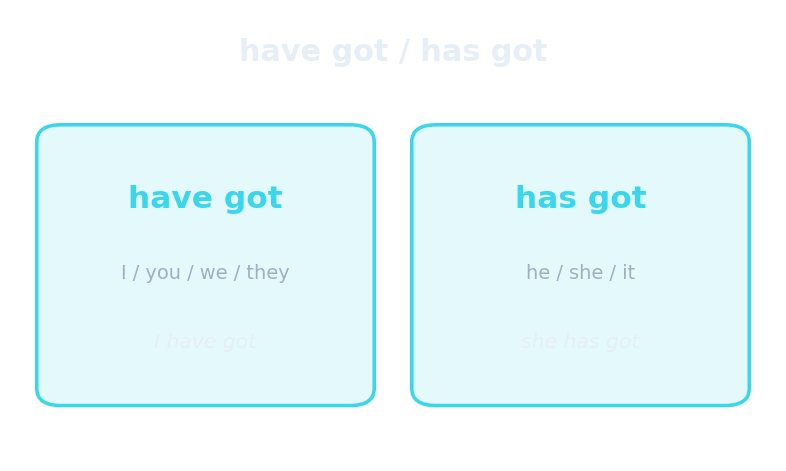
have got / has got
- I / you / we / they → have got.
- he / she / it → has got.
- Short forms: I've got, she's got, they've got.
have got / has got
- I / you / we / they → have got.
- he / she / it → has got.
- Formes abrégées : I've got, she's got, they've got.
have got or has got? · have got ou has got ?
he / she / it → has got; everyone else → have got. · il / elle / ça → has got ; tous les autres → have got.
Choose: He ___ got a new bike. · Choisissez : Il ___ une nouvelle vélo.
he / she / it → has got: “He has got a new bike.” · il / elle / ça → has got : « Il a un nouveau vélo. »
Complete: I ___ got two sisters. · Complétez : J'___ deux sœurs.
I / you / we / they → have got: “I have got two sisters.” · je / tu / nous / ils → have got : « J'ai deux sœurs. »
Translate into English: 她有一双蓝眼睛。 · Traduisez en anglais : 她有一双蓝眼睛。
she → has got: “She has got blue eyes.” · elle → has got : « She has got blue eyes. »
Negatives
- haven't got / hasn't got.
- I haven't got a pen. He hasn't got a car.
- It means "don't have / doesn't have".
Négatifs
- haven't got / hasn't got.
- Je n'ai pas de stylo. Il n'a pas de voiture.
- Cela signifie "ne pas avoir / ne pas avoir".
Is this correct? “She hasn't got a car.” · Est-ce correct ? « Elle n'a pas de voiture. »
has not got → hasn't got. Correct.
Questions
- Put Have / Has before the subject: Have you got a minute? Has she got a dog?
- Short answers: Yes, I have. / No, she hasn't.
Questions
- Placez Have / Has avant le sujet : Have you got a minute? Has she got a dog?
- Réponses courtes : Yes, I have. / No, she hasn't.
Common mistakes
- ❌ She have got long hair. → ✓ She has got long hair.
- ❌ Do you have got a pen? → ✓ Have you got a pen?
- ❌ Yes, I have got. → ✓ Yes, I have. — short answers stop at have / has.
Erreurs courantes
- ❌ She have got long hair. → ✓ Elle a les cheveux longs.
- ❌ Do you have got a pen? → ✓ As-tu un stylo ?
- ❌ Yes, I have got. → ✓ Oui, j'ai. — les réponses courtes s'arrêtent à have / has.
Put the words in order to make a question. · Mettez les mots dans l'ordre pour former une question.
Questions start with Have / Has: “Has your sister got a bike?” · Les questions commencent par Have / Has : « Your sister a-t-elle un vélo ? »
Short answer: “Have you got a pen?” — “Yes, I .” · Réponse courte : « Avez-vous un stylo ? » — « Oui, j' . »
Short answers stop at have / has — no “got”. · Les réponses courtes s'arrêtent à have / has — pas de « got ».
- have got (I/you/we/they) · has got (he/she/it) = "have".
- Negative: haven't got / hasn't got.
- Question: Have / Has before the subject.
- have got (I/you/we/they) · has got (he/she/it) = "avoir".
- Négatif : haven't got / hasn't got.
- Question : Have / Has avant le sujet.
Write one sentence about something you have, using “have got” or “has got”. · Écrivez une phrase sur quelque chose que vous avez, avec « have got » ou « has got ».
Example: “I have got a little dog.” · Exemple : « I have got a little dog. »