Present simple — everyday habits
IntroducedThe tense you will use most
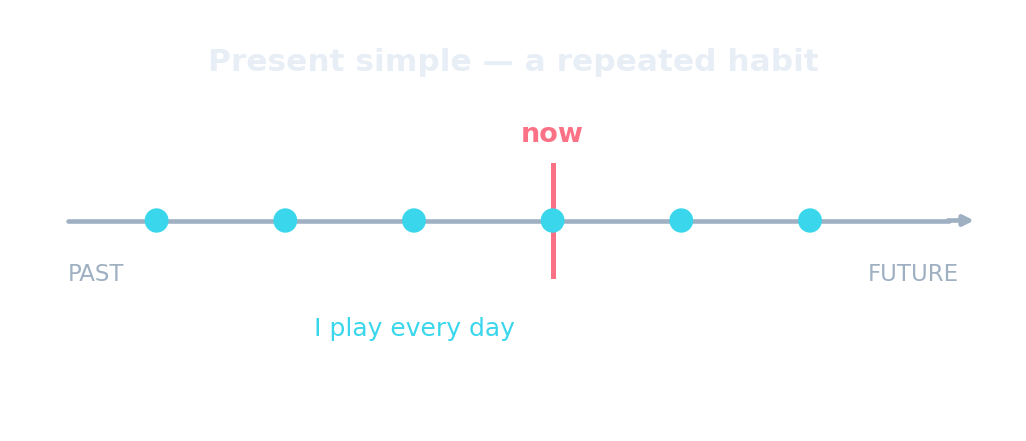
- The present simple is for things you do every day and facts.
- I get up at seven. The sun rises in the east.
- It's the tense you'll use most often.
I drink tea every day. The tea does not get a day off.
Base form, and -s for he / she / it
- I / you / we / they → the base verb: I play, we work.
- he / she / it → add -s: He plays. She works.
- go → goes, watch → watches, study → studies.
Does the verb need -s?
Only he / she / it adds -s to the verb in the present simple.
Choose: He ___ football every day.
he / she / it → add -s: “He plays football.”
Complete: She ___ (go) to school by bus.
“go” ends in -o, so add -es: go → goes.
Translate into English: 我喜欢茶。
I → base verb: “I like tea.” (not “I likes tea”)
Negatives: don't / doesn't
- I / you / we / they → don't + base verb: I don't eat meat.
- he / she / it → doesn't + base verb: He doesn't like tea.
- After don't / doesn't, no -s.
Is this correct? “He doesn't likes tea.”
After doesn't, use the base verb: “He doesn't like tea.”
Questions: Do / Does …?
- Do you …? · Does he …?
- Do you speak English? Does she live here?
- Short answers: Yes, I do. / No, he doesn't.
Common mistakes
- ❌ I very like English. → ✓ I like English very much. — never very + verb.
- ❌ He go to school. → ✓ He goes to school. — remember the -s!
- ❌ You like tea? → ✓ Do you like tea? — questions need do / does.
Match the verb to its he / she form.
-ch / -o → -es (watches, goes); consonant + y → -ies (studies); most verbs just add -s.
Which sentence is correct?
very never goes with a verb — say “like … very much”.
- Present simple = habits + facts.
- he / she / it → verb + -s.
- Negatives & questions use do / does + base verb.
Write one sentence about something you do every day. Use the present simple.
Example: “I get up at seven every day.”