can — ability and requests
IntroducedWhat you can do
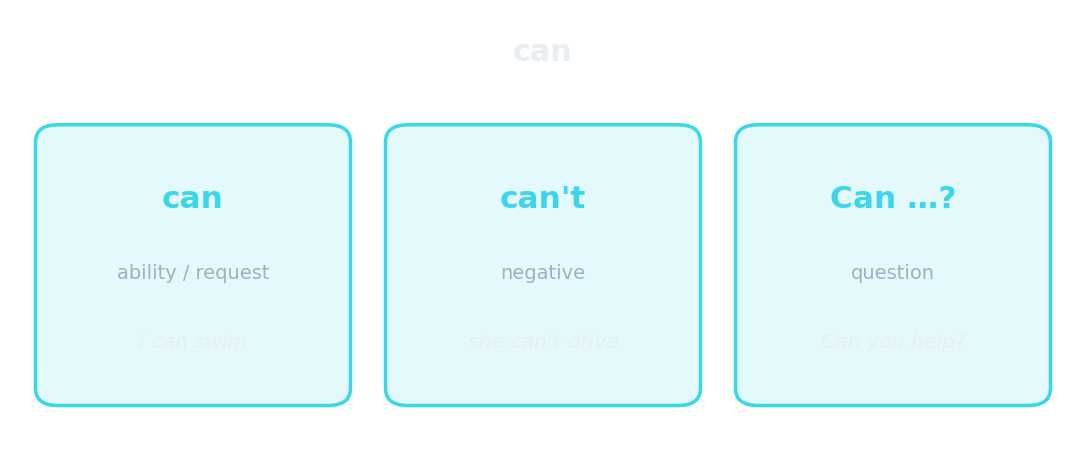
- can means "be able to" — it shows ability.
- We also use it to make requests.
- I can swim. Can you help me?
I can sing. My neighbours can hear me.
can + base verb
- can + the base verb, for every subject (no -s, no to).
- She can dance. They can speak English.
- Not can to dance, not can dances.
Explore
can — correct or wrong?
can is always followed by the base verb (no 'to', no -s).
Practice
Which sentence is correct?
can + base verb (no “to”): “I can swim.”
Practice
Translate into English: 我会游泳。
can + base verb: “I can swim.”
Negatives: can't
- cannot = can't + base verb.
- He can't drive. I can't come today.
Practice
Make it negative: She ___ drive. (cannot, short form)
cannot → can't: “She can't drive.”
Questions: Can …?
- Put Can before the subject: Can you swim? Can he cook?
- Short answers: Yes, I can. / No, I can't.
- No do / does with can.
Practice
Is this correct? “Does he can cook?”
can needs no “does”: “Can he cook?”
Common mistakes
- ❌ She cans swim. → ✓ She can swim. — can never takes -s.
- ❌ I don't can drive. → ✓ I can't drive.
- ❌ She can sing very good. → ✓ She can sing very well. — use well with verbs.
Practice
Which question is correct?
can makes its own question — no do / does: “Can you swim?”
Practice
Put the words in order to make a question.
can goes before the subject: “Can your friend play football?”
Key idea
- can + base verb = ability / requests (same for all subjects).
- Negative: can't (cannot).
- Question: Can before the subject — no do / does.
Practice
Write one sentence about something you can do, using “can”.
Example: “I can play the piano.”