Judging policy trade-offs
Introduit| English | Sens |
|---|---|
| policy trade-off/ˈpɒlɪsi treɪd ɒf/ | compromis politique |
| cyclical unemployment/ˈsaɪklɪkl ʌnemˈplɔɪmənt/ | chômage cyclique |
Phillips's curve, 1958
- In 1958 the economist A. W. Phillips plotted almost a century of British data. In years of low unemployment, wages rose fast; in years of high unemployment, they rose slowly. Pushing one objective seemed to cost another.
- Governments often face trade-offs between their goals.
Policy trade-offs
- A policy trade-off 政策权衡 is when moving closer to one objective moves you further from another.
- Growth against inflation; growth against the environment; lower unemployment against the current account.
Which is a policy trade-off?
Difficulté 1/5 · 100 pièces + un petit bonus lors de la première réussite aujourd'hui
One goal is lost as another is gained.
Cyclical unemployment
- Cyclical unemployment 周期性失业 is caused by too little demand in a downturn or recession.
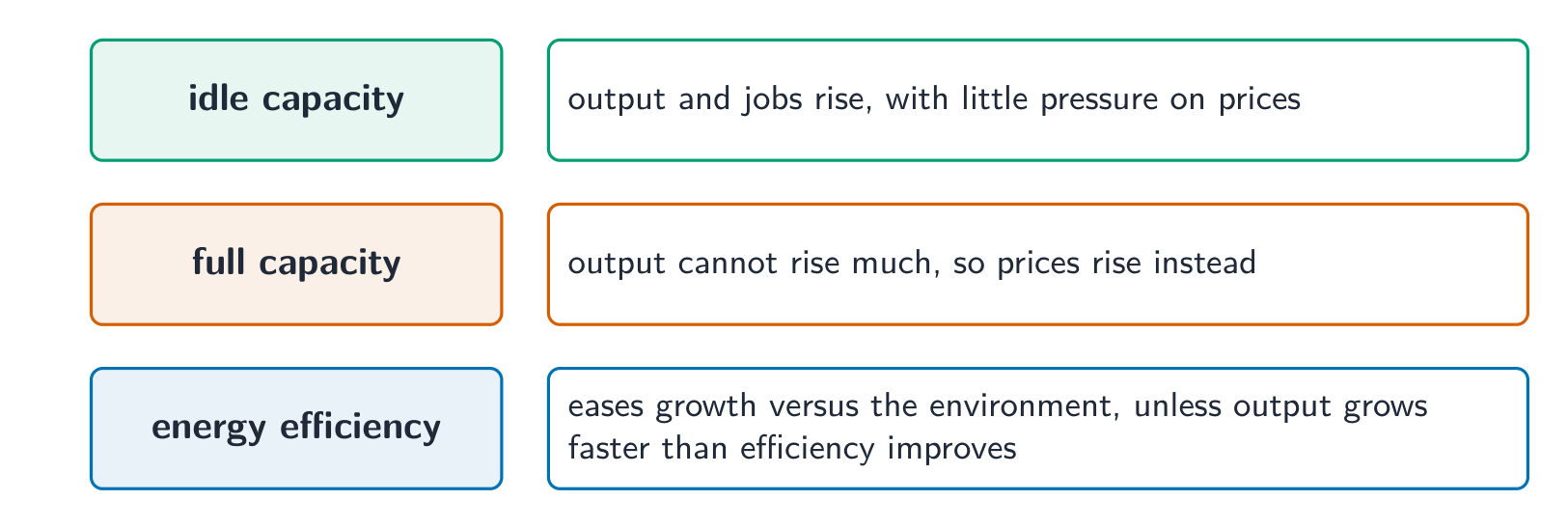
- Boosting demand cuts it, but if the economy is near full capacity, the boost mainly raises prices.
Cyclical unemployment is caused by
Difficulté 1/5 · 100 pièces + un petit bonus lors de la première réussite aujourd'hui
Demand-deficient unemployment.
Worked example: the same boost, twice
A government raises spending by 10 billion in two different years.
- Year A — recession, many idle factories: real output rises 2%, inflation rises only 0.5 percentage points; cyclical unemployment falls.
- Year B — near full capacity: real output rises 0.5%, inflation rises 3 points; firms cannot produce much more.
- Lesson: the same policy has different results depending on spare capacity.
Match each situation to the likely effect of a demand boost.
Difficulté 2/5 · 140 pièces + un petit bonus lors de la première réussite aujourd'hui
Spare capacity decides the split.
More conflicts
- Faster growth raises incomes, so people buy more imports: the current account worsens.
- Growth can increase pollution, conflicting with environmental goals.
Faster growth can worsen the current account because consumers buy more imports.
Difficulté 1/5 · 100 pièces + un petit bonus lors de la première réussite aujourd'hui
Higher incomes, more imports.
Judging a policy
- Ask: how much spare capacity is there? How long until it works? Who gains and who loses?
- Supply-side policies can raise growth without inflation, easing the trade-off in the long run.
Which policy can raise growth with little inflation in the long run?
Difficulté 1/5 · 100 pièces + un petit bonus lors de la première réussite aujourd'hui
It raises capacity.
Do not assume a policy always does the same thing. A demand boost in a deep recession mostly raises output; at full capacity, it mostly raises prices. State the conditions in your judgement.
A rise in government spending always raises output by the same amount.
Difficulté 1/5 · 100 pièces + un petit bonus lors de la première réussite aujourd'hui
It depends on spare capacity.
Objectives can conflict: growth against inflation, the current account and the environment. The size of each effect depends on spare capacity and time. Good evaluation states the conditions under which a policy works.
A government wants to cut unemployment by increasing spending. Evaluate the likely effects.
Trade-offs.