Classification, domains and evolutionary trees
Introduit| English | Sens |
|---|---|
| binomial name/baɪˈnəʊmɪəl neɪm/ | nom binomial |
| domain/dəˈmeɪn/ | domaine |
| evolutionary tree | A branching diagram representing proposed evolutionary relationships and common ancestry. |
Linnaeus names everything
- In 1758 Carl Linnaeus gave every known species a two-part Latin name. We are Homo sapiens; the domestic cat is Felis catus.
- His system sorted living things into groups by their structure and characteristics. Its main idea, and his naming method, are still used today.
The Linnaean system
- Organisms are placed in groups inside groups: kingdom → phylum → class → order → family → genus → species. A memory aid: King Philip Came Over For Good Soup.
- Each step down holds fewer organisms, and they are more alike. Two species in the same genus are more closely related than two species that share only a class.
| Rank | Lion | Domestic cat |
|---|---|---|
| kingdom | Animalia | Animalia |
| phylum | Chordata | Chordata |
| class | Mammalia | Mammalia |
| order | Carnivora | Carnivora |
| family | Felidae | Felidae |
| genus | Panthera | Felis |
| species | leo | catus |
Order the Linnaean groups from largest to smallest.
Difficulté 3/5 · 200 pièces + un petit bonus lors de la première réussite aujourd'hui
King Philip Came Over For Good Soup.
Which pair is most closely related?
Difficulté 1/5 · 100 pièces + un petit bonus lors de la première réussite aujourd'hui
The smaller the shared group, the more alike the organisms.
Binomial names
- A binomial name 双名 is the genus followed by the species: Panthera leo. The genus starts with a capital letter, the species with a small letter, and the name is written in italics (underlined when handwritten).
- Common names change from language to language and place to place, but the binomial name is the same for scientists everywhere. The tiger, Panthera tigris, shares a genus with the lion, so the two are close relatives.
In the binomial name Panthera leo, what is Panthera?
Difficulté 1/5 · 100 pièces + un petit bonus lors de la première réussite aujourd'hui
Genus first, then species.
Which shows the binomial name of the wolf written correctly?
Difficulté 1/5 · 100 pièces + un petit bonus lors de la première réussite aujourd'hui
Genus with a capital letter, species with a small letter, both in italics.
New evidence, new groups
- Better microscopes showed internal cell structures, and chemical analysis (of DNA and other molecules) showed differences Linnaeus could not see. Some organisms that looked alike turned out to be only distantly related.
- So in 1990 Carl Woese proposed the three-domain system. A domain 域 is a group above kingdom.
| Domain | Contains | Key point |
|---|---|---|
| Archaea | primitive bacteria | often live in extreme conditions, such as hot springs and salt lakes |
| Bacteria | true bacteria | prokaryotic cells, like those that cause disease |
| Eukaryota | protists, fungi, plants and animals | cells with a nucleus |
Match each organism to its domain.
Difficulté 2/5 · 140 pièces + un petit bonus lors de la première réussite aujourd'hui
Archaea are primitive bacteria; fungi have cells with a nucleus.
Evolutionary trees
- An evolutionary tree 进化树 shows how closely organisms are related. Scientists build it from classification data for living organisms, and from fossil data for extinct ones.
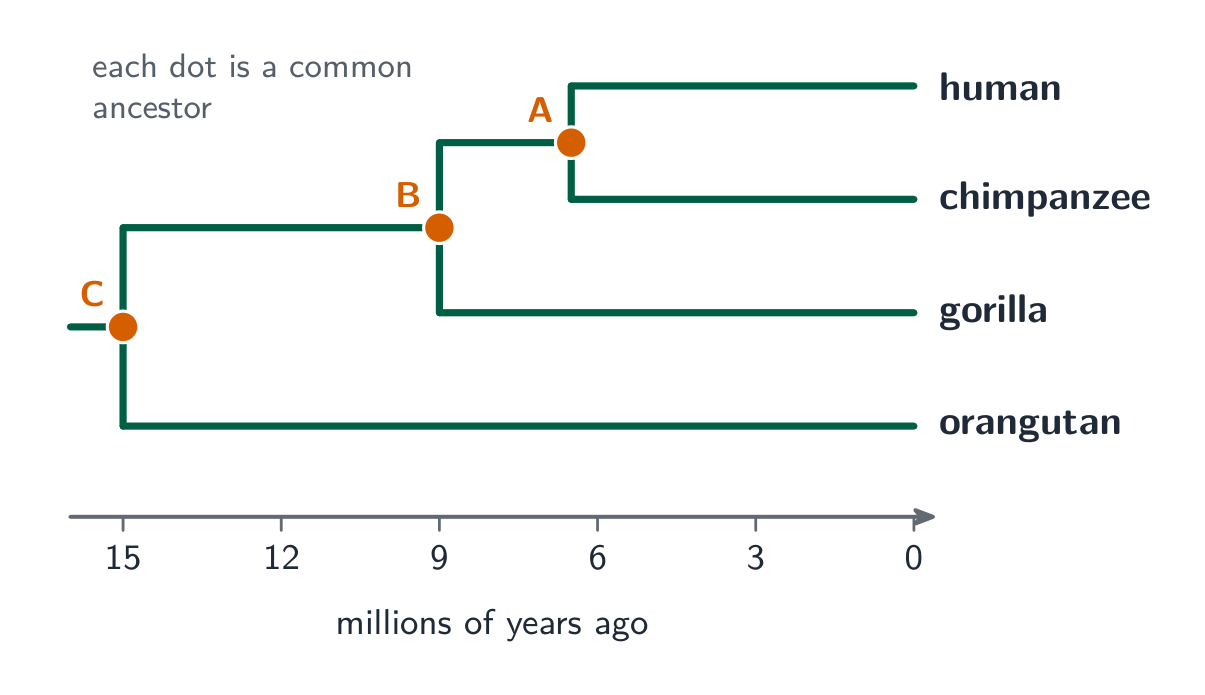
- Each branch point is a common ancestor. Two species whose branches meet at a more recent point are more closely related.
Read relationships from branch points
Rotate the branches: the drawing changes but the shared ancestors do not. Two groups are most closely related when they share the most recent branch point.
X and Y share a branch point 2 million years ago; X and Z share one 10 million years ago. Which is X most closely related to?
Difficulté 1/5 · 100 pièces + un petit bonus lors de la première réussite aujourd'hui
The more recent the common ancestor, the closer the relationship.
Worked example: reading the tree
Use the ape tree above.
- Closest living relative of humans: the chimpanzee. Their branches meet at A, about 6.5 million years ago, the most recent branch point for humans.
- Gorilla and chimpanzee: their branches meet at B, so their last common ancestor lived about 9 million years ago.
- Is the chimpanzee more closely related to the human or to the gorilla? To the human: A (6.5 million years ago) is more recent than B (9 million years ago).
- Orangutan: it joins the others only at C, about 15 million years ago, so it is the most distant relative of the four.
Use the ape tree. About how many million years ago did the last common ancestor of the gorilla and the human live?
Difficulté 2/5 · 140 pièces + un petit bonus lors de la première réussite aujourd'hui
The gorilla branch meets the human branch at B, about 9 million years ago.
Scientists want to add an extinct ape to the tree. What evidence do they mainly use?
Difficulté 1/5 · 100 pièces + un petit bonus lors de la première réussite aujourd'hui
Extinct organisms are placed using fossils; living ones using classification data such as DNA.
Exam-style questions
Q1 (2 marks): The jaguar is Panthera onca. Give the genus of the jaguar, and name one other animal in the same genus.
- Genus: Panthera ✓ — the first part of the binomial name.
- The lion (Panthera leo) or the tiger (Panthera tigris) ✓.
Q2 (2 marks): Explain why scientists replaced the old kingdom system with the three-domain system.
- New evidence from better microscopes and chemical analysis (of DNA) ✓
- showed that some organisms, such as Archaea and Bacteria, were much more different than they looked, so they needed separate groups ✓.
Where marks are lost: writing the genus in small letters; saying "Linnaeus was wrong" with no mention of the new evidence.
Rotating a branch does not change the relationships. You can swap the order of the tips on a tree. The branch points, which show shared ancestry, stay the same, so always read the branch points, not how near two names are printed.
Swapping the order of species on a tree changes their relationships.
Difficulté 1/5 · 100 pièces + un petit bonus lors de la première réussite aujourd'hui
The branch points stay the same.
Linnaeus classified organisms into kingdom, phylum, class, order, family, genus and species, and named each species with a binomial name (genus + species). New evidence from microscopes and chemical analysis led to Woese's three domains: Archaea, Bacteria and Eukaryota. On an evolutionary tree, the more recent the shared branch point, the more closely two species are related.
Describe how the classification of living things has changed since Linnaeus, and why. (4 marks)
Old system, new evidence, new system.