Communities: competition and interdependence
Introduit| English | Sens |
|---|---|
| interdependence/ˌɪntədɪˈpendəns/ | interdépendance |
| community/kəˈmjuːnɪti/ | communauté |
| Ecosystem/ˈiːkəʊsɪstəm/ | The community and its non-living environment. |
| stable community | stable community |
Wolves change rivers
- When wolves were brought back to Yellowstone in 1995, they hunted elk, which then stopped overgrazing riverbanks. Trees regrew, beavers returned, and even the rivers changed course.
- One species can affect many others. This is interdependence 相互依赖.
Levels of organisation
- Individual → population (all the organisms of one species in a habitat) → community 群落 (all the populations of different species in a habitat).
- Ecosystem 生态系统: the community plus the non-living (abiotic) parts of the environment, such as light, water and soil, and how they interact.
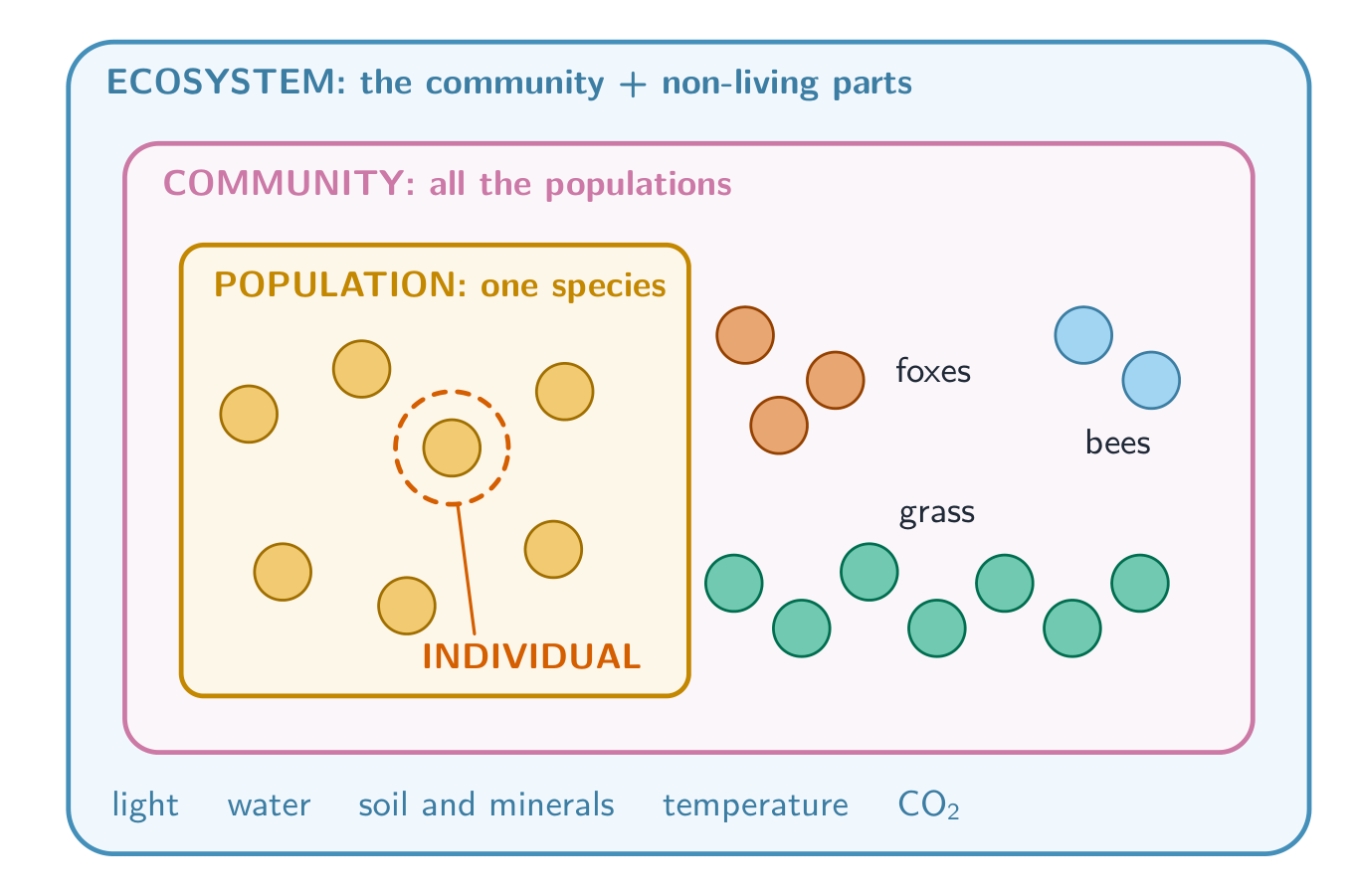
Order the levels, smallest first.
Difficulté 3/5 · 200 pièces + un petit bonus lors de la première réussite aujourd'hui
Each includes the one before.
What is an ecosystem?
Difficulté 1/5 · 100 pièces + un petit bonus lors de la première réussite aujourd'hui
Living + non-living.
Competition
- Plants compete for light, space, water and mineral ions from the soil. Animals compete for food, mates and territory.
- Organisms need these resources from their surroundings and from each other to survive and reproduce. When a resource is short, the better competitor gets more of it.
Plants or animals?
Difficulté 2/5 · 140 pièces + un petit bonus lors de la première réussite aujourd'hui
Different resources.
What species depend on each other for
| Need | Example |
|---|---|
| food | foxes need rabbits; rabbits need grass |
| shelter | birds nest in trees; insects live under bark |
| pollination | apple trees need bees to carry pollen between flowers |
| seed dispersal | birds eat berries and drop the seeds far from the parent plant |
What does the first species depend on the second for?
Difficulté 2/5 · 140 pièces + un petit bonus lors de la première réussite aujourd'hui
Food, shelter, pollination and seed dispersal are the four links to know.
A stable community
- In a stable community 稳定群落, all the species and environmental factors are in balance, so population sizes stay roughly the same over time.
- Old woodland and tropical rainforest are examples. Remove one species, and the balance shifts until a new balance is reached.
Which describes a stable community?
Difficulté 1/5 · 100 pièces + un petit bonus lors de la première réussite aujourd'hui
Births and deaths still happen, but they balance.
Worked example: one change ripples out
In a wood, foxes eat rabbits and rabbits eat grass. A disease kills half the foxes.
- Rabbits: fewer predators, so more survive to breed; their population rises.
- Grass: more rabbits eat more grass, so it falls.
- Later: less grass limits the rabbits; their numbers fall again. Every population is linked.
Foxes eat rabbits; rabbits eat grass. If foxes are removed, what happens first to the grass?
Difficulté 1/5 · 100 pièces + un petit bonus lors de la première réussite aujourd'hui
More rabbits eat more grass.
Exam-style question
Question (3 marks): In an orchard, bees pollinate the apple trees. Blackbirds eat the apples that fall. A pesticide sprayed on the orchard kills most of the bees. Explain how this could affect the blackbird population.
Model answer
- Fewer bees means fewer apple flowers are pollinated. ✓
- So fewer apples are produced, and the blackbirds have less food. ✓
- So fewer blackbirds survive or breed, and the population falls (unless they find other food). ✓
Where marks are lost: "the blackbirds die from the pesticide" (the question is about interdependence, not poison); or jumping from "bees die" to "blackbirds die" without the pollination and food links.
A community is not an ecosystem. A community is only the living organisms. An ecosystem includes the living community and the non-living environment, such as soil, water and light.
A community includes the soil and water in a habitat.
Difficulté 1/5 · 100 pièces + un petit bonus lors de la première réussite aujourd'hui
That is the ecosystem.
A population is one species; a community is all the species in a habitat; an ecosystem is the community and its non-living environment. Organisms compete for resources and depend on each other for food, shelter, pollination and seed dispersal, so a change in one population affects others. To explain a knock-on effect, follow one link at a time.
Explain what is meant by interdependence, with an example.
Depend on each other.