Passer au contenu
Sujets

AQA · GCSE · Biology

  • 1

    Biologie cellulaire

    1.1

    Biologie cellulaire : l'unité du vivant

    Every living thing is built from cells, and the differences between them decide what each can do. This reference covers AQA GCSE Biology 8461, topic 4.1 Cell biology.

    How the exam treats this topic:

    • Paper 1 (4.1–4.4) carries Cell biology. Required practicals: RP1 (light microscope), RP2 (antiseptics/antibiotics on agar, biology only) and RP3 (osmosis in plant tissue).
    • Culturing microorganisms is biology only; standard-form answers for bacterial numbers are HT only.
    • Calculations the exam demands: magnification (image ÷ real), real size from image and magnification, area by πr², percentage change in mass, surface-area-to-volume ratio, bacterial division counts.
    1.1

    Cell structure: eukaryotes and prokaryotes

    Programme

    Structure cellulaire, spécialisation, microscopie et culture (AQA 8461 énoncés 4.1.1.1-4.1.1.6, RP1, RP2).

    1. Décrire les cellules végétales, animales et bactériennes, en nommant leurs structures et leurs fonctions.
    2. Relier les structures des cellules spécialisées à leurs fonctions.
    3. Expliquer l'importance de la différenciation cellulaire.
    4. Calculer le grossissement, la taille réelle et la taille de l'image, avec la notation scientifique et les préfixes.
    5. Décrire la technique aseptique avec ses justifications, les comptages de division bactérienne et les zones d'inhibition (biologie uniquement).

    Source : Programme Cambridge International

    An animal cell, a plant cell and a bacterial cell with their key structures labelled.
    Learn the labels — the exam asks you to name and function them.
    Structure Function
    nucleus genetic material (DNA); controls the cell
    cytoplasm jelly where reactions happen
    cell membrane controls what enters and leaves
    mitochondria aerobic respiration releases energy
    ribosomes protein synthesis
    chloroplast (plant) photosynthesis
    permanent vacuole (plant) cell sap, keeps the cell firm
    cell wall (plant, cellulose) strength and support
    • Eukaryotic 真核 cells (plant and animal): genetic material enclosed in a nucleus.
    • Prokaryotic 原核 cells (bacteria) are much smaller; cytoplasm and cell membrane surrounded by a cell wall; genetic material is not in a nucleus — a single DNA loop plus one or more plasmids (small rings of DNA).

    Scale: use the prefixes centi (10⁻²), milli (10⁻³), micro (10⁻⁶), nano (10⁻⁹) and order-of-magnitude comparisons in standard form.

    Vocabulaire Entrainer
    English Français
    eukaryotic/ˌjuːkərɪˈɒtɪk/ eucaryote
    prokaryotic/ˌprɒkərɪˈɒtɪk/ procaryote
    1.1

    Cell specialisation, differentiation and microscopy

    Programme

    Structure cellulaire, spécialisation, microscopie et culture (AQA 8461 énoncés 4.1.1.1-4.1.1.6, RP1, RP2).

    1. Décrire les cellules végétales, animales et bactériennes, en nommant leurs structures et leurs fonctions.
    2. Relier les structures des cellules spécialisées à leurs fonctions.
    3. Expliquer l'importance de la différenciation cellulaire.
    4. Calculer le grossissement, la taille réelle et la taille de l'image, avec la notation scientifique et les préfixes.
    5. Décrire la technique aseptique avec ses justifications, les comptages de division bactérienne et les zones d'inhibition (biologie uniquement).

    Source : Programme Cambridge International

    Cellules spécialisées relate structure to function (learn one feature ↔ one advantage each):

    Cell Adaptation Function
    sperm cell tail for swimming, many mitochondria, acrosome with enzymes fertilisation
    nerve cell long axon, insulating sheath carrying impulses
    muscle cell many proteins fibres, many mitochondria contraction
    root hair cell large surface area, thin wall absorbing water and minerals
    xylem cell hollow, lignified walls, no end walls transporting water
    phloem cell sieve plates, few organelles transporting sugars

    Dérivation 分化: cells acquire different sub-cellular structures to become specialised. Animal cells differentiate mostly at an early stage; plant cells throughout life. In mature animals, cell division is mainly for repair and replacement.

    Microscopy: a light microscope uses lenses; an electron microscope has much higher magnification and resolving power 分辨能力, so far more sub-cellular structures could be seen and understood.

    $$\text{magnification} = \frac{\text{size of image}}{\text{size of real object}}$$

    Worked example. A cell image is 4.8 cm wide at magnification ×1200.

    • Convert first: $4.8\ \text{cm} = 4.8\times10^{-2}$ m $= 48\,000\ \mu\text{m}$.
      $$\text{real size} = \frac{\text{image size}}{\text{magnification}} = \frac{48\,000\ \mu\text{m}}{1200} = 40\ \mu\text{m}$$

    RP1: observe, draw and label plant and animal cells with a magnification scale included (e.g. a scale bar or the printed magnification).

    Vocabulaire Entrainer
    English Français
    Differentiation/ˌdɪfəˌrenʃɪˈeɪʃn/ différenciation
    resolving power/rɪˈzɒlvɪŋ ˈpaʊə/ pouvoir de résolution
    1.1

    Culturing microorganisms (biology only)

    Programme

    Structure cellulaire, spécialisation, microscopie et culture (AQA 8461 énoncés 4.1.1.1-4.1.1.6, RP1, RP2).

    1. Décrire les cellules végétales, animales et bactériennes, en nommant leurs structures et leurs fonctions.
    2. Relier les structures des cellules spécialisées à leurs fonctions.
    3. Expliquer l'importance de la différenciation cellulaire.
    4. Calculer le grossissement, la taille réelle et la taille de l'image, avec la notation scientifique et les préfixes.
    5. Décrire la technique aseptique avec ses justifications, les comptages de division bactérienne et les zones d'inhibition (biologie uniquement).

    Source : Programme Cambridge International

    Bacteria multiply by binary fission 二分裂 as often as once every 20 minutes with enough nutrients and a suitable temperature. They grow in nutrient broth or as colonies on agar gel.

    Aseptic technique 无菌操作 (each point earns a mark — know the pourquoi):

    • sterilise Petri dishes and culture media before use — kills unwanted microorganisms;
    • flame the inoculating loop before transferring bacteria — kills contaminants on the loop;
    • secure the lid with adhesive tape and store upside down — stops airborne contamination and condensation dripping;
    • in schools, incubate at a maximum of 25 °C — prevents growth of pathogens harmful to humans.

    Worked example (division count). One bacterium divides every 20 minutes for 3 hours.

    • 3 hours = 180 min = 9 division times; number $= 2^9 = 512$.

    Worked example (zone area). A clear zone of radius 4 mm around an antibiotic disc.

    $$A = \pi r^2 = \pi \times 4^2 = 50\ \text{mm}^2\ \text{(2 s.f.)}$$

    RP2: effect of antiseptics/antibiotics on bacterial growth — measure zones of inhibition with a ruler (several diameters, mean, ÷2), controls with no substance.

    Vocabulaire Entrainer
    English Français
    binary fission/ˈbaɪnəri ˈfɪʃn/ fission binaire
    Aseptic technique/æˈseptɪk tekˈniːk/ technique aseptique
    1.2

    Cell division: chromosomes, mitosis and the cell cycle

    Programme

    Division cellulaire et cellules souches (énoncés AQA 8461 4.1.2.1-4.1.2.3).

    1. Décrire les chromosomes et leur appariement dans les cellules somatiques.
    2. Décrire le cycle cellulaire en incluant les trois grandes phases et la mitose.
    3. Décrire la fonction des cellules souches chez les embryons, les animaux adultes et les méristèmes végétaux.
    4. Évaluer l'usage des cellules souches en médecine et pour le clonage végétal, y compris les risques et les objections éthiques.

    Source : Programme Cambridge International

    • Le nucleus contains chromosomes 染色体 made of DNA; each chromosome carries many genes; body cells have chromosomes in pairs (humans: 23 pairs).
    • Le cell cycle: DNA replicates → growth (more ribosomes and mitochondria) → mitosis 有丝分裂 (one set of chromosomes pulled to each end; nucleus divides) → cytoplasm and membranes divide → two identical cells.

    Mitosis matters for growth and development of multicellular organisms, and repair. Recognise contexts where mitosis is occurring (a growing root tip, healing skin, a tumour).

    Vocabulaire Entrainer
    English Français
    chromosomes/ˈkrəʊməsəʊmz/ chromosomes
    mitosis/maɪˈtəʊsɪs/ mitose
    1.2

    Cellules souches

    Programme

    Division cellulaire et cellules souches (énoncés AQA 8461 4.1.2.1-4.1.2.3).

    1. Décrire les chromosomes et leur appariement dans les cellules somatiques.
    2. Décrire le cycle cellulaire en incluant les trois grandes phases et la mitose.
    3. Décrire la fonction des cellules souches chez les embryons, les animaux adultes et les méristèmes végétaux.
    4. Évaluer l'usage des cellules souches en médecine et pour le clonage végétal, y compris les risques et les objections éthiques.

    Source : Programme Cambridge International

    A stem cell 干细胞 is an undifferentiated cell that can give rise to many more of the same type and, by differentiation, to other cell types.

    Source Can become
    embryo most types of human cell
    adult bone marrow many cells, including blood cells
    plant meristems any type of plant cell, throughout life

    Uses and evaluation (the credited pairs — benefit et risk/objection):

    • Médecine: potential treatment for diabetes and paralysis; therapeutic cloning makes an embryo with the patient's own genes, so cells are not rejected.
    • Risks/ethics: transfer of viral infection; ethical and religious objections to using embryos.
    • Plants: meristem clones — rare species preserved from extinction; disease-resistant crops cloned quickly and economically.
    Vocabulaire Entrainer
    English Français
    stem cell/stem sel/ cellule souche
    1.3

    Transport in cells

    Programme

    Transport dans les cellules (énoncé AQA 8461 4.1.3, RP3).

    1. Définir la diffusion, l'osmose et le transport actif avec des exemples et la distinction énergétique.
    2. Expliquer les facteurs influençant la vitesse de diffusion.
    3. Calculer et comparer les rapports surface/volume ; expliquer les adaptations des surfaces d'échange.
    4. Investiguer l'effet de la concentration du soluté sur la masse des tissus végétaux et calculer la variation pour cent (RP3).

    Source : Programme Cambridge International

    Process Direction Énergie Exemples
    diffusion 扩散 high → low concentration (net) aucun O₂/CO₂ in gas exchange; urea from cells to blood plasma
    osmosis 渗透 water from dilute → concentrated solution through a partially permeable membrane aucun water into plant cells
    active transport 主动运输 low → high (against the gradient) yes — from respiration mineral ions into root hairs; glucose from gut to blood

    Rate of diffusion increases with: concentration gradient, température, surface area of the membrane.

    Diffusion, osmosis and active transport compared in three panels.
    Direction and energy separate the three processes.
    Two cubes showing how doubling the side halves the surface-area-to-volume ratio.
    Bigger organisms need exchange surfaces.

    Rapport surface/volume: single-celled organisms have a large SA:V — enough exchange across the surface alone. Multicellular organisms need exchange surfaces and a transport system. Exchange surfaces are effective by: large surface area, thin membrane (short diffusion path), (animals) good blood supply, (animals, gas exchange) ventilation.

    Adapted exchange surfaces to know: small intestine and lungs in mammals, gills in fish, roots and leaves in plants.

    Worked example (SA:V). A cube of side 2 mm: SA $= 6\times2^2 = 24$ mm², V $= 8$ mm³, SA:V $= 3:1$. A cube of side 4 mm: SA $= 96$, V $= 64$, SA:V $= 1.5:1$ — doubling the side halves the ratio.

    RP3 (osmosis): potato pieces (same surface area, blotted dry, exact masses) in a range of sugar or salt solutions; measure percentage change in mass:

    $$\%\ \text{change} = \frac{\text{change in mass}}{\text{initial mass}} \times 100$$

    Interpretation: gain in dilute solutions (water enters); no change where the solution matches the cell concentration; loss in concentrated solutions (water leaves). Control variables: volume of solution, temperature, time, surface area.

    Vocabulaire Entrainer
    English Français
    diffusion/dɪˈfjuːʒn/ diffusion
    osmosis/ɒzˈməʊsɪs/ osmose
    active transport/ˈæktɪv ˈtrænspɔːt/ transport actif
    1.3

    Liste de contrôle avant de considérer ce sujet comme terminé

    • Label animal, plant and bacterial cells; match every structure to its function.
    • Specialised cells: one structural feature linked to one function each.
    • Magnification, real size and image size — convert units before dividing.
    • Aseptic technique whys; binary-fission counts; πr² zones (RP1, RP2).
    • Cell cycle stages and where mitosis occurs; stem cell sources with benefits and risks.
    • Diffusion, osmosis, active transport: direction, energy, examples; the three rate factors.
    • SA:V calculations; four exchange-surface features; percentage change in mass (RP3).
  • 2

    Organisation

    2.1

    Organisation : des cellules aux systèmes

    Cells form tissues, tissues form organs, organs form systems — and the digestive system, blood and plants each show the pattern. This reference covers AQA GCSE Biology 8461, topic 4.2 Organisation.

    How the exam treats this topic:

    • Paper 1 carries Organisation. Required practicals: RP4 (food tests) and RP5 (pH and amylase rate).
    • You must evaluate heart-disease treatments and stem-cell/lifestyle risk data, and interpret graphs and tables of risk factors.
    • Recall exactly: the enzymes table, the heart's vessels, blood components, plant tissues, transpiration factors.
    2.1

    Principles of organisation

    Programme

    Principes d'organisation et système digestif (énoncés AQA 8461 4.2.1-4.2.2.1, RP4, RP5).

    1. Classer les cellules, tissus, organes, systèmes d'organes et organismes.
    2. Décrire la nature des enzymes et leur mécanisme de clé-serrure ; relier l'activité à la température et au pH.
    3. Rappeler les sites et actions de l'amylase, des protéases et des lipases, avec des équations-mots.
    4. Expliquer les deux fonctions de la bile ; tester des aliments (RP4) et investiguer l'effet du pH sur l'amylase (RP5).

    Source : Programme Cambridge International

    Cells → tissues → organs → organ systems → organism.

    • A tissue 组织 is a group of cells with a similar structure and function.
    • An organ 器官 aggregates tissues performing specific functions.
    • Organ systems 器官系统 work together to form the whole organism.

    The digestive system is the named example of an organ system.

    Vocabulaire Entrainer
    English Français
    tissue/ˈtɪʃuː/ tissu
    organ/ˈɔːɡən/ organe
    organ systems/ˈɔːɡən ˈsɪstəmz/ systèmes d'organes
    2.1

    The human digestive system (4.2.2.1)

    Programme

    Principes d'organisation et système digestif (énoncés AQA 8461 4.2.1-4.2.2.1, RP4, RP5).

    1. Classer les cellules, tissus, organes, systèmes d'organes et organismes.
    2. Décrire la nature des enzymes et leur mécanisme de clé-serrure ; relier l'activité à la température et au pH.
    3. Rappeler les sites et actions de l'amylase, des protéases et des lipases, avec des équations-mots.
    4. Expliquer les deux fonctions de la bile ; tester des aliments (RP4) et investiguer l'effet du pH sur l'amylase (RP5).

    Source : Programme Cambridge International

    Enzymes 酶 are biological catalysts: proteins with an active site whose shape fits one substrate — the lock and key model. Temperature and pH change the rate; far from the optimum the enzyme denatures (active site changes shape).

    Enzyme Made in Acts on Products
    amylase (a carbohydrase) salivary glands, pancreas, small intestine starch simple sugars (glucose)
    protease stomach, pancreas, small intestine protéine amino acids
    lipase pancreas, small intestine lipids glycerol + 3 fatty acids

    Digestive enzymes turn food into small soluble molecules that can be absorbed into the bloodstream. The products build new carbohydrates, lipids and proteins; some glucose is used in respiration.

    Bile 胆汁: made in the liver, stored in the gall bladder. It is alcaline, neutralising hydrochloric acid from the stomach, and emulsifies fat into small droplets, increasing the surface area — both raise the rate of fat breakdown by lipase.

    RP4 food tests (learn reagent, colour change, substance):

    Test Reagent Positive result
    sugars (reducing) Benedict's, heat blue → brick-red
    starch iode orange/brown → blue-black
    protéine Biuret blue → purple
    lipids Sudan III red-stained layer on top

    RP5 (pH and amylase): buffer solutions at pH values, amylase + starch, continuous sampling onto a spotting tile with iodine, record the time for the starch to disappear — shortest time = fastest rate at the optimum pH.

    Vocabulaire Entrainer
    English Français
    enzyme/ˈenzaɪm/ enzyme
    Bile/baɪl/ bile
    2.2

    The heart, blood vessels and blood (4.2.2.2–4.2.2.3)

    Programme

    Le cœur, les vaisseaux sanguins, le sang et la maladie coronarienne (énoncés AQA 8461 4.2.2.2-4.2.2.4).

    1. Décrire le cœur et la circulation double avec les cinq vaisseaux nommés et les cellules pacemaker.
    2. Relier la structure de l'artère, de la veine et du capillaire à leur fonction.
    3. Connaître le plasma, les globules rouges, les globules blancs et les plaquettes ainsi que leurs adaptations.
    4. Expliquer la maladie coronarienne (CHD) et évaluer les stents, les statines, les valves, les greffes et les cœurs artificiels.

    Source : Programme Cambridge International

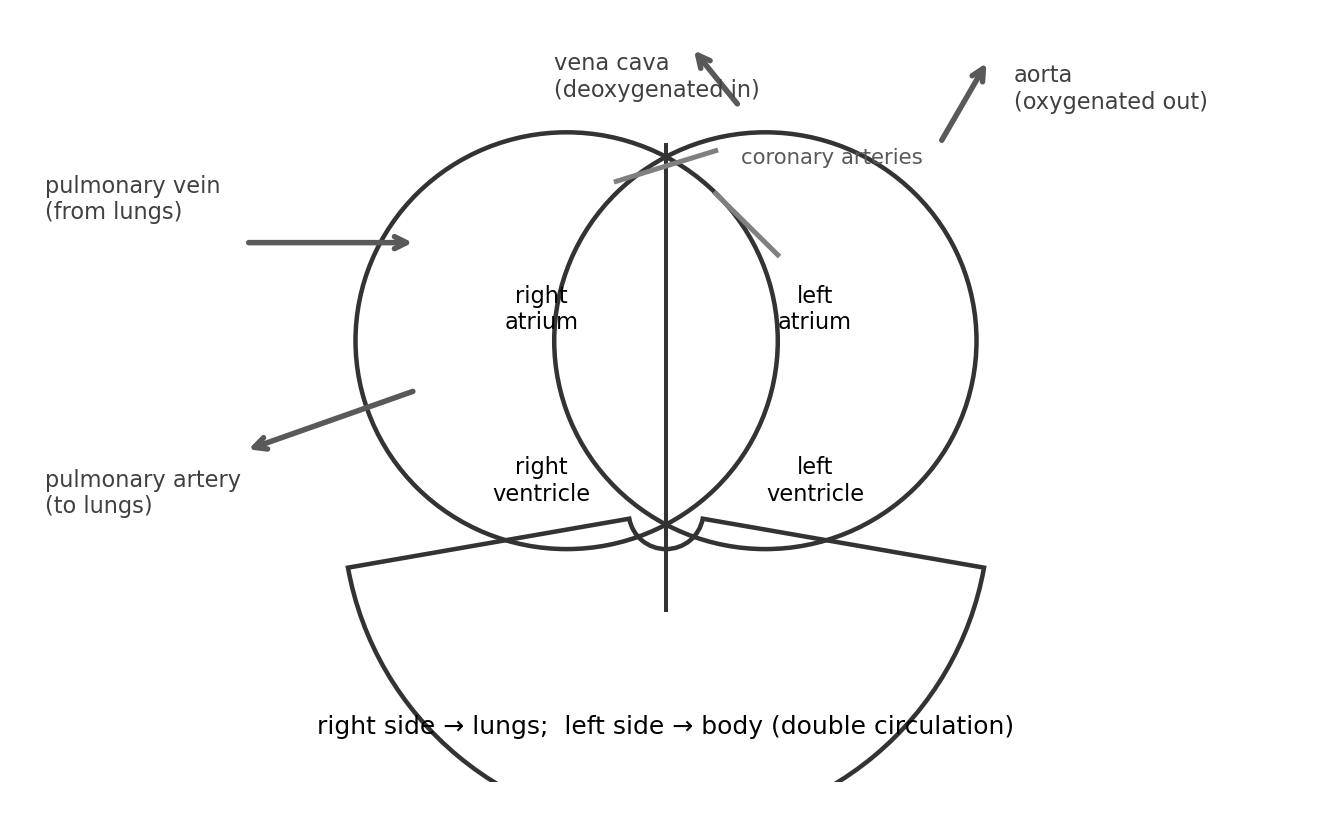
    The human heart with its four chambers and the five named vessels.
    Right side to the lungs; left side to the body.
    • The heart pumps blood in a double circulatory system: the right ventricle pumps blood to the lungs (gas exchange); the left ventricle pumps it around the rest of the body.
    • Vessels to know: aorta, vena cava, pulmonary artery, pulmonary vein, coronary arteries.
    • The resting heart rate is set by cells in the right atrium — the natural pacemaker; artificial pacemakers correct irregular rates.
    • Lungs: trachea → bronchi → alveoli 肺泡, surrounded by capillaries; alveoli are adapted by a large surface area, thin walls, good blood supply and ventilation.
    Vessel Structure Function
    artery thick, elastic, muscular walls; small lumen carries blood away at high pressure
    vein thin walls, large lumen, valves returns blood at low pressure
    capillary one cell thick exchange with tissues
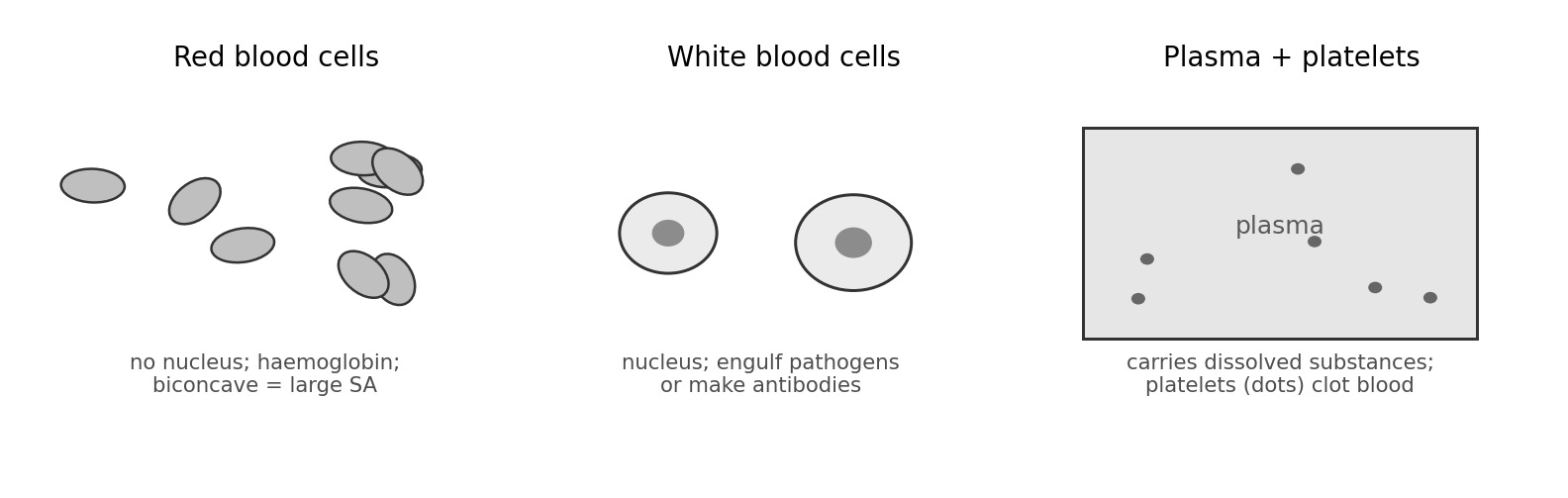
    Red cells, white cells, plasma and platelets.

    Sang is a tissue: plasma 血浆 (carries dissolved sugars, amino acids, CO₂, urea, hormones, and heat), red blood cells 红细胞 (no nucleus, packed with haemoglobin, biconcave — large surface area for oxygen transport), white blood cells 白细胞 (engulf pathogens or make antibodies), platelets 血小板 (clotting).

    Vocabulaire Entrainer
    English Français
    alveoli/ˈælvɪɒli/ alvéoles pulmonaires
    plasma/ˈplæzmə/ plasma
    red blood cells/red blʌd selz/ globules rouges
    white blood cells/waɪt blʌd selz/ globules blancs
    platelets/ˈpleɪtlɪts/ plaquettes sanguines
    2.2

    Coronary heart disease (4.2.2.4) and treatments

    Programme

    Le cœur, les vaisseaux sanguins, le sang et la maladie coronarienne (énoncés AQA 8461 4.2.2.2-4.2.2.4).

    1. Décrire le cœur et la circulation double avec les cinq vaisseaux nommés et les cellules pacemaker.
    2. Relier la structure de l'artère, de la veine et du capillaire à leur fonction.
    3. Connaître le plasma, les globules rouges, les globules blancs et les plaquettes ainsi que leurs adaptations.
    4. Expliquer la maladie coronarienne (CHD) et évaluer les stents, les statines, les valves, les greffes et les cœurs artificiels.

    Source : Programme Cambridge International

    In CHD layers of fatty material build up inside the coronary arteries, narrowing them — less blood, so less oxygen for the heart muscle. Evaluate each treatment with benefits and risks:

    Traitement Benefit Risk/limitation
    stents 支架 keeps the artery open, restores flow surgery risk; doesn't treat the cause
    statins 他汀 reduce blood cholesterol, slowing fatty deposits long-term medication with side effects (liver)
    valve replacement (biological or mechanical) restores one-way flow major surgery; mechanical need lifelong anti-clotting drugs
    transplant (heart / heart and lungs) cures failure donor shortage; rejection — immunosuppressants
    artificial heart keeps the patient alive while waiting, or lets the heart rest infection, clotting, bulky
    Vocabulaire Entrainer
    English Français
    stents/stents/ stents
    statins/ˈstætɪnz/ statines
    2.3

    Santé, mode de vie et cancer (4.2.2.5–4.2.2.7)

    Programme

    Santé, mode de vie et cancer (déclarations AQA 8461 4.2.2.5-4.2.2.7).

    1. Définir la santé et décrire les interactions entre les maladies et d'autres facteurs.
    2. Énoncer les facteurs de risque présentant des mécanismes causaux établis pour les maladies non transmissibles.
    3. Distinguer les tumeurs bénignes et malignes et décrire les tumeurs secondaires.
    4. Interpréter les données sur les facteurs de risque en distinguant corrélation et causalité.

    Source : Programme Cambridge International

    Health is the state of physical and mental well-being — not just the absence of disease. Diet, stress and life situations affect both; different diseases interact (immune defects → more infections; viruses → some cancers; immune reactions trigger asthma; severe physical illness → depression).

    Risk factors 危险因素 are linked to an increased rate of a disease — aspects of lifestyle or substances in the body/environment. A causal mechanism is proven for some, not others: diet/smoking/exercise → cardiovascular disease; obesity → Type 2 diabetes; alcohol → liver damage and brain function; smoking → lung disease and lung cancer; smoking and alcohol → unborn babies; carcinogens including ionising radiation → cancer. Interpret risk-factor data as correlation; proven mechanism makes it causation.

    Cancer results from changes in cells producing uncontrolled growth and division:

    • Benign tumours: contained in one area, usually within a membrane; do not invade.
    • Malignant tumours (cancers) invade neighbouring tissues and spread in the blood to form secondary tumours.

    Risk factors include lifestyle and, for some cancers, genes.

    Vocabulaire Entrainer
    English Français
    Risk factors/rɪsk ˈfæktəz/ facteurs de risque
    2.4

    Plant tissues and transport (4.2.3)

    Programme

    Tissus végétaux, organes et transport (déclaration AQA 8461 4.2.3).

    1. Relier les tissus végétaux (épiderme, parenchyme palissadique, parenchyme aéré, xylème, phloème, méristème, cellules gardiennes) à leurs fonctions.
    2. Expliquer les adaptations des poils radiculaires, du xylème et du phloème ainsi que les processus de transpiration et de translocation.
    3. Expliquer l'effet de la température, de l'humidité, du mouvement de l'air et de l'intensité lumineuse sur le taux de transpiration.

    Source : Programme Cambridge International

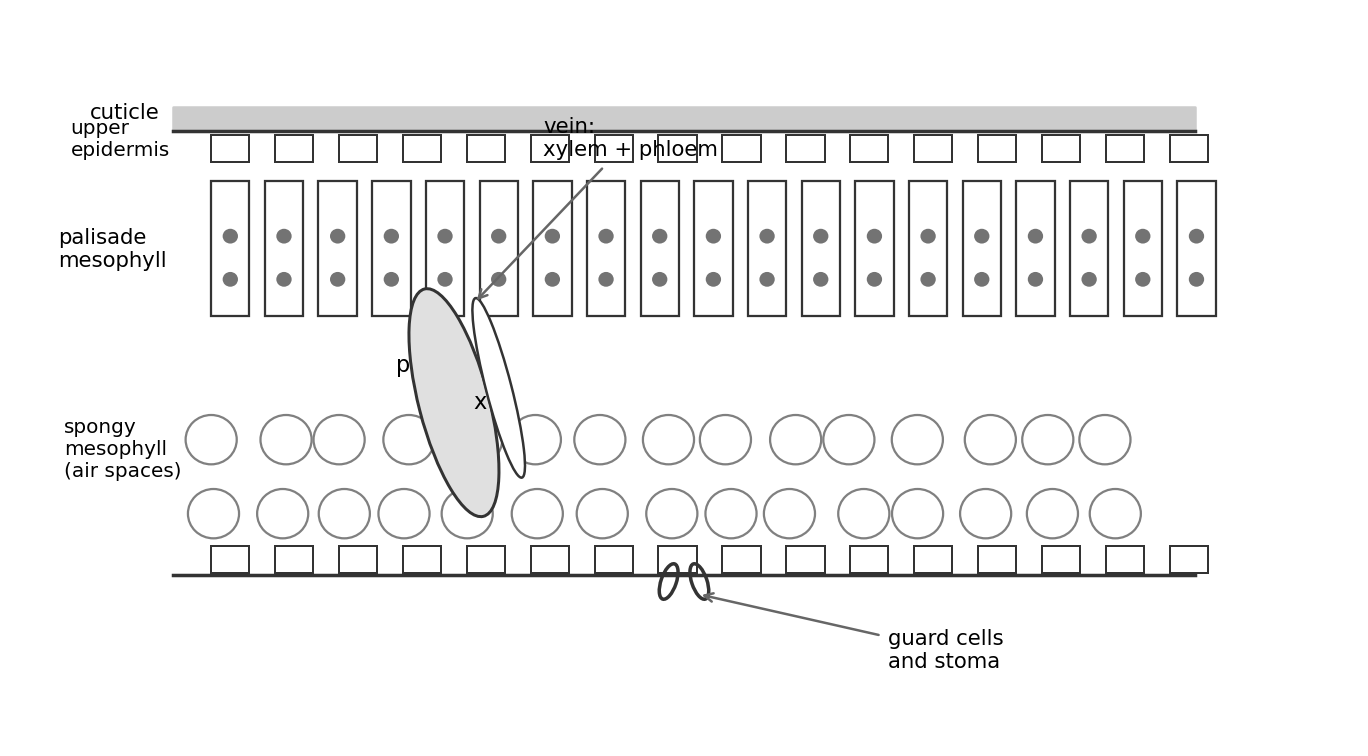
    A leaf in cross-section with its tissues labelled.
    Each tissue has one main job.
    • Epidermal tissue: protective covering; waxy cuticle on top.
    • Mésophylle palissadique 栅栏组织: packed chloroplasts — most photosynthesis.
    • Mésophylle lacuneux: air spaces for gas exchange.
    • Xylème 木质部: hollow tubes strengthened by lignin — carries water and mineral ions from roots to leaves in the transpiration stream.
    • Phloème 韧皮部: sieve tubes — carries dissolved sugars from leaves to the rest of the plant (translocation 运输).
    • Meristem: at the growing tips of shoots and roots (stem cells).
    • Guard cells 保卫细胞 surround stomata 气孔, controlling gas exchange and water loss.
    • Root hair cells: large surface area; water enters by osmosis, mineral ions by active transport.

    Transpiration 蒸腾作用 is the loss of water vapour from the leaves (mostly through stomata); it pulls the transpiration stream. The rate increases with: temperature ↑, air movement ↑, light intensity ↑ (stomata open); decreases with humidity ↑. Measure rate by water uptake with a potometer.

    Vocabulaire Entrainer
    English Français
    palisade mesophyll/ˈpælɪseɪd ˈmesəfɪl/ mésophylle en palissade
    Xylem/ˈzaɪləm/ xylème
    Phloem/ˈfləʊɪm/ phloème
    Guard cells/ɡɑːd selz/ cellules gardiennes
    stomata/ˈstəʊmətə/ stomates
    Transpiration/trænspəˈreɪʃn/ transpiration
    translocation/trænsləʊˈkeɪʃn/ translocation
    2.4

    Liste de contrôle avant de considérer ce sujet comme terminé

    • Order cells → tissues → organs → systems with one example each.
    • Enzyme table: name, site, substrate, products; lock and key; denaturing.
    • Bile: two functions with reasons; RP4 tests and colours; RP5 method.
    • Label the heart with all five named vessels; double circulation; pacemaker.
    • Artery/vein/capillary structure ↔ function; four blood components with adaptations.
    • CHD: cause + each treatment's benefit and risk.
    • Risk factors with causal mechanisms; benign vs malignant tumours.
    • Plant tissues and their jobs; xylem vs phloem; four transpiration factors.
  • 3

    Infection et réponse

    3.1

    Infection et réponse immunitaire : la guerre à l'intérieur

    Pathogens invade, defences respond, and medicine arms the fight. This reference covers AQA GCSE Biology 8461, topic 4.3 Infection and response.

    How the exam treats this topic:

    • Paper 1 carries this topic; RP2 (antibiotics/antiseptics on agar) links from topic 1.
    • Anticorps monoclonaux (4.3.2) and plant disease (4.3.3) are biology only, and monoclonals plus plant-disease detection are HT only.
    • Recall exactly: each named disease → pathogen type, symptoms and spread; the defence systems; the drug-testing stages.
    Vocabulaire Entrainer
    English Français
    Pathogens/ˈpæθədʒnz/ agents pathogènes
    3.1

    Communicable diseases and pathogens (4.3.1.1)

    Programme

    Maladies transmissibles, types de pathogènes et maladies nommées (déclarations AQA 8461 4.3.1.1-4.3.1.5).

    1. Expliquer comment les virus, bactéries, protistes et champignons se propagent chez les animaux et les plantes, et comment cette propagation est réduite.
    2. Rappeler la rougeole, le VIH, le TMV, Salmonella, la gonorrhée, la rouille noire du rosier et le paludisme avec leur type de pathogène, leur mode de propagation, leurs symptômes et leur contrôle.

    Source : Programme Cambridge International

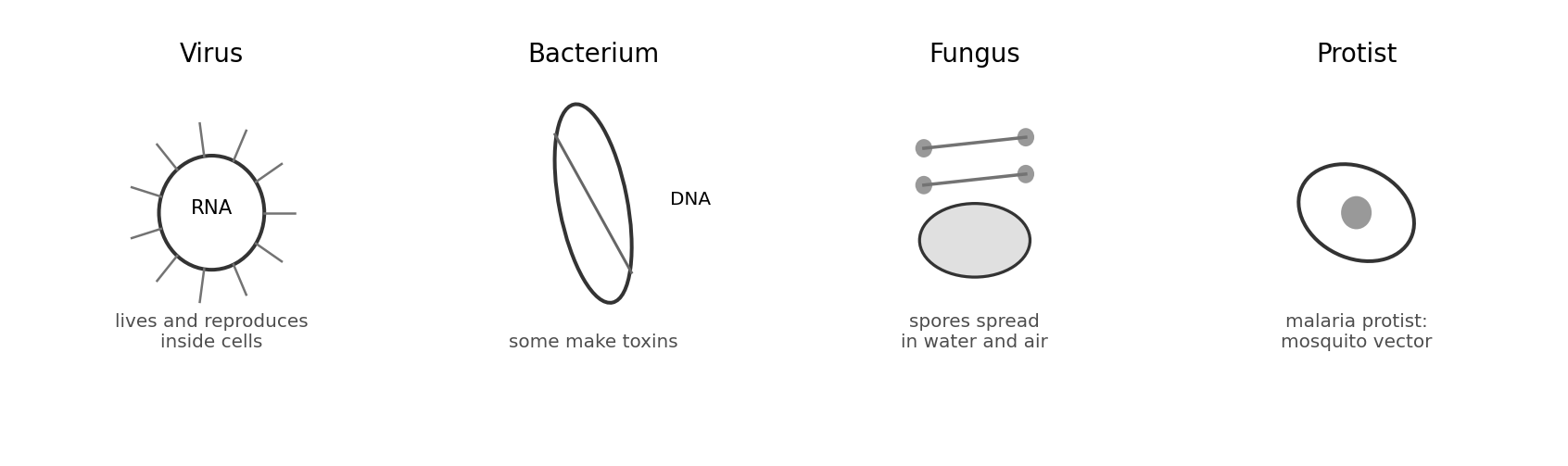
    The four pathogen types with their key features.

    Pathogens are microorganisms 病原体 causing infectious disease: viruses, bacteria, protists, fungi. They infect plants or animals and spread by direct contact, water or air. Bacteria may produce toxins 毒素 that damage tissues; viruses live and reproduce inside cells.

    Reducing spread: hygiene (hand washing), sterilising wounds, clean water, sewage treatment, using condoms, vector control (mosquito nets, draining water).

    Vocabulaire Entrainer
    English Français
    toxins/ˈtɒksɪnz/ toxines
    3.1

    Named diseases (4.3.1.2–4.3.1.5)

    Programme

    Maladies transmissibles, types de pathogènes et maladies nommées (déclarations AQA 8461 4.3.1.1-4.3.1.5).

    1. Expliquer comment les virus, bactéries, protistes et champignons se propagent chez les animaux et les plantes, et comment cette propagation est réduite.
    2. Rappeler la rougeole, le VIH, le TMV, Salmonella, la gonorrhée, la rouille noire du rosier et le paludisme avec leur type de pathogène, leur mode de propagation, leurs symptômes et leur contrôle.

    Source : Programme Cambridge International

    Disease Pathogen Dispersion Symptoms/signs Control
    measles virus droplet inhalation (sneezes, coughs) fever, red skin rash; can be fatal vaccination of young children
    HIV virus sexual contact, exchange of body fluids (shared needles) flu-like illness; attacks immune cells → late-stage AIDS antiretroviral drugs; safe sex; clean needles
    TMV (tobacco mosaic virus) virus (plants) contact between plants mosaic discolouration of leaves; reduced photosynthesis and growth resistant varieties; hygiene
    Salmonella bacterium food ingested in unhygienic conditions fever, cramps, vomiting, diarrhoea (bacteria + toxins) poultry vaccinated (UK); hygienic food prep
    gonorrhoea bacterium sexual contact thick yellow/green discharge, pain urinating antibiotics (resistance rising); condoms
    rose black spot fungus (plants) spores in water/air black spots on leaves; leaves yellow and drop removing/burning leaves; fungicide
    malaria protist mosquito vector recurrent fever; can be fatal nets; stopping mosquito breeding
    3.2

    Human defence systems and immunity (4.3.1.6–4.3.1.7)

    Programme

    Systèmes de défense humains, vaccination et médicaments (déclarations AQA 8461 4.3.1.6-4.3.1.9).

    1. Décrire les systèmes de défense non spécifiques et les trois actions des globules blancs.
    2. Expliquer la vaccination au niveau individuel et son effet sur la population.
    3. Distinguer antibiotiques et antalgiques ; expliquer pourquoi les antibiotiques ne traitent pas les virus ; décrire la résistance.
    4. Décrire les sources de découverte de médicaments et les étapes précliniques/cliniques incluant les essais en double insu.

    Source : Programme Cambridge International

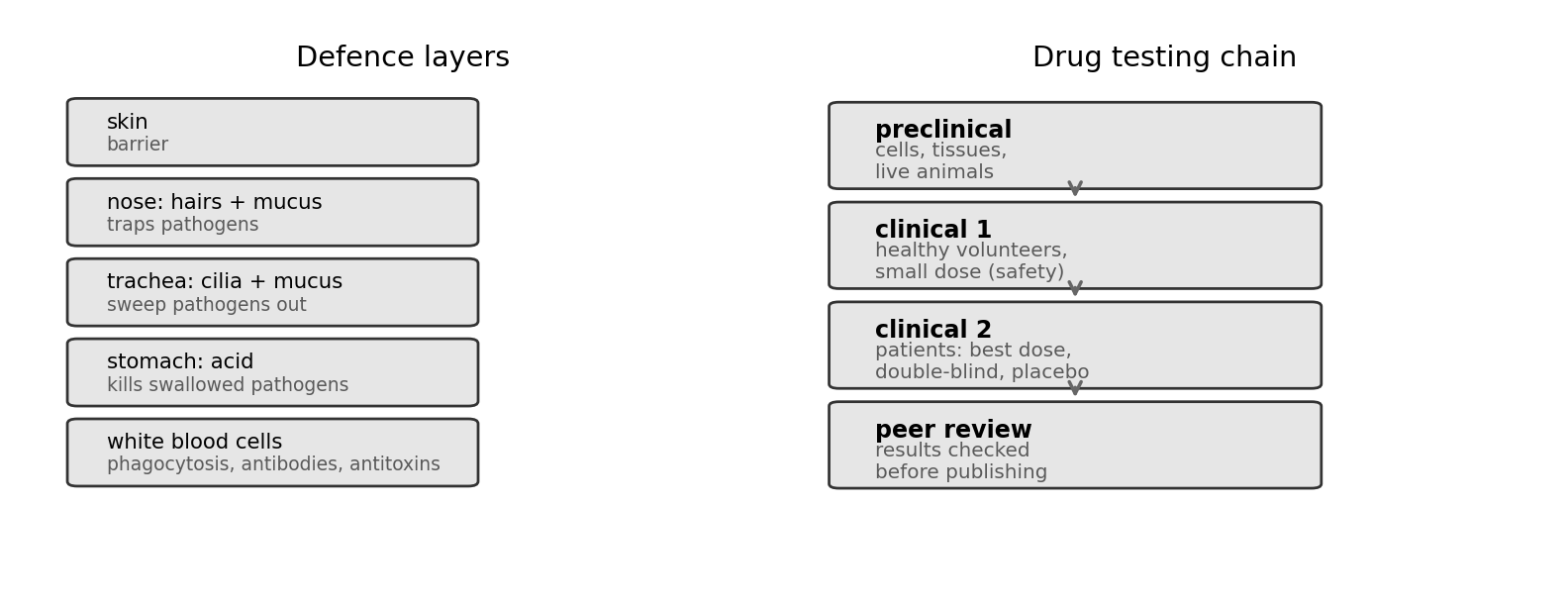
    The defence layers and the drug-testing chain.

    Non-specific defences: skin (barrier, scabbing); nose (hairs, mucus); trachea and bronchi (mucus, cilia); stomach (hydrochloric acid).

    Le immune system destroys pathogens that enter. White blood cells defend by:

    1. phagocytosis — engulfing 吞噬 pathogens;
    2. antibody production — proteins 抗体 that bind the specific antigen;
    3. antitoxin production — neutralising 抗毒素 toxins.

    Vaccination 疫苗: small quantities of dead or inactive pathogen stimulate white blood cells to make antibodies; on re-infection, memory cells respond quickly with the correct antibodies, preventing infection. Herd effect: immunising a large proportion reduces the spread for everyone. Evaluate: benefits (epidemic control, e.g. measles) vs rare side effects.

    Vocabulaire Entrainer
    English Français
    phagocytosis/ˌfæɡəsɪˈtəʊsɪs/ phagocytose
    antibody production/ˈæntɪbɒdi prəˈdʌkʃn/ production d'anticorps
    antitoxin production/ˌæntɪˈtɒksɪn prəˈdʌkʃn/ production d'antitoxines
    Vaccination/ˌvæksɪˈneɪʃn/ vaccination
    3.2

    Antibiotics, painkillers and drug development (4.3.1.8–4.3.1.9)

    Programme

    Systèmes de défense humains, vaccination et médicaments (déclarations AQA 8461 4.3.1.6-4.3.1.9).

    1. Décrire les systèmes de défense non spécifiques et les trois actions des globules blancs.
    2. Expliquer la vaccination au niveau individuel et son effet sur la population.
    3. Distinguer antibiotiques et antalgiques ; expliquer pourquoi les antibiotiques ne traitent pas les virus ; décrire la résistance.
    4. Décrire les sources de découverte de médicaments et les étapes précliniques/cliniques incluant les essais en double insu.

    Source : Programme Cambridge International

    • Antibiotiques 抗生素 (e.g. penicillin) cure bacterial disease by killing bacteria inside the body — specific antibiotics for specific bacteria. They cannot kill viruses (viruses live inside cells; killing them would damage body tissue). Résistance is a major concern — the race for new antibiotics.
    • Painkillers treat symptoms but do not kill pathogens.

    Drug development: traditionally extracted from plants/microorganisms — digitalis from foxgloves (heart), aspirin from willow, penicillin from Penicillium mould (Fleming). Most new drugs are chemically synthesised, but starting points may still be plant chemicals.

    Testing stages: preclinical (cells, tissues, live animals) → clinical trials on healthy volunteers (low dose, safety) then patients (optimum dose, effectiveness) → double-blind trials with a placebo; results peer-reviewed.

    Vocabulaire Entrainer
    English Français
    Antibiotics/ˌæntɪbaɪˈɒtɪks/ antibiotiques
    3.3

    Monoclonal antibodies (biology only, HT)

    Programme

    Anticorps monoclonaux, biologie seule et HT (déclaration AQA 8461 4.3.2).

    1. Décrire la production d'anticorps monoclonaux par hybridome.
    2. Décrire les utilisations dans le diagnostic, la mesure, la recherche et le traitement du cancer.

    Source : Programme Cambridge International

    Anticorps monoclonaux 单克隆抗体 are produced from a single clone of cells, specific to one binding site on one protein antigen. Producing them: stimulate mouse lymphocytes to make the antibody → fuse with a tumour cell to make a hybridoma 杂交瘤 — it divides AND makes the antibody → clone the hybridoma → collect and purify large amounts of one specific antibody.

    Uses: pregnancy tests; measuring hormone/chemical levels in blood; detecting pathogens; research — fluorescent antibodies locate molecules; cancer treatment — antibody bound to a radioactive/toxic substance delivers it only to cancer cells.

    Vocabulaire Entrainer
    English Français
    Monoclonal antibodies/ˈmɒnəʊklɒnl ˈæntɪbɒdiz/ anticorps monoclonaux
    hybridoma/ˌhaɪbrɪˈdəʊmə/ hybridome
    3.4

    Plant disease (biology only)

    Programme

    Maladies des plantes, biologie uniquement (AQA 8463 énoncé 4.3.3).

    1. Détecter une maladie des plantes à partir de ses signes et l'identifier par des tests manuels, en laboratoire ou par anticorps monoclonaux.
    2. Expliquer les carences en ions nitrates et magnésium.
    3. Décrire les réponses de défense physiques, chimiques et mécaniques des plantes.

    Source : Programme Cambridge International

    Detection (HT): stunted growth, spots on leaves, areas of decay, growths, malformed stems/leaves, discolouration, presence of pests.

    Identification (HT): gardening manual/website; laboratory analysis; testing kits using monoclonal antibodies.

    Named plant problems: TMV (viral), rose black spot (fungal), aphids 蚜虫 (insects).

    Ion deficiencies: too little nitrate → stunted growth (nitrate needed for amino acids/protein); magnésium deficiency → chlorosis (yellow leaves 缺绿 — magnesium needed to make chlorophyll).

    Defence responses: physical — cellulose cell walls, waxy cuticle, bark/dead layers; chemical — antibacterial chemicals, poisons; mechanical — thorns, hairs, drooping/curling leaves, mimicry.

    Vocabulaire Entrainer
    English Français
    aphids/ˈeɪfɪdz/ pucerons
    chlorosis/ˈklɔːrəʊsiz/ chlorose
    3.4

    Liste de contrôle avant de considérer ce sujet comme terminé

    • Four pathogen types; three routes of spread; two ways to reduce each named disease's spread.
    • Recite the disease table: pathogen, spread, symptoms, control.
    • Four non-specific defences; three white-blood-cell actions.
    • Vaccination mechanism + population effect; antibiotic vs painkiller; why antibiotics fail on viruses.
    • Drug sources (foxglove, willow, Penicillium) and the preclinical/clinical stages with placebo and double-blind.
    • (HT, biology) Hybridoma production sequence and four monoclonal uses.
    • (Biology) Plant disease signs, identification methods, nitrate/magnesium deficiencies, three defence classes.
  • 4

    Bioénergétique

    4.1

    Bioénergétique : photosynthèse et respiration

    Les plantes captent l'énergie du Soleil ; chaque cellule la restitue ensuite. Cette référence couvre AQA GCSE Biologie 8461, sujet 4.4 Bioénergétique.

    Comment ce sujet est abordé à l'examen :

    • Le papier 1 porte sur la Bioénergétique. RP6 : intensité lumineuse et taux de photosynthèse à l'aide de valisère.
    • Les graphiques de facteur limitant avec deux ou trois facteurs, la loi du carré inverse et l'économie des serres sont uniquement HT.
    • Les équations sont des équations motées — maîtrisez aussi leurs formes symboliques (CO₂, H₂O, O₂, C₆H₁₂O₆).
    4.1

    Photosynthèse (4.4.1.1)

    Programme

    Photosynthèse (AQA 8461 énoncés 4.4.1.1-4.4.1.2, RP6).

    1. Rédiger les équations mot et symbolique de la photosynthèse et la décrire comme endothermique.
    2. Expliquer comment l'intensité lumineuse, la concentration en CO2 et la température limitent le taux de photosynthèse, y compris l'interprétation des graphiques de facteurs limitants.
    3. (HT) Utiliser la relation inverse au carré entre l'intensité lumineuse et la distance, et les raisons économiques liées aux serres.
    4. Décrire RP6 : intensité lumineuse et taux de photosynthèse avec de l'égeria, ses contrôles et le calcul du taux.

    Source : Programme Cambridge International

    $$\text{carbon dioxide} + \text{water} \xrightarrow{\ \text{light}\ } \text{glucose} + \text{oxygen}$$
    $$6\,\text{CO}_2 + 6\,\text{H}_2\text{O} \rightarrow \text{C}_6\text{H}_{12}\text{O}_6 + 6\,\text{O}_2$$

    La photosynthèse est une réaction endothermique : l'énergie est transférée de l'environnement vers les chloroplastes par la lumière.

    4.1

    Taux de photosynthèse et facteurs limitants (4.4.1.2)

    Programme

    Photosynthèse (AQA 8461 énoncés 4.4.1.1-4.4.1.2, RP6).

    1. Rédiger les équations mot et symbolique de la photosynthèse et la décrire comme endothermique.
    2. Expliquer comment l'intensité lumineuse, la concentration en CO2 et la température limitent le taux de photosynthèse, y compris l'interprétation des graphiques de facteurs limitants.
    3. (HT) Utiliser la relation inverse au carré entre l'intensité lumineuse et la distance, et les raisons économiques liées aux serres.
    4. Décrire RP6 : intensité lumineuse et taux de photosynthèse avec de l'égeria, ses contrôles et le calcul du taux.

    Source : Programme Cambridge International

    Taux de photosynthèse en fonction d'un seul facteur limitant à la fois.
    Chaque courbe monte puis s'aplatit là où un autre facteur devient limitant.

    Le taux augmente avec : l'intensité lumineuse, la concentration en CO₂, la température (jusqu'à l'optimum enzymatique), et la quantité de chlorophylle.

    Lecture des graphiques à un seul facteur : le plateau signifie qu'un autre facteur est devenu limitant. (HT) Sur les graphiques à deux ou trois facteurs, identifiez quel facteur est limitant à chaque point.

    (HT) Loi du carré inverse : doubler la distance à la lampe réduit au quart l'intensité lumineuse :

    $$\text{light intensity} \propto \frac{1}{\text{distance}^2}$$

    (HT) Économie des serres : ajouter de la chaleur, de la lumière ou du CO₂ augmente le taux — mais chaque élément a un coût ; le producteur ajoute le facteur limitant le moins cher, jusqu'au seuil où le rendement supplémentaire ne justifie plus la dépense.

    Dispositif RP6 : valisère sous une entonnoir inversé dans un bécher, avec une lampe placée à distance mesurable.

    RP6 : potamot en eau à différentes distances de la lampe ; compter les bulles d'oxygène par minute (ou collecter le gaz) ; contrôler la température et le CO₂ (hydrogénocarbonate de sodium) ; répéter et calculer la moyenne ; taux = bulles ÷ temps.

    Exemple résolu. Bulles : 30 par minute à 10 cm ; à 20 cm, l'intensité lumineuse est un quart, donc on s'attend à environ 8 par minute (si la lumière reste limitante).

    4.1

    Utilisations du glucose (4.4.1.3)

    Programme

    Photosynthèse (AQA 8461 énoncés 4.4.1.1-4.4.1.2, RP6).

    1. Rédiger les équations mot et symbolique de la photosynthèse et la décrire comme endothermique.
    2. Expliquer comment l'intensité lumineuse, la concentration en CO2 et la température limitent le taux de photosynthèse, y compris l'interprétation des graphiques de facteurs limitants.
    3. (HT) Utiliser la relation inverse au carré entre l'intensité lumineuse et la distance, et les raisons économiques liées aux serres.
    4. Décrire RP6 : intensité lumineuse et taux de photosynthèse avec de l'égeria, ses contrôles et le calcul du taux.

    Source : Programme Cambridge International

    Le glucose produit par la photosynthèse est utilisé pour :

    • la respiration ;
    • transformé en amidon insoluble pour le stockage ;
    • graisse ou huile pour le stockage ;
    • cellulose pour les parois cellulaires ;
    • acides aminés pour les protéines — cela nécessite aussi des ions nitrate du sol.
    4.2

    Respiration (4.4.2.1)

    Programme

    Respiration et métabolisme (AQA 8461 énoncés 4.4.1.3, 4.4.2.1-4.4.2.3).

    1. Citer cinq utilisations du glucose issu de la photosynthèse.
    2. Comparer la respiration aérobie et anaérobie dans les muscles et chez la levure, avec des équations mot, et l'importance économique de la fermentation.
    3. Expliquer la réponse du corps à l'exercice et (HT) la dette d'oxygène et le rôle du foie.
    4. Définir le métabolisme et lister les réactions qu'il comprend.

    Source : Programme Cambridge International

    La respiration est une réaction exothermique se déroulant en continu dans les cellules vivantes, transférant l'énergie nécessaire à : la construction de molécules plus grandes, aux mouvements et au maintien de la chaleur corporelle.

    Aérobie Anaérobie (muscle) Anaérobie (plante/levure)
    oxygène nécessaire non nécessaire non nécessaire
    équation glucose + oxygène → CO₂ + eau glucose → acide lactique glucose → éthanol + CO₂
    énergie beaucoup plus beaucoup moins beaucoup moins

    La respiration anaérobie chez la levure est la fermentation, importante économiquement pour le pain (le CO₂ provoque la levée) et les boissons alcoolisées.

    Vocabulaire Entrainer
    English Français
    endothermic/ˌendəʊˈθɜːmɪk/ endothermique
    exothermic/eɡzəˈðɜːmɪk/ exothermique
    fermentation/fɜːmənˈteɪʃn/ fermentation
    oxygen debt/ˈɒksɪdʒn det/ dette d'oxygène
    Metabolism/məˈtæbəlɪzəm/ métabolisme
    lactic acid/ˈlæktɪk ˈæsɪd/ acide lactique
    limiting factor/ˈlɪmɪtɪŋ ˈfæktə/ facteur limitant
    4.2

    Réponse à l'exercice (4.4.2.2)

    Programme

    Respiration et métabolisme (AQA 8461 énoncés 4.4.1.3, 4.4.2.1-4.4.2.3).

    1. Citer cinq utilisations du glucose issu de la photosynthèse.
    2. Comparer la respiration aérobie et anaérobie dans les muscles et chez la levure, avec des équations mot, et l'importance économique de la fermentation.
    3. Expliquer la réponse du corps à l'exercice et (HT) la dette d'oxygène et le rôle du foie.
    4. Définir le métabolisme et lister les réactions qu'il comprend.

    Source : Programme Cambridge International

    Pendant l'exercice, la fréquence cardiaque, la fréquence respiratoire et le volume d'air respiré augmentent pour fournir davantage de sang oxygéné aux muscles. Si l'apport en oxygène est insuffisant, les muscles passent à la respiration anaérobie : l'oxydation incomplète du glucose accumule de l'acide lactique → fatigue ; une dette d'oxygène s'accumule.

    (HT) Le sang transporte l'acide lactique vers le foie, qui le reconvertit en glucose. La dette d'oxygène correspond à l'oxygène supplémentaire nécessaire après l'exercice pour réagir avec et éliminer l'acide lactique accumulé.

    4.2

    Métabolisme (4.4.2.3)

    Programme

    Respiration et métabolisme (AQA 8461 énoncés 4.4.1.3, 4.4.2.1-4.4.2.3).

    1. Citer cinq utilisations du glucose issu de la photosynthèse.
    2. Comparer la respiration aérobie et anaérobie dans les muscles et chez la levure, avec des équations mot, et l'importance économique de la fermentation.
    3. Expliquer la réponse du corps à l'exercice et (HT) la dette d'oxygène et le rôle du foie.
    4. Définir le métabolisme et lister les réactions qu'il comprend.

    Source : Programme Cambridge International

    Métabolisme est l'ensemble des réactions dans une cellule ou un organisme ; la respiration les alimente. Il comprend :

    • glucose → amidon, glycogène, cellulose ;
    • glycérol + 3 acides gras → lipides ;
    • glucose + ions nitrates → acides aminés → protéines ;
    • la respiration ;
    • dégradation des protéines excédentaires → urée pour l'excrétion.
    4.2

    Liste de contrôle avant de considérer ce sujet comme acquis

    • Rédigez les équations mot et symbolique de la photosynthèse ; précisez qu'elle est endothermique + lumière→chloroplastes.
    • Expliquez les quatre facteurs de vitesse ; lisez les graphiques d'un seul facteur s'infléchissant ; (HT) loi du carré inverse et économie des serres.
    • Décrivez RP6 avec ses contrôles et le calcul du taux.
    • Énumérez cinq usages du glucose (avec nitrate pour les protéines).
    • Comparez les équation aérobie avec les deux équations anaérobie ; nommez les deux produits et usages de la fermentation.
    • Exercice : trois augmentations ; acide lactique et dette en oxygène ; (HT) rôle du foie.
    • Définissez le métabolisme avec ses cinq volets.
  • 5

    Homéostasie et réponse

    5.1

    Homéostasie et réponse : maintenir des conditions stables

    • L'homéostasie est la régulation des conditions internes d'une cellule ou d'un organisme, afin de maintenir des conditions optimales pour l'action enzymatique et toutes les fonctions cellulaires, en réponse aux variations internes et externes.
    • L'organisme contrôle la concentration de glucose sanguin, la température corporelle et les niveaux d'eau.
    • Tout système de contrôle automatique possède : des récepteurs (détectent les stimuli), des centres de coordination (cerveau, moelle épinière, pancréas — reçoivent et traitent l'information) et des effecteurs (muscles ou glandes — provoquent la réponse qui rétablit les niveaux optimaux).
    • Les réponses nerveuses sont rapides et de courte durée ; les réponses hormonales sont plus lentes mais agissent plus longtemps.
    5.1

    Homéostasie et système nerveux (4.5.1–4.5.2.1, RP7)

    Programme

    Homeostasis and the nervous system (AQA 8461 statements 4.5.1-4.5.2.1, RP7).

    1. Define homeostasis and name the three conditions the body controls.
    2. Describe receptors, coordination centres and effectors, and the stimulus-receptor-coordinator-effector-response pathway.
    3. Explain the reflex arc, including sensory neurone, synapse, relay neurone and motor neurone, and why reflexes are automatic and rapid.
    4. Describe RP7: the effect of a factor on human reaction time, with controls and data handling.

    Source : Programme Cambridge International

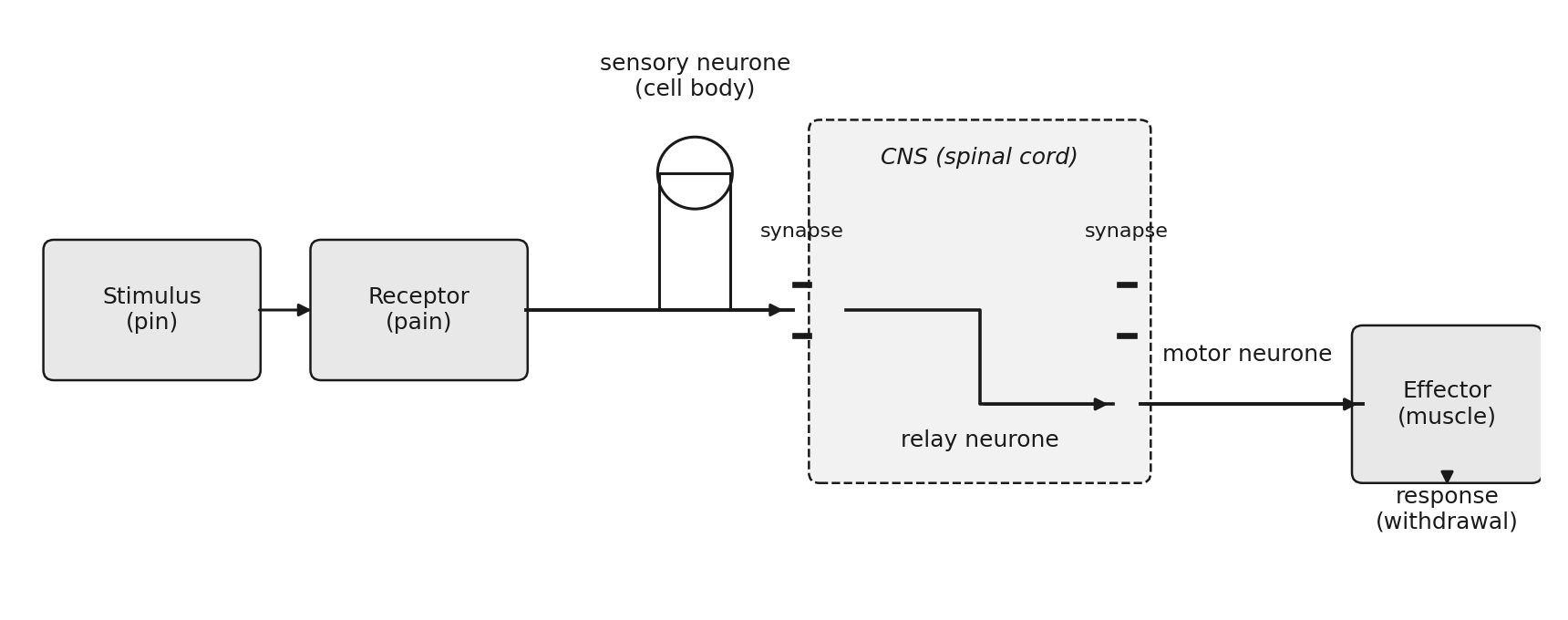
    Le trajet : stimulus → récepteur → coordinateur (SNC : cerveau + moelle épinière) → effecteur (contraction musculaire / sécrétion glandulaire) → réponse.

    L'information circule le long de cellules appelées neurones sous forme d'impulsions électriques. Le SNC coordonne la réponse des effecteurs.

    L'arc réflexe : stimulus vers récepteur, neurone sensoriel avec corps cellulaire, neurone intermédiaire dans le SNC, neurone moteur vers effecteur, avec synapses entre neurones.

    L'arc réflexe — protection automatique et rapide qui ne fait pas intervenir la partie consciente du cerveau :

    stimulus → récepteur → neurone sensoriel → synapse → neurone intermédiaire (dans le SNC) → synapse → neurone moteur → effecteur → réponse.

    À une synapse, l'influx électrique arrive à l'extrémité d'un neurone et un produit chimique est libéré ; il diffuse à travers l'espace et déclenche un influx électrique dans le neurone suivant.

    RP7 — Temps de réaction : concevoir et mener une enquête sur l'effet d'un facteur (ex. caféine) sur le temps de réaction humain. Lâcher une règle entre les doigts et le pouce d'un partenaire ; mesurer la distance de rattrapage ; convertir en temps (ou utiliser un test informatique) ; contrôler les variables (même main, même hauteur) ; répéter et calculer une moyenne. Interpréter des données de temps de réaction à partir de graphiques et de tableaux.

    Vocabulaire Entrainer
    English Français
    Homeostasis/ˌhəʊmiːəˈstɑːsiz/ homéostasie
    neurone/ˈnjuːrəʊn/ neurone
    synapse/ˈsɪnæps/ synapse
    retina/ˈretɪnə/ rétine
    5.2

    Le cerveau, l'œil et la température — biologie uniquement (4.5.2.2–4.5.2.4)

    Programme

    Le cerveau, l'œil et la température corporelle — biologie uniquement (déclarations AQA 8461 énoncés 4.5.2.2-4.5.2.4).

    1. Identifier le cortex cérébral, le cervelet et la moelle allongée avec leurs fonctions, et (HT) les difficultés d'investigation et de traitement du cerveau.
    2. Relier les structures oculaires aux fonctions et expliquer l'accommodation pour les objets proches et éloignés.
    3. Expliquer la myopie et l'hypermétropie ainsi que leur correction par des lentilles et de nouvelles technologies.
    4. Expliquer comment la vasodilatation, la transpiration, la vasoconstriction et les frissons régulent la température corporelle (HT en contexte).

    Source : Programme Cambridge International

    Le cerveau (HT supplémentaire)

    Identifier sur un schéma : cortex cérébral (conscience, mémoire, langage), cervelet (équilibre, coordination des mouvements), moelle allongée (rythme cardiaque, respiration).

    (HT) Difficultés d'étude et de traitement du cerveau : il est complexe et fragile, facilement endommagé, et difficile d'accès. Méthodes de cartographie : étude de patients avec lésions cérébrales, stimulation électrique de régions, et imagerie par résonance magnétique. Évaluer les avantages et les risques des interventions cérébrales.

    L'œil

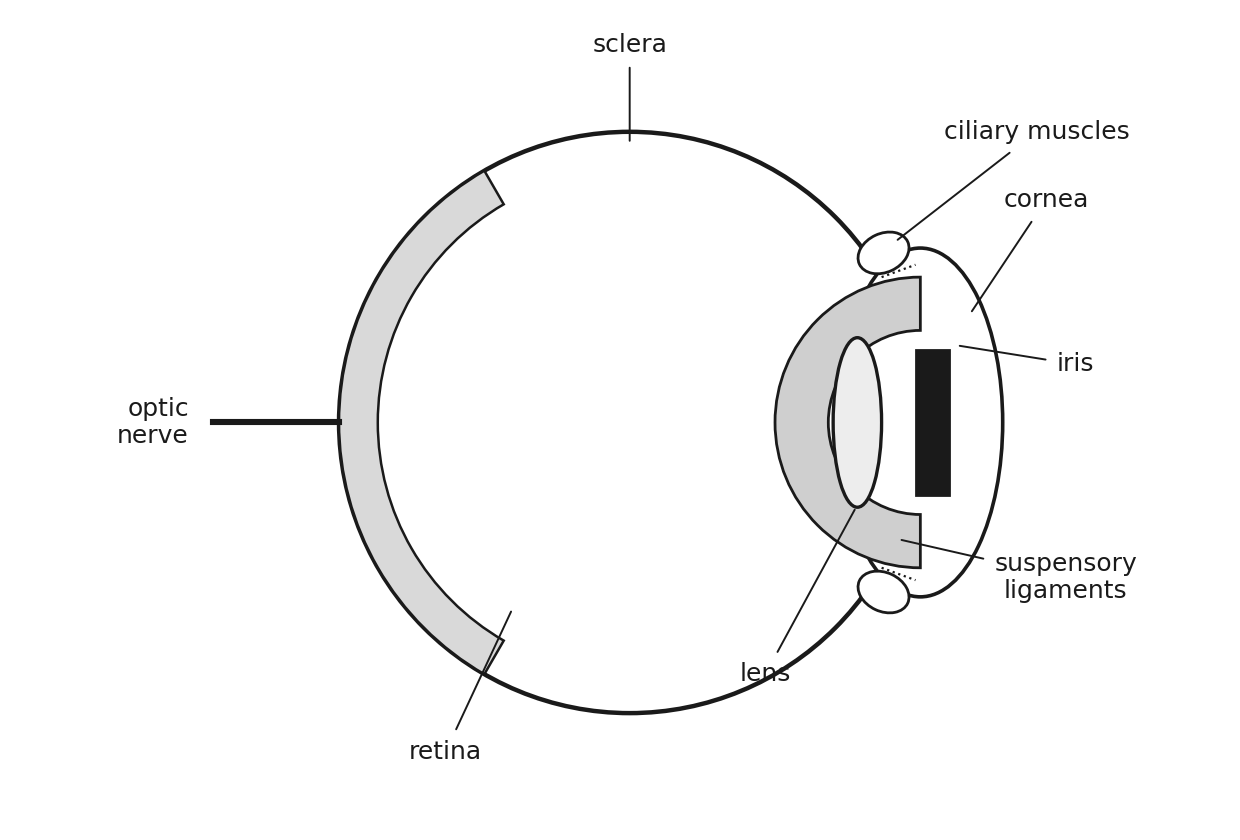
    Coupe verticale de l'œil : sclère, cornée, iris, cristallin, muscles ciliaires, ligaments suspensifs, rétine et nerf optique.

    Identifier et expliquer : rétine (cellules réceptrices sensibles à l'intensité lumineuse et aux couleurs), nerf optique (transporte les influx de la rétine vers le cerveau), sclère (couche externe résistante), cornée (réfracte la lumière), iris (muscles colorés contrôlant la taille de la pupille — adaptation réflexe à la faible/lumière vive), muscles ciliaires et ligaments suspensifs (contrôlent la forme du cristallin).

    Accommodation — modification de la forme du cristallin pour la mise au point :

    objet proche objet lointain
    muscles ciliaires se contractent se relâchent
    ligaments suspensifs se relâchent tendus
    cristallin plus épais, forte réfraction mince, faible réfraction

    Défauts visuels : myopie (vue courte — les objets lointains se focalisent devant la rétine ; corrigée par une lentille convergente), hypermétropie (vue longue — les objets proches se focalisent derrière la rétine ; lentille divergente). Traitements : verres correcteurs, lentilles de contact, chirurgie laser pour remodeler la cornée, remplacement du cristallin.

    Contrôle de la température corporelle

    Le centre thermorégulateur du cerveau possède des récepteurs sensibles à la température sanguine ; les récepteurs cutanés lui envoient des influx.

    • Trop chaud : les vaisseaux sanguins se dilatent (vasodilatation) — plus de sang près de la surface transfère de l'énergie vers l'environnement ; sueur produite — l'évaporation de la sueur transporte de l'énergie loin du corps.
    • Trop froid : les vaisseaux sanguins se contractent (vasoconstriction) ; la transpiration s'arrête ; les muscles squelettiques se contractent (frissons — la respiration transfère de l'énergie pour réchauffer le sang).

    (HT) Expliquez en contexte comment chaque mécanisme abaisse ou élève la température pour la ramener à son optimum.

    Vocabulaire Entrainer
    English Français
    accommodation/əˌkɒməˈdeɪʃn/ accommodation visuelle
    myopia/maɪˈəʊpɪə/ myopie
    hyperopia/ˌhaɪpəˈrəʊpɪə/ hypermétropie
    vasodilation/ˌvæsədɪˈleɪʃn/ vasodilatation
    vasoconstriction/ˌvæsəkənˈstrɪkʃn/ vasoconstriction
    5.3

    Coordination hormonale chez l'humain (4.5.3)

    Programme

    Coordination hormonale chez l'humain (déclarations AQA 8461 énoncé 4.5.3).

    1. Décrire le système endocrinien : glandes, hormones, organes cibles et les six glandes nommées.
    2. Expliquer le contrôle de la glycémie par l'insuline, (HT) le glucagon et la rétroaction négative, et comparer le diabète de Type 1 et de Type 2.
    3. (Bio) Décrire l'équilibre hydrique et azoté : reins, filtration et réabsorption sélective, (HT) l'ADH, et dialyse contre greffe.
    4. (HT) Expliquer les interactions FSH, LH, œstrogène et progestérone dans le cycle menstruel, les méthodes contraceptives et la fécondation in vitro.
    5. (HT) Expliquer l'adrénaline et la thyroxine, avec rétroaction négative.

    Source : Programme Cambridge International

    Le système endocrinien est formé par des glandes qui sécrètent des hormones directement dans le sang ; le sang les transporte vers des organes cibles. Plus lent que les nerfs, mais plus durable. Identifiez sur un schéma corporel : glande pituitaire (« glande maîtresse » du cerveau), pancréas, thyroïde, glande surrénale, ovaire, testicules.

    La glycémie est surveillée et régulée par le pancréas :

    • Trop élevée → le pancréas sécrète l'insuline → le glucose passe du sang dans les cellules ; dans les cellules hépatiques et musculaires, l'excès de glucose est converti en glycogène pour être stocké.
    • (HT) Trop basse → le pancréas sécrète le glucagon → le glycogène est reconverti en glucose, libéré dans le sang. Le couple insuline-glucagon constitue une boucle de rétroaction négative.

    Diabète : Type 1 — le pancréas ne produit pas assez d'insuline ; glycémie non contrôlée traitée par des injections d'insuline. Type 2 — les cellules de l'organisme ne répondent plus à l'insuline ; traité par un régime alimentaire contrôlé en glucides et un programme d'exercice physique ; l'obésité est un facteur de risque. Interprétez les graphiques de glycémie avec et sans diabète.

    Équilibre hydrique et azoté — biologie uniquement

    L'eau quitte l'organisme par les poumons (expiration) et la peau (transpiration, avec des ions et de l'urée) — sans contrôle. L'excès d'eau, d'ions et d'urée est éliminé par les reins sous forme d'urine. Les cellules qui perdent ou gagnent trop d'eau par osmose fonctionnent mal. (HT) Les acides aminés en excès provenant de l'alimentation sont déaminés dans le foie : l'ammoniac (toxique) → urée pour une excrétion sûre.

    Les reins filtrent le sang et réabsorbent sélectivement le glucose, certains ions et l'eau. (HT) Si le sang est trop concentré, la glande pituitaire libère l'ADH, ce qui rend les tubules rénaux plus perméables, permettant ainsi une réabsorption accrue de l'eau — nouvelle rétroaction négative.

    Insuffisance rénale : traitée par une greffe ou une dialyse — le sang circule entre des membranes semi-perméables dans un liquide dialysant aux concentrations appropriées en eau/ions, afin que les déchets diffusent hors du sang tout en retenant le glucose et les substances utiles ; évaluez le dispositif mécanique face à la greffe.

    Hormones de la reproduction humaine

    Œstrogène (ovaire) — hormone principale féminine ; à la puberté, les ovocytes mûrissent et l'un d'eux est libéré tous les 28 jours environ (ovulation). Testostérone (testicules) — stimule la production de spermatozoïdes.

    (HT) Le cycle menstruel :

    Hormone Source Rôle
    FSH glande pituitaire provoque la maturation d'un ovocyte dans l'ovaire (dans le follicule)
    LH glande pituitaire stimule la libération de l'ovocyte (ovulation)
    Œstrogène ovaire (follicule) entretient et épaissit la muqueuse utérine ; stimule le pic de LH
    Progestérone ovaire (corps jaune) maintient l'endomètre ; inhibe FSH et LH
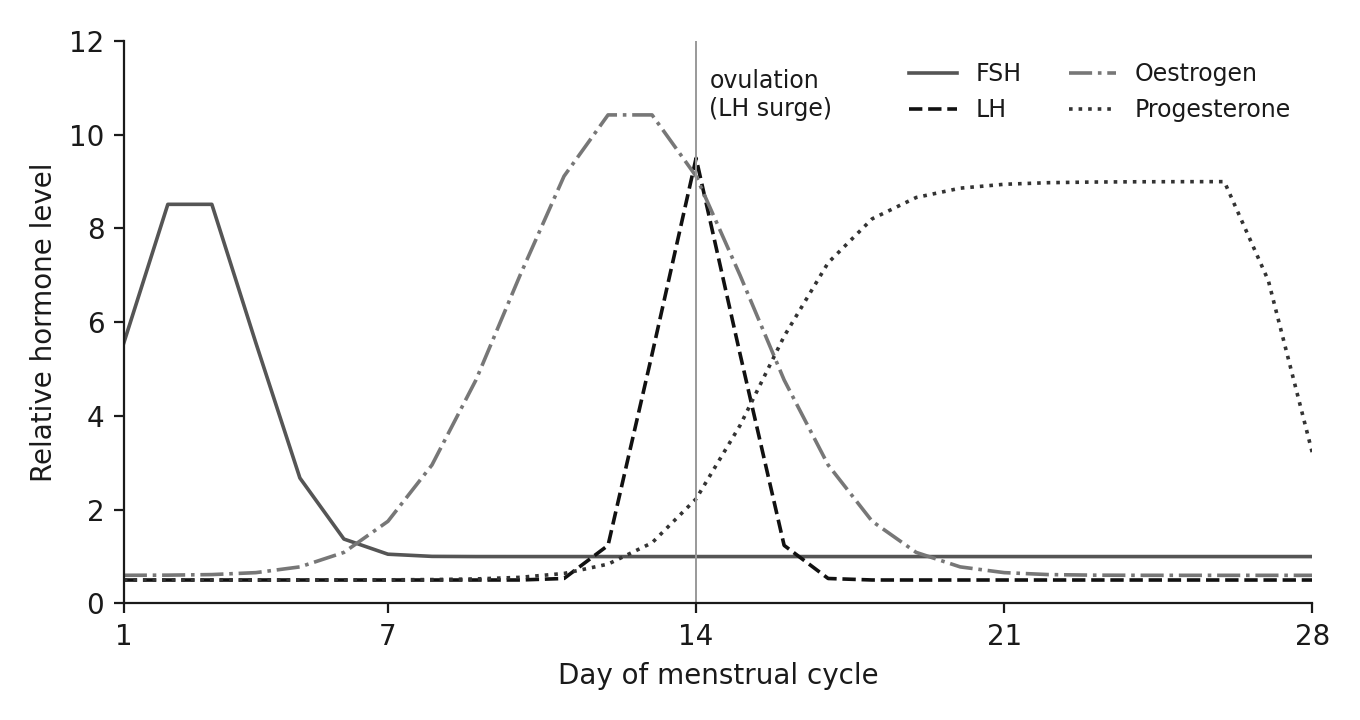
    Niveaux hormonaux au cours du cycle menstruel de 28 jours : FSH au début, augmentation des œstrogènes, pic de LH au jour 14 et ovulation, puis progestérone.

    (HT) Interpréter les graphiques des niveaux hormonaux tout au long du cycle : FSH initie la croissance folliculaire → les œstrogènes augmentent → le pic de LH déclenche l'ovulation (vers le jour 14) → la progestérone épaissit l'endomètre jusqu'à sa chute, ce qui relance le cycle.

    Contraception — évaluer les méthodes hormonales et non hormonales : pilules contraceptives (inhibent FSH pour empêcher la maturation des ovocytes), injections/implants/transdermiques à libération prolongée de progestérone, méthodes barrières (condoms, diaphragme), dispositifs intra-utérins, spermicides, abstinence lors de la présence d'un ovocyte dans la trompe, stérilisation.

    Infertilité (HT) : « médicaments fécondants » (FSH + LH) stimulent la maturation des ovocytes. FIV : FSH et LH stimulent plusieurs ovocytes → ovocytes prélevés et fécondés avec des spermatozoïdes en laboratoire → embryons se développent en petits amas cellulaires → un ou deux embryons transférés dans l'utérus. Évaluation : stress émotionnel/physique, taux de succès faibles, risque de grossesses multiples.

    Rétroaction négative (HT) : adrénaline (glandes surrénales, peur/stress) augmente la fréquence cardiaque et la livraison d'oxygène et de glucose au cerveau et aux muscles — réponse « combat ou fuite ». Thyroxyne (thyroïde) stimule le taux métabolique basal et est importante pour la croissance et le développement ; son niveau est régulé par rétroaction négative. Interpréter les schémas simples de rétroaction négative.

    Vocabulaire Entrainer
    English Français
    hormone/ˈhɔːməʊn/ hormone
    insulin/ˈɪnsjuːlɪn/ insuline
    glycogen/ˈɡlaɪkədʒn/ glycogène
    glucagon/ˈɡluːkæɡən/ glucagon
    negative feedback/ˈneɡətɪv ˈfiːdbæk/ rétroaction négative
    urea/juːˈrɪə/ urée
    ADH/ˌeɪ diː ˈeɪtʃ/ hormone antidiurétique (HAD)
    oestrogen/ˈiːstrədʒn/ œstrogène
    ovulation/ˌɒvjʊˈleɪʃn/ ovulation
    testosterone/teˈstɒstərəʊn/ testostérone
    5.4

    Hormones végétales — biologie uniquement (4.5.4)

    Programme

    Hormones végétales — biologie uniquement (déclarations AQA 8461 énoncé 4.5.4, RP8).

    1. Expliquer le phototropisme et le géotropisme par une distribution inégale d'auxines dans les tiges et les racines.
    2. Décrire RP8 : l'effet de la lumière ou de la gravité sur les plantules récemment germées, avec mesures de longueur et dessins légendés.
    3. (HT) Décrire les utilisations des auxines, gibbérellines et éthène en agriculture, horticulture et industrie alimentaire.

    Source : Programme Cambridge International

    Les plantes produisent des hormones pour coordonner et contrôler la croissance ainsi que les réponses à la lumière (phototropisme) et à la gravité (gravitropisme/geotropisme). Une distribution inégale d'auxine provoque des taux de croissance inégaux chez les racines et les tiges — les tiges se courbent vers la lumière ; les racines poussent vers le bas.

    RP8 : explorer l'effet de la lumière ou de la gravité sur des plantules nouvellement germées — enregistrer sous forme de mesures de longueur et de dessins biologiques légendés soignés.

    (HT) Les gibbérellines initient la germination des graines ; l'éthylène contrôle la division cellulaire et la maturation des fruits.

    (HT) Utilisations : auxines comme herbicides, poudres favorisant l'enracinement et pour promouvoir la croissance en culture tissulaire ; éthylène pour contrôler la maturation lors du stockage et du transport ; gibbérellines pour lever la dormance des graines, promouvoir la floraison et augmenter la taille des fruits. Considérer l'impact des herbicides sur la biodiversité.

    Vocabulaire Entrainer
    English Français
    auxin/ˈɔːksɪn/ auxine
    phototropism/ˌfəʊtəʊˈtrəʊpɪzəm/ phototropisme
    gravitropism/ˈɡrævɪtrəʊpɪzəm/ gravitropisme
    sweat/swet/ sueur
    5.4

    Liste de contrôle avant de considérer ce sujet comme acquis

    • Définir l'homéostasie ; récepteur–centre de coordination–effecteur dans cet ordre ; arc réflexe dessiné avec synapse.
    • Pièces de l'œil et tableau de l'accommodation par cœur ; myopie vs hypermétropie avec corrections.
    • Température : vasodilatation/sudation vs vasoconstriction/frissons, en contexte (HT).
    • Insuline et (HT) glucagon avec rétroaction négative ; traitements Type 1 vs Type 2.
    • (Bio) filtration rénale + réabsorption sélective ; (HT) AHD ; dialyse vs greffe.
    • (HT) Interactions FSH–œstrogènes–LH–progestérone et graphique ; liste des contraceptifs ; étapes de la FIV ; adrénaline et thyroxyne.
    • (Bio) tropismes avec auxine ; RP8 ; (HT) les trois utilisations hormonales.
  • 6

    Hérédité, variation et évolution

    6.1

    Hérédité, variation et évolution : transmission

    • Sexual reproduction mixes genetic information; asexual reproduction clones it. Meiosis halves chromosomes for gametes; fertilisation restores them.
    • DNA → genes → alleles → phenotype: the Punnett square turns this into probabilities.
    • Natural selection changes inherited characteristics across generations. Selective breeding, genetic engineering and cloning (biology only) use different mechanisms. Fossils and resistant bacteria provide evolutionary evidence; classification uses evidence of relationships.
    6.1

    Reproduction, ADN et génomes (4.6.1.1–4.6.1.5)

    Programme

    Reproduction, ADN et génomes (déclarations AQA 8461 énoncés 4.6.1.1-4.6.1.5).

    1. Comparer la reproduction sexuée et asexuée, avec les organismes nommés utilisant les deux.
    2. Expliquer comment la méiose réduit de moitié le nombre de chromosomes et la fécondation le restaure, et tracer le développement embryonnaire.
    3. Décrire l'ADN, les gènes et le génome, et discuter de l'importance du génome humain.
    4. (Bio) Décrire la structure nucléotidique de l'ADN et le code des bases ; (HT) synthèse des protéines et effet des mutations.

    Source : Programme Cambridge International

    Reproduction sexuée — fusion of male and female gametes (sperm + egg in animals; pollen + egg in flowering plants). Meiosis forms gametes; mixing of genetic information gives variety in offspring. Reproduction asexuée — one parent, no fusion, mitosis only: genetically identical offspring (clones 克隆).

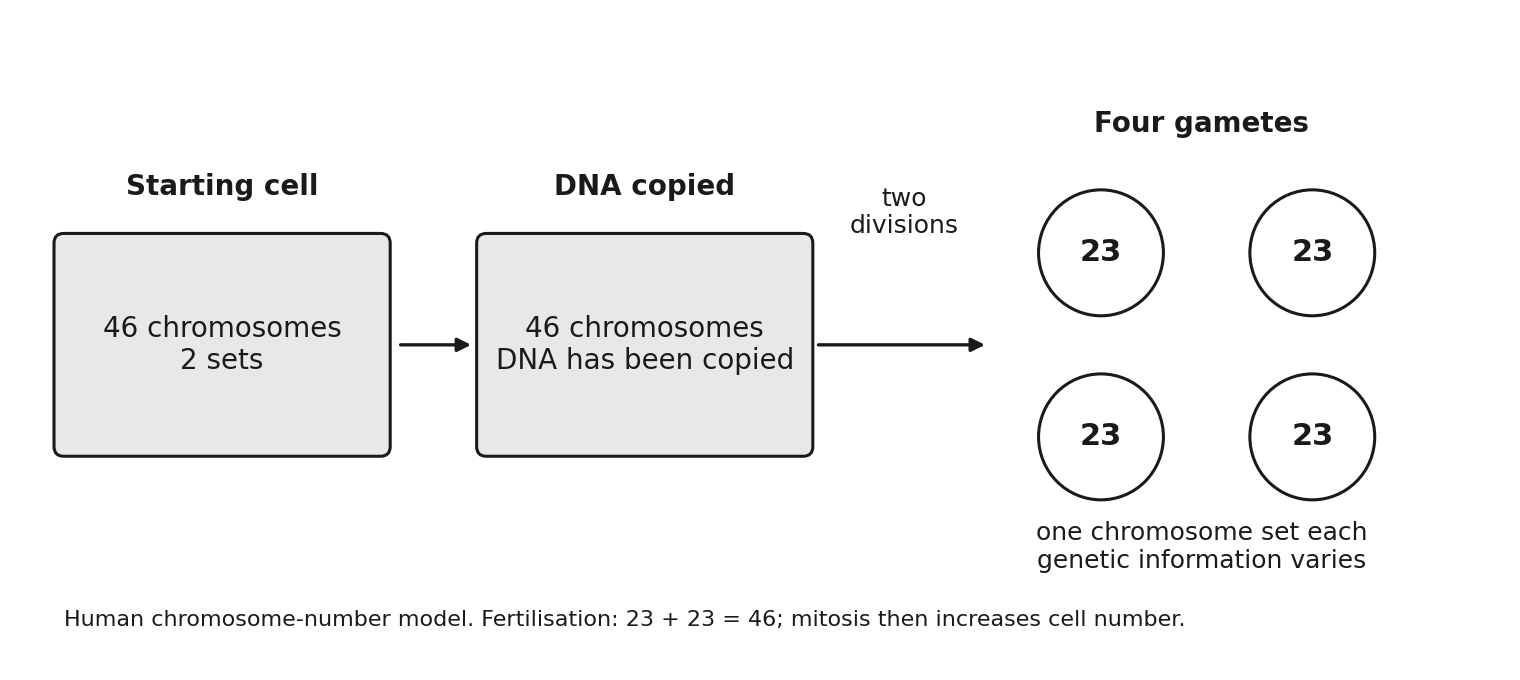
    Meiosis: one parent cell's chromosomes are copied, then two divisions give four genetically different gametes, each with a single set of chromosomes.

    Méiose 减数分裂: in reproductive organs, copies of the genetic information are made first, then the cell divides deux fois to form four gametes, each with a single set of chromosomes — all genetically different. Fécondation restores the normal number; the new cell divides by mitosis and cells differentiate as the embryo develops.

    (Bio) Sexual vs asexual: sexual gives variation — a survival advantage if the environment changes, and the variation selective breeding uses; asexual needs no mate (time and energy efficient), is faster, and produces many identical offspring when conditions are favourable. Malarial parasites: asexual in the human host, sexual in the mosquito; many fungi: asexual spores + sexual; strawberry plants: sexual seeds + asexual runners; daffodils: bulb division.

    DNA and the genome: DNA is a polymer of two strands forming a double helix, held in the nucleus as chromosomes. A gene 基因 is a small section of DNA that codes for a sequence of amino acids → a specific protein. The genome 基因组 is the entire genetic material of the organism. Importance of the human genome: searching for genes linked to disease; understanding and treating inherited disorders; tracing human migration patterns from the past.

    (Bio) DNA structure: a polymer of four different nucleotides 核苷酸 — common sugar + phosphate group + one of four bases — A 腺嘌呤, C 胞嘧啶, G 鸟嘌呤, T 胸腺嘧啶; alternating sugar–phosphate backbone; a sequence of three bases codes for one amino acid, and the base order controls the amino-acid order of the protein.

    (HT Bio) Protein synthesis: on ribosomes, from a template; carrier molecules bring specific amino acids in the correct order; the chain folds into a unique shape that lets the protein work as an enzyme, hormone or structural protein (e.g. collagen). In complementary strands C pairs with G, T with A. Mutations change the base sequence: a mutation may leave the protein unchanged, alter it slightly, or change its shape so an enzyme no longer fits its substrate or a structural protein loses strength. Variants in non-coding DNA can switch genes on and off, changing how genes are expressed.

    Apply the reproduction and DNA knowledge

    Try first — strawberries. Seeds form after fertilisation; runners form without gamete fusion. Identify the two routes and explain which may help a population survive a new disease.

    Worked reasoning. Seeds result from sexual reproduction: meiosis makes gametes and fertilisation mixes genetic information. Variation means some offspring may resist the disease. Runners form by mitosis from one parent: clones, apart from mutation. Asexual reproduction needs no mate and is fast in favourable conditions; neither route guarantees survival.

    Try first — chromosome number. A human cell has 46 chromosomes before meiosis. Predict the number of gametes, their chromosome number, the number after fertilisation and the division growing the embryo.

    Worked reasoning. DNA is copied before two divisions form four gametes, each with 23 chromosomes (one set). DNA copying does not change the count to 92 chromosomes at that point. Fertilisation combines 23 + 23 = 46; mitosis increases embryo cell number and cells differentiate. The diagram models chromosome numbers, not the stages of meiosis.

    Try first — scale and code. Distinguish a gene, chromosome and genome. (HT Bio) Write the bases complementary to A C G T and explain whether a mutation must stop an enzyme working.

    Worked reasoning. A gene is a DNA section coding an amino-acid sequence for a protein; a chromosome contains a long DNA molecule and many genes; a genome is all the organism’s genetic material. Complementary bases are T G C A. At ribosomes, a template and carrier molecules determine the amino-acid order; the chain folds. A mutation may leave the protein unchanged or change its shape and function. Non-coding variants can change whether genes are expressed.

    Vocabulaire Entrainer
    English Français
    meiosis/meɪˈəʊsɪs/ méiose
    clone/kləʊn/ clone
    gene/dʒiːn/ gène
    genome/ˈdʒiːnəʊm/ génome
    nucleotide/ˈnjuːklɪɒtaɪd/ nucléotide
    6.2

    Hérédité génétique, troubles et détermination du sexe (4.6.1.6–4.6.1.8)

    Programme

    Hérédité génétique, troubles et détermination du sexe (énoncés AQA 8461 4.6.1.6-4.6.1.8).

    1. Définir gamète, chromosome, gène, allèle, dominant, récessif, homozygote, hétérozygote, génotype et phénotype.
    2. Remplir et interpréter les carrés de Punnett et les arbres généalogiques, avec les ratios et probabilités.
    3. Expliquer l'hérédité de la polydactylie et de la mucoviscidose et juger des questions relatives au dépistage embryonnaire.
    4. Déterminer le sexe avec le croisement XX/XY, y compris les ratios.

    Source : Programme Cambridge International

    Learn the terms: gamete 配子 (sex cell), chromosome 染色体 (DNA structure), gene (section coding a protein), allele 等位基因 (a form of a gene), dominante 显性 (expressed with one copy), récessif 隐性 (expressed only with two), homozygous 纯合 (two same alleles), heterozygous 杂合 (two different), genotype 基因型 (alleles present), phenotype 表现型 (characteristics expressed).

    Single-gene examples: fur colour in mice; red-green colour blindness. Most characteristics result from multiple genes interacting.

    Punnett squares and crosses: complete a Punnett square, extract ratios (e.g. 3:1, 1:1) and probabilities from genetic crosses and family trees. (HT) Construct a cross from parent genotypes and predict outcomes with probability.

    Inherited disorders: polydactyly 多指症 (extra fingers or toes) — dominante allele; cystic fibrosis 囊性纤维化 (a disorder of cell membranes) — récessif allele. Make informed judgements about the economic, social and ethical issues of embryo screening.

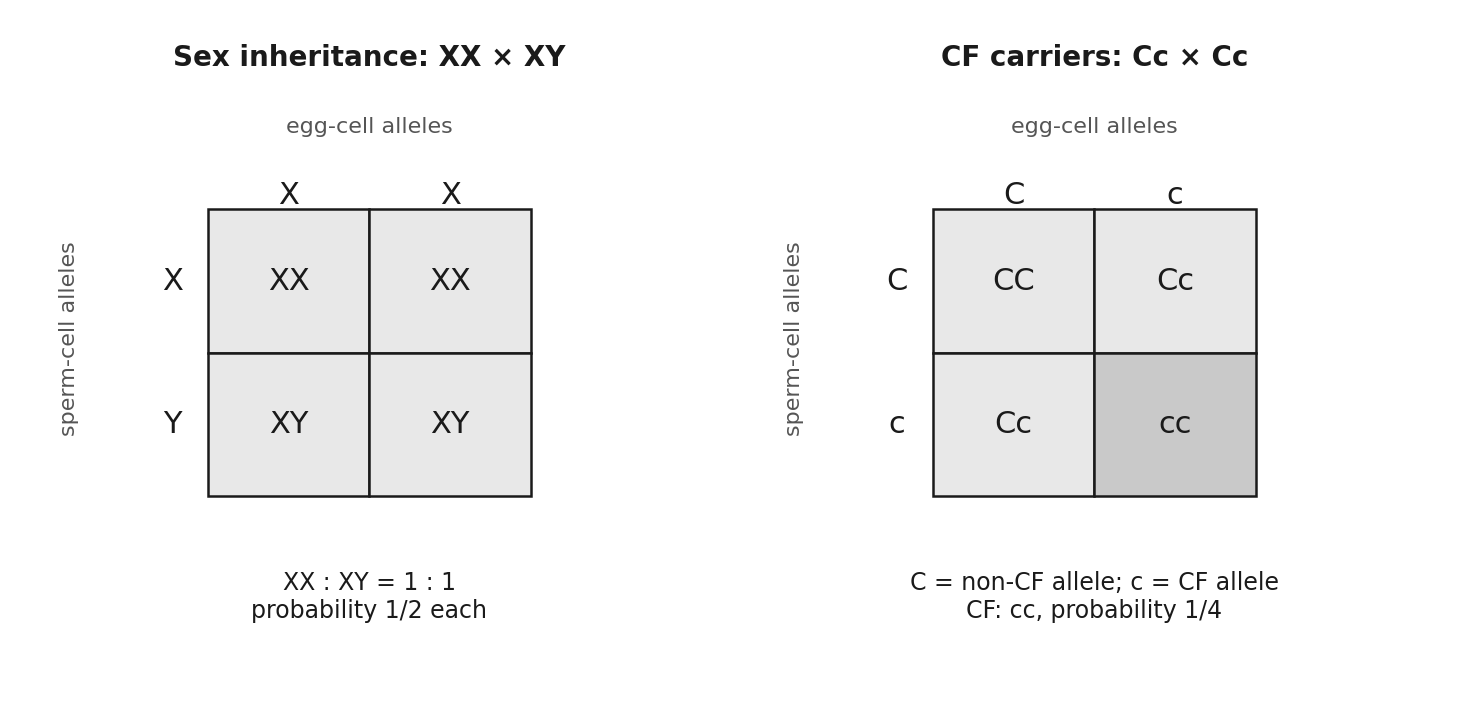
    Left: the XX × XY sex cross giving a 1:1 ratio. Right: two cystic-fibrosis carriers (Cc × Cc), with a 1/4 probability of cc.

    Sex determination: body cells have 23 pairs of chromosomes; 22 pairs control characteristics, one pair carries the sex genes — female XX, male XY. A sex cross (X×X, X×Y) gives a 1:1 ratio, 50 % chance each.

    From terms to family inference and probabilities

    Try first — terminology. D causes dominant polydactyly; d does not. Classify Dd and predict its phenotype and gamete alleles.

    Worked reasoning. Dd is heterozygous (two different alleles); DD and dd are homozygous. Genotype means the alleles present; phenotype means the characteristics expressed. Dd is affected because one D is expressed. “Dominant” does not mean stronger or more common. Gametes contain D or d, not Dd.

    Guided family inference — adapted from AQA June 2024 Paper 2H Q06.2. An affected father and unaffected mother have an unaffected son. Deduce the father’s genotype before reading the answer.

    Worked reasoning. The mother and son are dd. The father passed d to his son, but must also carry D because he is affected. Therefore he is Dd. The child’s genotype supplies evidence that the father’s phenotype alone cannot provide.

    Construct a cross (HT). Two unaffected CF carriers are Cc and Cc. Each produces gametes C or c. Combining them gives CC, Cc, Cc, cc: probability of CF = 1/4; probability of being a carrier = 1/2. Carriers do not have CF in this recessive model. The separate XX × XY cross gives XX, XX, XY, XY: probability 1/2 each in the GCSE sex-determination model.

    Exam transfer — adapted from AQA June 2024 Paper 2H Q06.3. An affected mother Dd and unaffected father dd have three unaffected sons. Construct a cross and predict whether the fourth child will be affected.

    Worked reasoning. Egg alleles D/d combine with sperm alleles d/d to give Dd, dd, Dd, dd. Two of four equally likely combinations are affected: probability = 2/4 = 1/2. Earlier births do not change this probability. The four boxes describe possible combinations, not four promised children.

    Evaluate — teacher-written screening scenario. Screening can identify embryos with the CF genotype, but treatment is costly and some embryos may not be used. A biological benefit is identifying cc embryos to inform the couple’s decisions. Cost can limit access and creates funding choices. Some families object to selecting or not using embryos; others prioritise reducing inherited disease. An informed judgement uses the stated evidence and recognises different values.

    Vocabulaire Entrainer
    English Français
    gamete/ˈɡæmiːt/ gamète
    chromosome/ˈkrəʊməsəʊm/ chromosome
    allele/əˈliːl/ allèle
    dominant/ˈdɒmɪnənt/ dominante
    recessive/rɪˈsesɪv/ récessif
    homozygous/ˌhɒməˈzɪɡəs/ homozygote
    heterozygous/ˌhetrəˈzɪɡəs/ hétérozygote
    genotype/ˈdʒenətaɪp/ génotype
    phenotype/ˈfenətaɪp/ phénotype
    polydactyly/ˌpɒlɪˈdæktili/ polydactylie
    cystic fibrosis/ˈsɪstɪk fɪˈbrəʊsɪs/ mucoviscidose
    6.3

    Variation, sélection dirigée, génie génétique et clonage (4.6.2)

    Programme

    Variation, sélection artificielle, génie génétique et clonage (énoncés AQA 8461 4.6.2).

    1. Décrire l'interaction génotype-environnement, les trois causes de variation et le rôle de la mutation.
    2. Expliquer l'évolution par sélection naturelle et la formation de nouvelles espèces.
    3. Décrire la sélection artificielle, ses utilisations et le risque d'endogamie.
    4. Décrire le génie génétique avec (HT) ses principales étapes, avantages, risques et objections.
    5. (Bio) Décrire la culture tissulaire, les boutures, les transplantations d'embryons et le clonage de cellules adultes.

    Source : Programme Cambridge International

    Variation 变异 — differences between individuals in a population — comes from genes inherited (genetic), conditions of development (environmental), or a combination. There is usually extensive genetic variation within a population; all genetic variants arise from mutations — most have no effect on the phenotype, some influence it, very few determine it. A rare mutation giving a new phenotype suited to an environmental change can change the species rapidly.

    Évolution: a change in the inherited characteristics of a population over time, through natural selection 自然选择, which may result in a new species. All species evolved from simple life forms that first developed over three billion years ago. Natural selection: variation → the phenotype best suited to the environment survives and breeds → those characteristics are passed on. If two populations become so different they cannot interbreed to produce fertile offspring, two new species have formed.

    Sélection dirigée (artificial selection): choose parents with the desired characteristic from a mixed population → breed → choose the best offspring → repeat over many generations. Uses: disease resistance in food crops; animals with more meat or milk; dogs with gentle natures; large or unusual flowers. Risk: inbreeding 近交 — breeds prone to disease or inherited defects.

    Genetic engineering: modifying the genome by introducing a gene from another organism to give a desired characteristic — GM crops resistant to insect attack or herbicides (increased yields); bacteria engineered to make human insulin. (HT) Steps: enzymes isolate the required gene → inserted into a vector (bacterial plasmid or virus) → vector inserts the gene into the required cells → transferred early in development so the organism develops with the desired characteristic. Weigh benefits (medicine, agriculture) against risks (wild-flower and insect populations, unexplored health effects) and ethical objections.

    (Bio) Cloning: tissue culture — small groups of plant cells grown into identical new plants (preserving rare species; nurseries); cuttings — simple, older gardeners' method; embryo transplants — splitting unspecialised cells of a developing animal embryo into identical embryos placed in host mothers; adult cell cloning — nucleus removed from an unfertilised egg cell → nucleus from an adult body cell inserted → electric shock makes it divide into an embryo → ball of cells placed in the womb.

    Apply variation, selection and biotechnology

    Start with variation — teacher-written seedling case. Seedlings differ in inherited disease resistance. Genetically identical plants grow to different heights under different light conditions. Identify genetic and environmental variation, then explain what may happen during a disease outbreak.

    Worked reasoning. Resistance alleles provide genetic variation; light conditions can cause environmental differences in height. Phenotype often depends on both. Resistant plants may survive the disease and reproduce more successfully, passing favourable alleles to offspring. Over generations, resistance alleles can become more common. Mutations change DNA; they do not occur because an organism needs a particular change.

    Exam transfer — adapted from AQA June 2024 Paper 2H Q01.2. Describe natural selection using insects that already vary in inherited insecticide resistance.

    Worked reasoning. The insecticide is a selection pressure: more susceptible insects die. Resistant survivors reproduce and pass resistance alleles to offspring. The population’s inherited characteristics change across generations; an individual does not evolve just by being sprayed. Speciation requires populations to become unable to interbreed to produce fertile offspring.

    Compare mechanisms — teacher-written crop case. A grower wants inherited disease resistance without transferring a gene. Select resistant parents from a mixed population, breed them, select resistant offspring and repeat over many generations. This is selective breeding, not natural selection or genetic engineering. Repeatedly breeding close relatives risks inherited defects and reduced genetic variation.

    Linked exam explanation — adapted from AQA June 2024 Paper 2H Q09.1. GM soya plants resist glyphosate. Explain how spraying the field can increase yield.

    Worked reasoning. Glyphosate kills weeds but the resistant crop survives. Less competition gives the crop more light, water and mineral ions. More light and water can support photosynthesis, producing glucose for respiration and building biomass. Nitrate ions support amino-acid and protein synthesis. Link resources to growth and harvested yield; “GM means higher yield” omits the mechanism. These are authored explanation points checked against the scheme, not an official model or a guaranteed score.

    HT — follow a gene. Enzymes isolate a required gene (for example, human insulin). Insert it into a vector such as a bacterial plasmid; use the vector to introduce it into the required cells. The modified cells express the gene and produce the substance. For a developing animal or plant, introduce the gene early so the organism develops with the desired characteristic.

    Evaluate — teacher-written GM scenario. An insect-resistant crop suffers less target-pest damage, but a study reports fewer nearby non-target insects without establishing why. Reduced damage may improve harvest. The insect decline raises a food-web concern; compare modified and unmodified fields while accounting for habitat and pesticide use. Association alone does not prove the inserted gene caused the decline. Judge the particular modification and evidence.

    Biology — choose and order cloning methods. A nursery can use tissue culture to grow plants from small groups of cells, or cuttings from a parent plant. Embryo transplants split cells before they specialise and place identical embryos into host mothers. Adult cell cloning removes an unfertilised egg’s nucleus, inserts an adult body-cell nucleus, stimulates division with an electric shock, and transfers the ball of cells to a womb. The adult body-cell donor supplies the nuclear genetic information. Environmental differences can still affect a clone’s phenotype.

    Vocabulaire Entrainer
    English Français
    variation/ˌveərɪˈeɪʃn/ variation
    natural selection/ˈnætʃərəl sɪˈlekʃn/ sélection naturelle
    inbreeding/ˈɪnbriːdɪŋ/ consanguinité
    adenine/ˈædəniːn/ adénine
    cytosine/ˈsaɪtəsaɪn/ cytosine
    guanine/ˈɡwɑːnaɪn/ guanine
    thymine/ˈθaɪmaɪn/ thymine
    6.4

    Evolution, genetics and evidence (4.6.3, biology only)

    Programme

    Évolution, génétique et preuves (énoncés AQA 8461 4.6.3, biologie uniquement).

    1. Décrire la théorie de Darwin, pourquoi elle n'a été acceptée que progressivement, et la théorie de Lamarck.
    2. Décrire les contributions de Wallace et de Mendel ainsi que l'essor de la génétique.
    3. Expliquer les fossiles et leur formation, pourquoi le registre est incomplet, les causes d'extinction et les arbres évolutifs.
    4. Expliquer les bactéries résistantes aux antibiotiques et comment ralentir cette résistance.

    Source : Programme Cambridge International

    (Bio) Darwin's theory: wide variation within a species; individuals best suited to the environment survive to breed; the useful characteristics are passed on. Published in On the Origin of Species (1859). Accepted only gradually: it challenged the idea that God made all living things; insufficient evidence at publication; the mechanism of inheritance was unknown for another 50 years. Lamarck's rival theory — that changes acquired during an organism's lifetime are inherited — is now known to be wrong in almost all cases.

    (Bio) Wallace: independently proposed evolution by natural selection; joint 1858 publications with Darwin prompted Darwin to publish; best known for warning colouration and pioneering work on speciation — the steps by which new species arise.

    (Bio) Mendel and the growth of genetics: mid-19th-century breeding experiments showed each characteristic is inherited through 'units' passed unchanged to descendants; late 19th century — chromosomes observed in cell division; early 20th century — the units behave like chromosomes → genes on chromosomes; mid-20th century — DNA structure determined and gene function worked out. Mendel's work was unrecognised in his lifetime.

    (Bio) Evidence for evolution: genes show characteristics pass to offspring; fossils; antibiotic resistance in bacteria.

    (Bio) Fossils form when parts do not decay (a decay condition is absent), when parts are replaced by minerals as they decay, or as preserved traces (footprints, burrows, rootlet traces). Early soft-bodied life left few traces, mostly destroyed by geological activity — so science cannot be certain how life began. Extinction means no individuals of a species remain — causes include new diseases, new predators, competition, environmental change, catastrophic events. Evolutionary trees use current classification data and fossil data.

    (Bio) Resistant bacteria: mutations produce genetic variants; some are resistant to a particular antibiotic. Susceptible bacteria are killed, while resistant survivors reproduce quickly and pass on resistance genes. The resistant strain becomes more common and can spread (for example, MRSA). This population change is evidence for evolution. Resistance can make infection harder to treat; it does not mean every antibiotic is ineffective or that people have no immune defence. Reducing inappropriate prescribing and unnecessary agricultural antibiotic use reduces avoidable selection pressure. Developing new antibiotics takes time and resources.

    Try first — resistance explanation. A population contains susceptible and resistant variants before antibiotic exposure. Explain why resistant bacteria become more common, and correct “the antibiotic makes every bacterium mutate because it needs resistance”.

    Worked reasoning. Genetic variation already exists; mutations are not directed by need. Antibiotic exposure selects survivors. Resistant bacteria reproduce and pass resistance genes to offspring, increasing their share of the population. Selection and inheritance explain the change without claiming that every individual becomes resistant.

    Use historical and fossil evidence

    Explain the history (Biology). Darwin and Wallace independently proposed natural selection; their joint writings appeared in 1858 and Darwin published his book in 1859. Acceptance was gradual: the theory challenged prevailing creation beliefs, some scientists found the evidence insufficient, and inheritance mechanisms were unknown. Mendel’s plant breeding suggested inherited units. His work’s importance was recognised after his death; later chromosome behaviour, genes on chromosomes and DNA structure connected these units to physical mechanisms.

    Apply speciation — teacher-written case. A barrier separates a population into different habitats. Different selection pressures favour different variants; survivors reproduce and pass favourable alleles to offspring. Mutations supply genetic variants. Over many generations the populations may diverge. Separation alone does not prove a new species: inability to interbreed to produce fertile offspring is the stated species criterion.

    Interpret evidence — teacher-written fossil case. A footprint preserved in rock is a trace fossil; a shell replaced by minerals illustrates mineral replacement. Conditions that prevent decay can also preserve remains. Soft-bodied organisms may leave no trace, and geological activity destroys fossils. An incomplete record still supplies evidence of past organisms and change. A species missing from one site is not necessarily extinct: extinction means no living individuals remain anywhere.

    Read the diagram. Trace A and B back to their first shared fork: this is their most recent common ancestor. A and C share the older ancestor of all four species, so A and B are more closely related. This is a schematic without a time scale; do not infer dates from branch lengths or relationships from vertical spacing. Trees use classification and fossil evidence.

    6.5

    Classification des êtres vivants (4.6.4)

    Programme

    Classification des êtres vivants (énoncé AQA 8461 4.6.4).

    1. Décrire le système linnéen et la nomenclature binomiale.
    2. Décrire le système à trois domaines de Woese et ce qui l'a motivé.
    3. Interpréter les arbres évolutifs à l'aide des données de classification et des fossiles.

    Source : Programme Cambridge International

    Linnaeus: classification by structure and characteristics into kingdom, phylum, class, order, family, genus, species; organisms named by the binomial system (genus + species).

    Three-domain system (Carl Woese), from chemical-analysis evidence: archaea (a distinct domain of prokaryotes, including many organisms from extreme environments), bacteria (true bacteria), eukaryota (protists, fungi, plants, animals). Improvements in microscopes and biochemistry drove the new models.

    An evolutionary tree: branches from a common ancestor; identify the first shared fork when tracing two tips back to their most recent common ancestor; drawn lengths here are not a time scale.

    Evolutionary trees show how scientists believe organisms are related — interpret them using classification and fossil data.

    Apply classification. In Panthera leo et Panthera tigris, Panthera identifies the shared genus; the second word distinguishes the species within it. The ranks are kingdom → phylum → class → order → family → genus → species. New microscopy and chemical-analysis evidence can reveal relationships that external appearance does not show, leading to revised classification. Woese’s three domains are archaea, bacteria and eukaryota.

    Final retrieval. Without the answers, explain (1) how 23-chromosome gametes restore 46 at fertilisation; (2) the next affected-child probability for Dd × dd after three unaffected births; (3) how antibiotic exposure changes a bacterial population. Check: two gamete sets combine; the cross gives a 1/2 probability independently at each birth; resistant survivors reproduce and pass on resistance genes. Then use the earlier worked examples to retrieve gene transfer, cloning order and common ancestry.

    6.5

    Liste de contrôle avant de considérer ce sujet comme terminé

    • Meiosis (four gametes, halved number) vs mitosis; sexual vs asexual advantages with named organisms.
    • All ten genetics terms; Punnett squares with ratios; polydactyly vs cystic fibrosis; XX/XY cross 1:1.
    • (Bio) DNA nucleotides and bases; (HT) protein synthesis and mutations.
    • Variation three sources; natural selection sequence; selective breeding steps and inbreeding risk; (HT) genetic engineering steps; (Bio) four cloning methods.
    • (Bio) Darwin/Wallace/Mendel history, fossil formation and why the record is incomplete, MRSA story, Linnaeus ranks and the three domains.
  • 7

    Écologie

    7.1

    Écologie : communautés, cycles et impacts humains

    • The Sun's energy passes through ecosystems; carbon and water cycle between the living and non-living world.
    • Communities compete and depend on each other; adaptations fit organisms to their conditions.
    • Human activity — waste, land use, deforestation, global warming — threatens biodiversity, and trophic-level biology (bio only) explains why food chains are short.
    7.1

    Adaptations, interdépendance et compétition (4.7.1)

    Programme

    Adaptations, interdependence and competition (AQA 8461 statement 4.7.1).

    1. Describe the levels of organisation in an ecosystem and define ecosystem, community, biotic and abiotic.
    2. Suggest the factors for which plants and animals compete, and explain interdependence.
    3. Explain how given abiotic and biotic factor changes affect a community.
    4. Explain structural, behavioural and functional adaptations, and extremophiles.

    Source : Programme Cambridge International

    An ecosystem 生态系统 is the interaction of a community of living organisms (biotic 生物因子) with the non-living (abiotic factor 非生物因子) parts of their environment. Levels of organisation: individual → population → community → ecosystem.

    Compétition 竞争: plants compete for light, space, water and mineral ions; animals compete for food, mates and territory. Interdependence 相互依赖: each species depends on others for food, shelter, pollination, seed dispersal — remove one species and the whole community can be affected.

    Abiotic factors affecting a community: light intensity, temperature, moisture levels, soil pH and mineral content, wind intensity and direction, carbon dioxide levels (plants), oxygen levels (aquatic animals). Biotic factors : availability of food, new predators arriving, new pathogens, one species outcompeting another until numbers fall too low to breed. Explain the effect of a change in any of these from given data.

    Adaptations 适应性 — features that enable survival in normal conditions — are structural (shape/body), behavioural (actions) or functional (processes, e.g. camouflage chemistry, venom). Extremophiles 极端微生物 live in extreme environments — high temperature, pressure or salt — e.g. bacteria in deep-sea vents.

    Vocabulaire Entrainer
    English Français
    ecosystem/ˈiːkəʊsɪstəm/ écosystème
    biotic factor/baɪˈɒtɪk ˈfæktə/ facteur biotique
    abiotic factor/ˌæbɪˈɒtɪk ˈfæktə/ facteur abiotique
    competition/ˌkɒmpəˈtɪʃn/ compétition
    interdependence/ˌɪntədɪˈpendəns/ interdépendance
    adaptation/ˌædæpˈteɪʃn/ adaptation
    extremophile/ekˈstreməfaɪl/ extrémophile
    7.2

    Organisation d'un écosystème et cycles de matière (4.7.2, RP9/RP10)

    Programme

    Organisation of an ecosystem and material cycles (AQA 8461 statement 4.7.2, RP9/RP10).

    1. Use food-chain vocabulary from producer to tertiary consumer and interpret predator-prey cycles.
    2. Describe RP9 sampling with transects and quadrats, with mean, mode and median.
    3. Explain the carbon and water cycles and the role of microorganisms.
    4. (Bio) Explain how temperature, water and oxygen affect decay rate, with RP10 and biogas.

    Source : Programme Cambridge International

    Photosynthetic organisms are the producers 生产者 of biomass for life on Earth. Food chains: producer (green plant/alga making glucose by photosynthesis) → primary consumers 初级消费者 → secondary consumers 次级消费者 → tertiary consumers 三级消费者. A predator-prey cycle: prey numbers rise first, the predator population follows with a delay, and both oscillate.

    Predators kill and eat prey; in a stable community their numbers rise and fall in cycles — interpret the classic predator–prey graph (prey rises first, predator follows).

    Sampling (RP9): transects and quadrats measure the distribution and abundance of species; calculate mean, mode, median of abundance; plot graphs with suitable scales.

    The carbon cycle: photosynthesis takes CO2 into plants, feeding passes carbon to animals, decay by decomposers returns it, with respiration and combustion releasing CO2.

    Carbon cycle: returns carbon from organisms to the atmosphere as carbon dioxide for photosynthesis — respiration (plants, animals, decomposers), decay, combustion. Water cycle: evaporation and precipitation provide fresh water before it drains to the sea. Microorganisms recycle materials — returning carbon to the atmosphere as CO₂ and mineral ions to the soil. The nitrogen cycle is NOT required.

    (Bio) Decomposition (RP10): temperature, water and oxygen affect the rate of decay. Gardeners and farmers provide optimum conditions for rapid decay 腐解 of waste into compost — a natural fertiliser. Anaerobic decay produces methane — biogas generators. RP10: effect of temperature on the rate of decay of fresh milk by measuring pH change.

    (HT Bio) Environmental change: temperature, water availability, atmospheric-gas composition — changes may be seasonal, geographic or human-caused — shift the distribution of species.

    Vocabulaire Entrainer
    English Français
    producer/prəˈdjuːsə/ producteur
    primary consumer/ˈpraɪməri kənˈsuːmə/ consommateur primaire
    secondary consumer/ˈsekəndəri kənˈsuːmə/ consommateur secondaire
    tertiary consumer/ˈtɜːʃjəri kənˈsuːmə/ consommateur tertiaire
    decomposition/ˌdiːkɒmpəˈzɪʃn/ décomposition
    7.3

    Biodiversité et interactions humaines (4.7.3)

    Programme

    Biodiversity and human interactions (AQA 8461 statement 4.7.3).

    1. Define biodiversity and explain why it stabilises ecosystems.
    2. Explain how waste, land use, deforestation and global warming reduce biodiversity.
    3. Describe programmes that maintain biodiversity.

    Source : Programme Cambridge International

    Biodiversité 生物多样性 is the variety of all different species on Earth or within an ecosystem; it stabilises ecosystems by reducing the dependence of one species on another, and our own future relies on maintaining it.

    • Waste management: population growth and living standards increase resource use and waste → pollution 污染 in water (sewage, fertiliser, toxic chemicals), air (smoke, acidic gases) and on land (landfill, toxic chemicals) — killing plants and animals.
    • Land use: building, quarrying, farming and dumping waste reduce land for other species; destroying peat bogs for garden compost destroys habitat and biodiversity, and decaying or burnt peat releases CO₂.
    • Deforestation in tropical areas: land for cattle and rice fields, crops for biofuels.
    • Global warming: rising atmospheric CO₂ and methane contribute to global warming; describe biological consequences (distribution shifts, migration changes, biodiversity loss).

    Maintaining biodiversity — programmes reducing negative human effects: breeding programmes for endangered species; protection and regeneration of rare habitats; field margins and hedgerows reintroduced in single-crop areas; reduced deforestation and CO₂ emissions; recycling rather than landfill.

    Vocabulaire Entrainer
    English Français
    biodiversity/ˌbaɪəʊdaɪˈvɜːsɪti/ biodiversité
    pollution/pəˈluːʃn/ pollution
    7.4

    Niveaux trophiques et sécurité alimentaire — biologie uniquement (4.7.4–4.7.5)

    Programme

    Trophic levels and food security, biology only (AQA 8461 statements 4.7.4-4.7.5).

    1. Name the trophic levels, describe decomposers and construct pyramids of biomass.
    2. Explain biomass loss between levels and calculate transfer efficiency.
    3. Describe the biological factors threatening food security.
    4. Evaluate farming techniques, sustainable fisheries and the role of biotechnology.

    Source : Programme Cambridge International

    Trophic levels: 1 producers (plants, algae); 2 primary consumers (herbivores); 3 secondary consumers (carnivores eating herbivores); 4 tertiary consumers (carnivores eating carnivores). Apex predators have no predators. Decomposers secrete enzymes onto dead material and absorb the small soluble food molecules.

    A pyramid of biomass with producers at the bottom and about 10 percent of biomass passing to each level above.

    Pyramids of biomass: trophic level 1 at the bottom; construct from data. Transfer of biomass: producers transfer ~1 % of incident light energy into biomass; only ~10 % of biomass passes from each level to the next — losses from egested faeces (not all ingested material is absorbed) and déchets (CO₂ and water from respiration, water and urea in urine); glucose used in respiration. Calculate efficiency by percentage or fraction of mass.

    Food security 粮食安全 — having enough food for the population — is threatened by: rising birth rate; changing diets in developed countries; new pests and pathogens; environmental changes (famine when rains fail); the cost of agricultural inputs; conflicts affecting water or food availability.

    Farming techniques improve efficiency by restricting energy transfer from food animals to the environment — limiting movement et controlling temperature; high-protein feeds increase growth. Weigh these against ethical objections to intensive farming.

    Sustainable fisheries: maintain fish stocks where breeding continues — control net size and fishing quotas .

    Role of biotechnology: culturing microorganisms for food — Fusarium fungus grown on glucose syrup in aerobic conditions produces mycoprotein 菌蛋白 (protein-rich, vegetarian); GM bacteria produce insulin; GM crops such as golden rice add food or nutritional value.

    Vocabulaire Entrainer
    English Français
    food security/fuːd sɪˈkjʊərɪti/ sécurité alimentaire
    mycoprotein/ˈmaɪkəprəʊtiːn/ mycoprotéine
    7.4

    Liste de contrôle avant de considérer ce sujet comme terminé

    • Definitions chain: ecosystem, community, abiotic/biotic factors with examples.
    • Plant vs animal competition; interdependence consequences; three adaptation types + extremophiles.
    • Food-chain vocabulary; predator–prey cycle read off a graph; RP9 sampling with mean/mode/median.
    • Carbon and water cycles with decomposers' role; (bio) decay factors + biogas + RP10.
    • Four human threats + five biodiversity programmes named.
    • (Bio) Trophic levels, pyramid shape, 10 % rule with efficiency calculation.
    • (Bio) Six food-security threats; efficiency farming, net size and quotas, mycoprotein, golden rice.

Se connecter ou créer un compte

IGCSE, A-Level & AP