Antibiotic resistance: selection acts on bacteria
Introduit| English | Sens |
|---|---|
| strain/streɪn/ | souche |
| Antibiotic resistance/ˌæntɪbaɪˈɒtɪk rɪˈzɪstəns/ | When bacteria are no longer killed by an antibiotic. |
Superbugs
- In 2019, drug-resistant bacteria were directly responsible for about 1.27 million deaths worldwide. MRSA, a strain 菌株 of Staphylococcus aureus, resists many common antibiotics.
- Antibiotic resistance 抗生素耐药性 is natural selection happening in hospitals today, fast enough to watch.
What is MRSA?
Difficulté 1/5 · 100 pièces + un petit bonus lors de la première réussite aujourd'hui
A resistant strain of Staphylococcus aureus.
How resistance arises
- Bacteria reproduce very fast, and each time their DNA is copied there is a small chance of a mutation. Mutations produce new variants; by chance, a few may be resistant to an antibiotic.
- The mutation happens at random, before the antibiotic is used. The antibiotic does not cause it.
Using an antibiotic causes the mutation that makes bacteria resistant.
Difficulté 1/5 · 100 pièces + un petit bonus lors de la première réussite aujourd'hui
The mutation is random and happens anyway; the antibiotic only selects the resistant bacteria.
How it spreads
- When the antibiotic is used, the non-resistant bacteria die. The resistant bacteria survive, reproduce and pass on the resistance gene, so the resistant strain becomes common.
- People have no immunity to the new strain and there is no effective treatment, so it spreads between people, especially in hospitals.
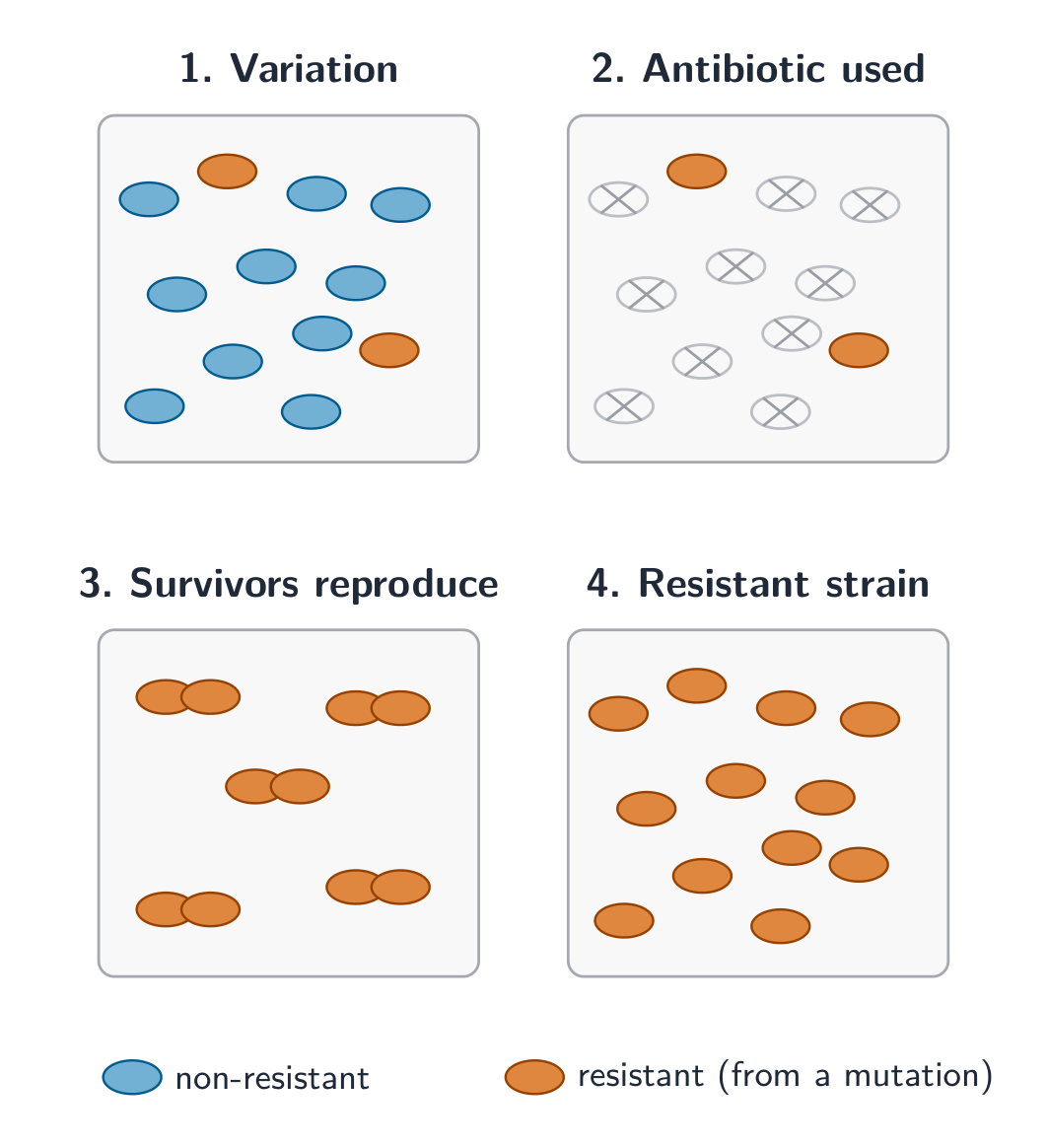
Order the development of antibiotic resistance.
Difficulté 3/5 · 200 pièces + un petit bonus lors de la première réussite aujourd'hui
Natural selection in bacteria.
Worked example: one dose
A population has 10 resistant and 90 non-resistant bacteria. An antibiotic kills 80 of the non-resistant ones.
- Survivors $= 10 + (90 - 80) = 20$.
- Resistant share $= \dfrac{10}{20} \times 100 = 50\%$, up from 10%.
- No new mutation was needed: the antibiotic simply removed the competition.
The antibiotic selects; it does not cause the mutation
10 resistant and 90 susceptible bacteria; the dose kills 80 of the susceptible ones. The 10 resistant survivors are now 50% of the population, up from 10%, with no new mutation.
5 resistant and 95 non-resistant bacteria; a dose kills 90 non-resistant. What percentage of survivors is resistant?
Difficulté 2/5 · 140 pièces + un petit bonus lors de la première réussite aujourd'hui
5 ÷ (5 + 5) × 100 = 50%.
Worked example: why it spreads so fast
In good conditions a bacterium can divide every 20 minutes. Start with one resistant bacterium.
- Divisions in 5 hours: 5 × 60 ÷ 20 = 15.
- Number of bacteria: the number doubles each time, so $2^{15} = 32\,768$.
- So: one resistant survivor can become tens of thousands in an afternoon, all carrying the resistance gene.
A resistant bacterium divides every 30 minutes. How many bacteria are there after 3 hours, starting from one?
Difficulté 2/5 · 140 pièces + un petit bonus lors de la première réussite aujourd'hui
3 hours = 6 divisions, so 2⁶ = 64.
Exam-style question
Question (5 marks): Explain how a population of bacteria becomes resistant to an antibiotic.
Model answer
- A random mutation in a bacterium's DNA ✓
- makes it resistant to the antibiotic. ✓
- When the antibiotic is used, the non-resistant bacteria are killed, but the resistant ones survive. ✓
- The resistant bacteria reproduce (quickly) ✓
- and pass on the resistance gene, so the resistant strain increases in the population. ✓
Where marks are lost: "the bacteria become immune" (immunity is something your body has); "the antibiotic causes the mutation"; or stopping after "they survive" without reproduce and pass on.
Slowing it down
| Action | Why it helps |
|---|---|
| no antibiotics for viral or mild infections | antibiotics do not kill viruses, so using them only selects resistant bacteria |
| finish the whole course | kills all the bacteria, so the more resistant survivors cannot multiply |
| limit antibiotics in farming | less use means less selection of resistant strains |
| hospital hygiene and isolating infected patients | stops resistant strains spreading from person to person |
Why should a doctor not give antibiotics for a cold?
Difficulté 1/5 · 100 pièces + un petit bonus lors de la première réussite aujourd'hui
No benefit, but more selection for resistance.
Which help slow the spread of resistance?
Difficulté 2/5 · 140 pièces + un petit bonus lors de la première réussite aujourd'hui
Overuse speeds resistance.
New drugs are slow
- Developing a new antibiotic is slow and very expensive, and few companies do it.
- It is unlikely to keep up with the emergence of new resistant strains, so slowing resistance matters.
Bacteria do not become resistant "to survive". No bacterium decides to change. Resistance comes from random mutation; the antibiotic only selects which variants survive.
Bacteria choose to become resistant when they meet an antibiotic.
Difficulté 1/5 · 100 pièces + un petit bonus lors de la première réussite aujourd'hui
Resistance comes from random mutation.
A random mutation can make a bacterium resistant. The antibiotic kills the non-resistant bacteria; the resistant ones survive, reproduce and pass on the gene, so the resistant strain spreads. To slow resistance: no antibiotics for viruses, finish courses, limit farm use and keep hospitals clean. New antibiotics are slow to develop.
Explain why patients should finish a course of antibiotics even if they feel better. (3 marks)
Link to selection.