The End of the Cold War
Introduit| English | Sens |
|---|---|
| mujahideen | Afghan fighters who resisted the Soviet invasion of Afghanistan from 1979 to 1989. |
| glasnost/ˈɡlæsnɒst/ | Gorbachev's policy of openness from 1985, which allowed more free discussion and criticism in the Soviet Union. |
| perestroika/ˈperɪstrɔɪkə/ | Gorbachev's policy of restructuring the Soviet economy from 1985, allowing some market elements. |
The last soldier crosses the bridge, February 1989
- On 15 February 1989, General Boris Gromov walked across the Friendship Bridge from Afghanistan into the Soviet Union — the last Soviet soldier to leave. The war had lasted more than nine years and killed about 15 000 Soviet soldiers and perhaps a million Afghans. Nine months later, the Berlin Wall opened; by December 1991, the Soviet Union itself had ended.
- The Cold War ended because of Soviet economic weakness, a costly war and growing discontent inside the Soviet bloc.
The Soviet war in Afghanistan began in December 1979 and ended in February 1989. About how many years did it last?
Difficulté 2/5 · 140 pièces + un petit bonus lors de la première réussite aujourd'hui
More than nine years.
Competing with a wealthier rival
- The US economy was about twice the size of the Soviet economy, yet the Soviets tried to match American military spending.
- In the 1980s, US President Reagan increased spending further, including plans for a missile-defence system.
Why was competing with the US so costly for the Soviets?
Difficulté 1/5 · 100 pièces + un petit bonus lors de la première réussite aujourd'hui
A wealthier rival.
A costly and failed war
- The Soviet Union invaded Afghanistan in December 1979 to support a communist government.
- Afghan mujahideen 圣战者 fighters, armed by the US, Pakistan and others, fought on; the war drained money and morale.
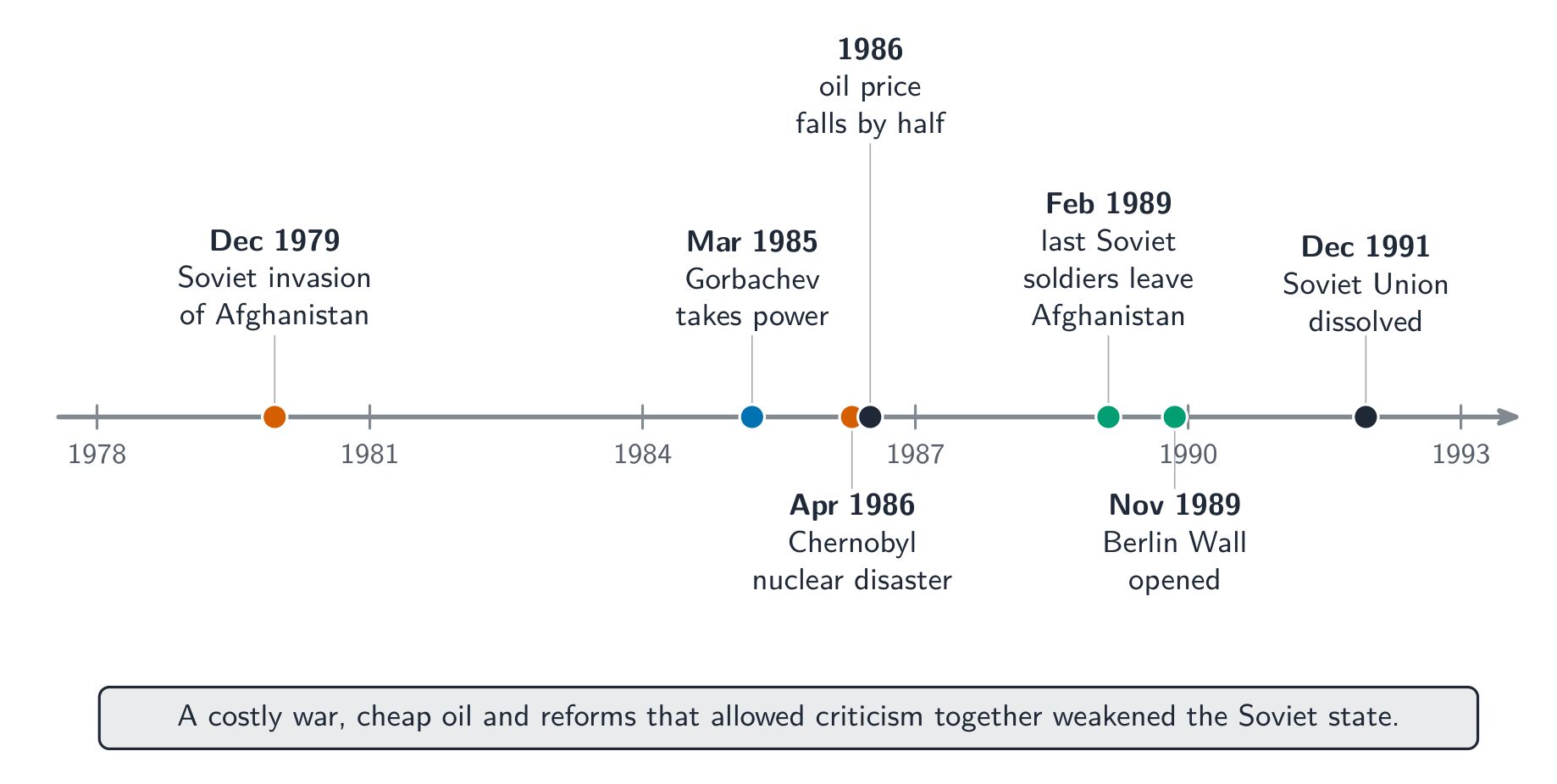
Follow the Cold War to its end
The CED names specific pressures rather than a single cause, and they act together.
Worked example: explaining an ending
- Economic weakness: Soviet growth slowed to near zero in the 1980s, and falling oil prices after 1985 cut income.
- Reform: Mikhail Gorbachev introduced glasnost 公开性 (openness) and perestroika 经济改革 (restructuring) from 1985 — and allowed criticism that weakened the system.
- Discontent: in Poland, the trade union Solidarity won elections in June 1989; Eastern European governments fell one after another, and in 1991 the Soviet republics declared independence.
Match each term to its meaning.
Difficulté 2/5 · 140 pièces + un petit bonus lors de la première réussite aujourd'hui
Reform and discontent.
Which caused the Soviet collapse?
Difficulté 2/5 · 140 pièces + un petit bonus lors de la première réussite aujourd'hui
Three pressures.
Discontent in the bloc
- People in Eastern Europe wanted freedom and better living standards.
- Gorbachev chose not to send troops to stop the changes, unlike in Hungary (1956) and Czechoslovakia (1968).
Effects
- Germany was reunited in October 1990, and 15 new states replaced the Soviet Union.
- The United States was left as the only superpower.
Put these events in order.
Difficulté 3/5 · 200 pièces + un petit bonus lors de la première réussite aujourd'hui
1979, 1985, 1989, 1991.
The Cold War did not end only because of US pressure. Soviet economic weakness, Gorbachev's own reforms and the actions of Eastern Europeans were just as important.
US pressure alone ended the Cold War.
Difficulté 1/5 · 100 pièces + un petit bonus lors de la première réussite aujourd'hui
Soviet weakness and Eastern Europeans mattered too.
The Soviet Union could not keep up with a wealthier rival, lost money and morale in Afghanistan, and faced growing discontent. Gorbachev's reforms opened the system to criticism, Eastern Europe broke free in 1989, and the Soviet Union ended in 1991.
Explain the causes of the end of the Cold War.
Causation.