Setting the Stage
Introduit| English | Sens |
|---|---|
| self-determination/self dɪˌtɜːmɪˈneɪʃn/ | The principle that a people should choose its own government. |
A petition ignored, a declaration read, 1919 and 1945
- In 1919 a young Vietnamese man sent a petition to the peace conference at Versailles asking for rights for the people of French Indochina. It was ignored.
- In September 1945 the same man, now called Ho Chi Minh, declared Vietnam's independence in Hanoi. He began by quoting the American Declaration of Independence: "All men are created equal".
Which document did Ho Chi Minh quote in 1945?
Difficulté 1/5 · 100 pièces + un petit bonus lors de la première réussite aujourd'hui
All men are created equal.
Hopes disappointed after 1918
- After the First World War, US President Wilson spoke of self-determination 民族自决 — the right of peoples to choose their own government. Many colonised peoples hoped it applied to them.
- It did not. Britain and France took Germany's colonies and Ottoman lands as mandates, and protests in Egypt, India and Korea in 1919 were put down.
The right of peoples to choose their own government is called self-____.
Difficulté 1/5 · 100 pièces + un petit bonus lors de la première réussite aujourd'hui
Wilson spoke of it in 1918.
The balance of power moved after 1945
- The Second World War left Britain, France and the Netherlands exhausted and in debt. Japan's victories in 1941–42 had shown that European empires could be beaten.
- The two strongest victors, the United States and the Soviet Union, both opposed the old European empires, though for different reasons.
Why were European empires weaker after 1945?
Difficulté 2/5 · 140 pièces + un petit bonus lors de la première réussite aujourd'hui
Britain and France were among the victors.
Movements were ready
- Nationalist parties built between the wars — such as the Indian National Congress, led by Gandhi and Nehru — had mass support by 1945.
- Millions of colonial soldiers had fought for Britain and France, and returned asking why they should not rule themselves.
The Indian National Congress had mass support by 1945.
Difficulté 1/5 · 100 pièces + un petit bonus lors de la première réussite aujourd'hui
Built between the wars under Gandhi and Nehru.
Worked example: explaining a difference. Why did independence come after 1945 but not after 1918? In 1918 the colonial powers had won and were strong enough to keep their empires. In 1945 they were weak, the new superpowers did not support their empires, and nationalist movements were organised. The same hope for self-government met different conditions.
Why did independence come after 1945 but not after 1918?
Difficulté 1/5 · 100 pièces + un petit bonus lors de la première réussite aujourd'hui
Weak empires, new superpowers, organised movements.
Two stories at once
- After 1945, decolonisation and the Cold War happened together. A new state choosing its economic system — planned or market — was also choosing sides.
- Some new states refused to choose: at Bandung in 1955, leaders from Asia and Africa met, and the Non-Aligned Movement followed in 1961.
1918 or 1945?
Sort each condition by the moment it describes.
Put these in order.
Difficulté 3/5 · 200 pièces + un petit bonus lors de la première réussite aujourd'hui
1919, 1945, 1955, 1961.
Do not treat 1918 and 1945 as the same moment. Hopes for self-government existed after both wars, but only after 1945 did the balance of power allow most of them to succeed.
The hopes of 1918 succeeded as well as those of 1945.
Difficulté 1/5 · 100 pièces + un petit bonus lors de la première réussite aujourd'hui
Only after 1945 did the balance of power allow independence.
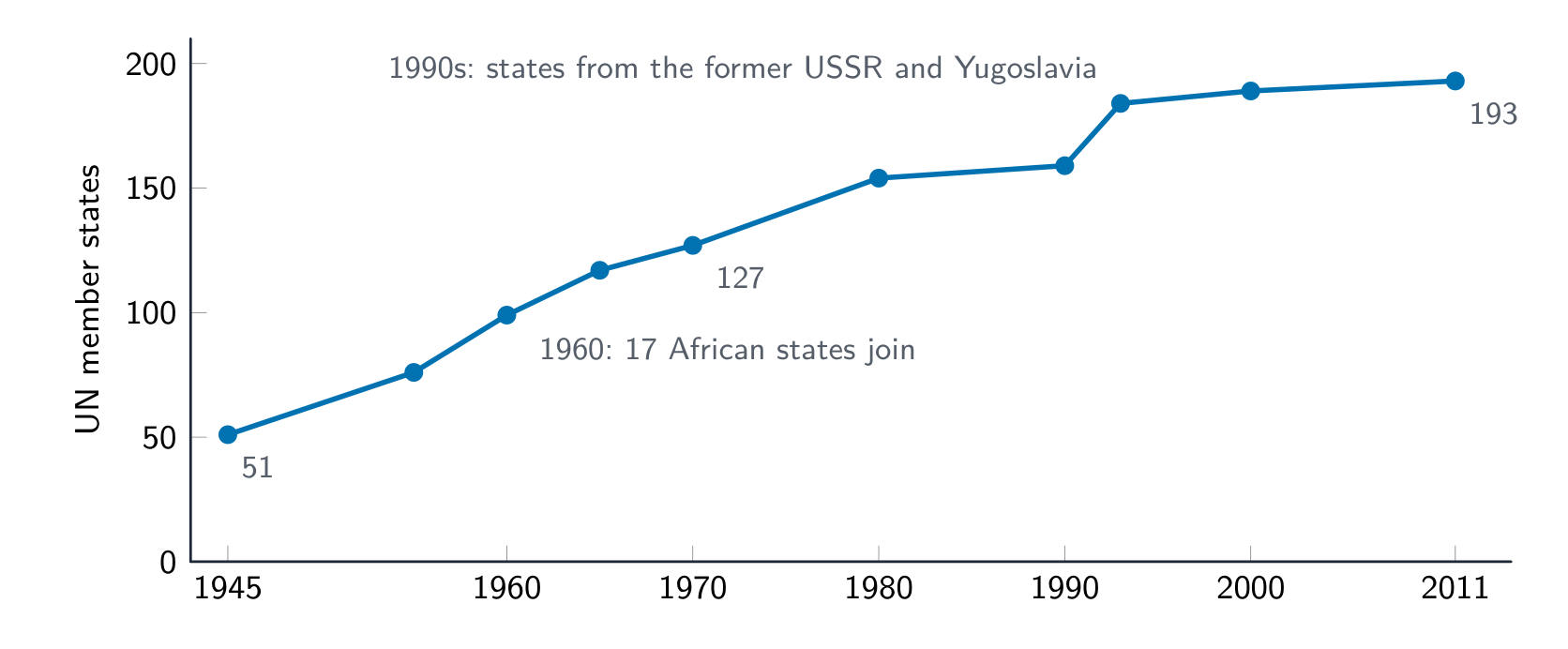
After 1918 colonised peoples' hopes for self-determination were disappointed. After 1945 the colonial powers were exhausted, the United States and the Soviet Union opposed the old empires, and nationalist movements were organised, so empires broke up. The UN grew from 51 members in 1945 to 127 by 1970, while new states also faced pressure to take sides in the Cold War.
Explain why the end of the Second World War led to the break-up of empires, while the end of the First World War did not.
Same hopes, different conditions.