How State Power Shifted
Introduit| English | Sens |
|---|---|
| Berlin Conference | The 1884-85 meeting of European powers in Berlin that set rules for claiming land in Africa, with no Africans present. |
| Congo Free State | The Congo territory owned personally by King Leopold II of Belgium from 1885 to 1908, where forced labour for rubber killed huge numbers of people. |
| settler colony | A colony where large numbers of people from the ruling country came to live permanently and farm, often pushing out the Indigenous people. |
Dividing a continent at a table, 1884–85
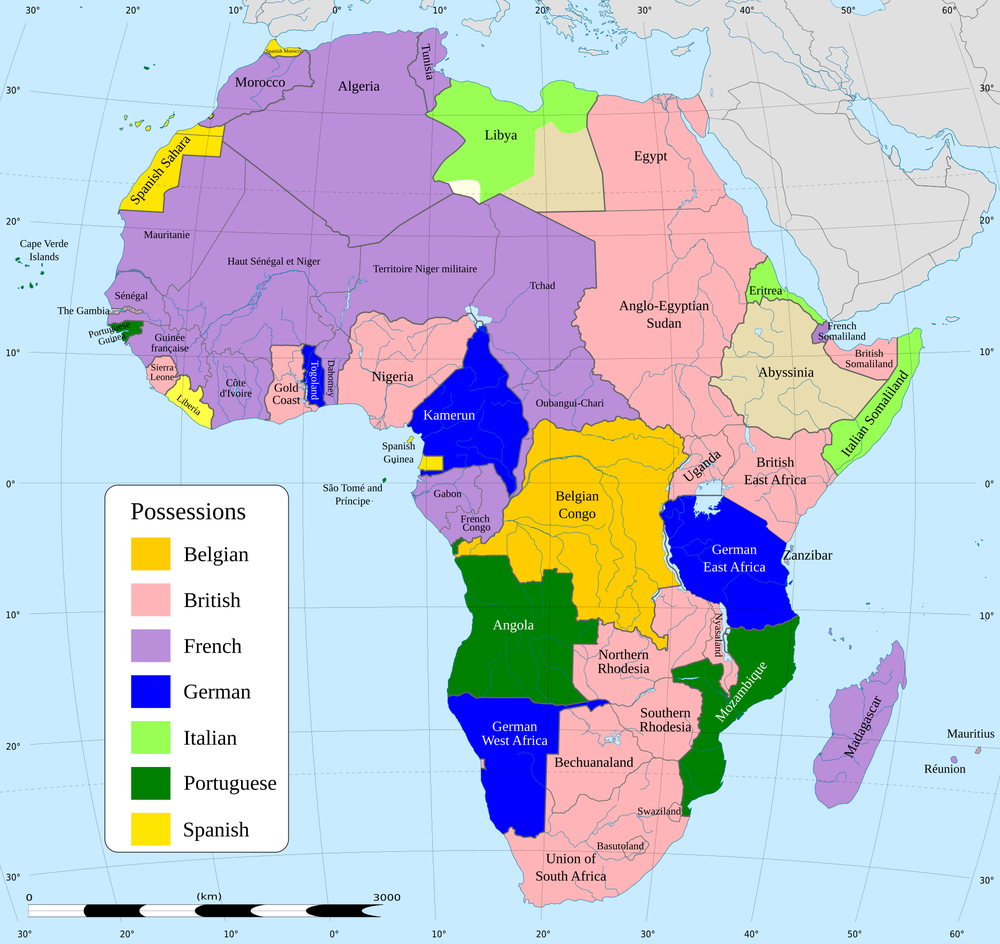
- From November 1884 to February 1885, diplomats from 14 states met in Berlin to set rules for claiming Africa. No African was invited. The Berlin Conference 柏林会议 said a European power had to occupy land "effectively" to claim it. In 1880, Europeans controlled about 10% of Africa; by 1914, about 90%.
- In the 19th century, industrial states expanded their empires, while older empires lost ground.
What did the Berlin Conference require to claim African land?
Difficulté 1/5 · 100 pièces + un petit bonus lors de la première réussite aujourd'hui
No African was invited.
European control of Africa rose from about 10% (1880) to about 90% (1914). By how many percentage points?
Difficulté 2/5 · 140 pièces + un petit bonus lors de la première réussite aujourd'hui
90 − 10.
Tightening a grip already held
- Some states turned trading posts into direct rule. After the 1857 rebellion, the British government replaced the East India Company and ruled India directly from 1858.
- The Dutch government took over the Dutch East India Company's lands in Indonesia in 1800.
The British government took direct rule of India in 1858.
Difficulté 1/5 · 100 pièces + un petit bonus lors de la première réussite aujourd'hui
After the 1857 rebellion.
Who gained, and who declined
- Britain, France, Germany, Belgium, Japan and the United States gained colonies.
- Spain and Portugal lost most of their American empires in the early 1800s, and the Ottoman Empire lost land in the Balkans and North Africa.
Follow how imperial state power shifted
European states, the United States and Japan all expanded — which is what makes this a global rather than a European story.
Match each state to its direction.
Difficulté 2/5 · 140 pièces + un petit bonus lors de la première réussite aujourd'hui
Who gained and who declined.
Worked example: the Congo, from king to state
- 1885: King Leopold II of Belgium was recognised as personal owner of the Congo Free State 刚果自由邦.
- Method: his companies forced people to collect rubber, and soldiers cut off hands when quotas were missed. The population may have fallen by millions.
- 1908: after an international protest campaign, Belgium's parliament took the Congo from the king. Rule became a state's responsibility, though forced labour did not end at once.
Put the Congo's history in order.
Difficulté 3/5 · 200 pièces + un petit bonus lors de la première réussite aujourd'hui
1885 to 1908.
Settler colonies
- In each settler colony 移民殖民地, such as Australia, New Zealand and South Africa, Europeans came to farm and stay, pushing Indigenous people off their land.
- In Australia, the Aboriginal population fell sharply through disease and violence.
Expanding overland
- Russia expanded over land into Central Asia and Siberia; the United States expanded west across North America; Japan took Taiwan (1895) and Korea (1910).
- Overland expansion was imperialism too, even without ships.
Empire did not only mean ships to distant colonies. Russia, the United States and Japan expanded overland or into neighbouring lands, and that was also imperialism.
Overland expansion by Russia was not imperialism.
Difficulté 1/5 · 100 pièces + un petit bonus lors de la première réussite aujourd'hui
It was imperialism too.
After 1850, industrial states turned trading posts into direct rule, divided Africa after the Berlin Conference, built settler colonies and expanded overland. The Congo's change from Leopold's property to a Belgian colony in 1908 shows how imperial power shifted to states.
Explain how imperial state power changed between 1750 and 1900.
Change over time.