The Enlightenment
Introduit| English | Sens |
|---|---|
| Enlightenment/enˈlaɪtənmənt/ | Lumières |
| empiricist/emˈpɪrɪsɪst/ | A person who believes that knowledge comes from experience and observation rather than from birth or tradition. |
| natural rights/ˈnætʃərəl raɪts/ | Rights that all people are born with, such as life, liberty and property, which no government can rightly take away. |
| social contract/ˈsəʊʃl ˈkɒntrækt/ | contrat social |
| suffrage/ˈsʌfrɪdʒ/ | droit de vote |
A book of all knowledge, 1751
- In 1751, Denis Diderot and Jean d'Alembert published the first volume of the Encyclopédie in Paris. By 1772 it had 28 volumes and about 72 000 articles, on everything from science and trades to religion and government. It claimed that reason, not tradition, should judge all things. The French government banned it in 1759, but printing continued in secret.
- In the 18th century, the Enlightenment 启蒙运动 applied reason and observation to society, government and religion.
The first volume appeared in 1751 and the last in 1772. Over how many years?
Difficulté 2/5 · 140 pièces + un petit bonus lors de la première réussite aujourd'hui
1772 − 1751.
A method before a politics
- Thinkers used the methods of the Scientific Revolution — observation and reason — to study people and society.
- John Locke was an empiricist 经验主义者: he argued that knowledge comes from experience, not from birth.
What did Locke as an empiricist argue?
Difficulté 1/5 · 100 pièces + un petit bonus lors de la première réussite aujourd'hui
Empiricism.
New political ideas
- Natural rights 自然权利: Locke said people are born with rights to life, liberty and property.
- The social contract 社会契约: Rousseau and Locke argued that governments get their power from the people, who may replace a government that breaks its side.
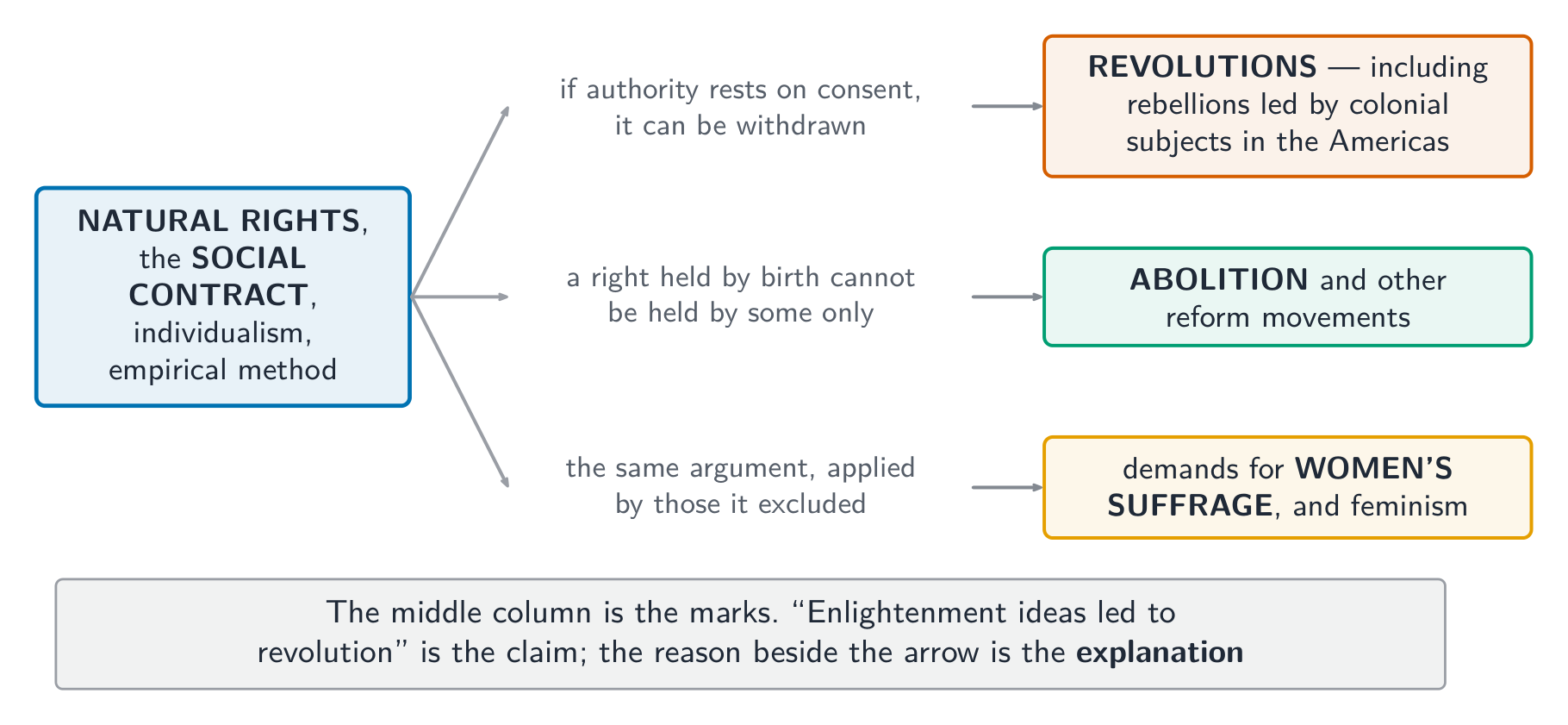
Trace an Enlightenment idea to a movement
'Enlightenment ideas led to revolution' is the claim; the reason in between is the explanation.
Match each idea to its meaning.
Difficulté 2/5 · 140 pièces + un petit bonus lors de la première réussite aujourd'hui
Political ideas.
Worked example: from idea to movement
- Idea: natural rights and the social contract.
- Reasoning: if rights are natural and government rests on consent, a government that violates rights loses its authority.
- Movement: the American Declaration of Independence (1776) said "all men are created equal" with rights to "life, liberty and the pursuit of happiness"; France's Declaration of the Rights of Man followed in 1789.
Put the chain in order.
Difficulté 3/5 · 200 pièces + un petit bonus lors de la première réussite aujourd'hui
From idea to movement.
Religion re-examined
- Voltaire attacked religious intolerance; many thinkers believed in deism — a God who created the world but did not interfere.
- They called for separation of church and state and religious toleration.
A challenge to gender hierarchy
- In 1792, Mary Wollstonecraft's A Vindication of the Rights of Woman argued that women had the same reason as men and should be educated equally.
- Later, women used these ideas to demand suffrage 选举权 — the right to vote.
Match each thinker to the work.
Difficulté 2/5 · 140 pièces + un petit bonus lors de la première réussite aujourd'hui
Enlightenment thinkers.
Enlightenment ideas did not lead only to revolution. Some rulers, such as Frederick II of Prussia, used them for reform from above, and reformers used them to campaign against slavery.
Enlightenment ideas led only to revolutions.
Difficulté 1/5 · 100 pièces + un petit bonus lors de la première réussite aujourd'hui
Also reform from above and anti-slavery.
The Enlightenment applied reason to society. Locke's natural rights and the social contract argued that government rests on consent, inspiring the American (1776) and French (1789) declarations. Thinkers also re-examined religion, and Wollstonecraft challenged gender hierarchy.
Explain how Enlightenment ideas influenced revolutions.
Causation.