Belief Systems, 1450–1750
Introduit| English | Sens |
|---|---|
| indulgence | A document sold by the Catholic Church that was said to reduce the punishment for sins; its sale was attacked by Luther in 1517. |
| The Protestant Reformation/ðə ˈprɒtɪstənt rɪfɔːˈmeɪʃn/ | Réforme protestante |
| Sunni/ˈsʌni/ | sunnite |
| Shi'a/ʃɪə/ | chiite |
| Sikhism/ˈsiːkɪzəm/ | sikhisme |
| syncretic/sɪnˈkretɪk/ | syncrétique |
Ninety-five arguments, October 1517
- On 31 October 1517, Martin Luther, a German monk and teacher, sent 95 arguments — his Ninety-five Theses — against the sale of indulgences 赎罪券, papers the Church sold to reduce punishment for sins. Printing presses copied them, and within weeks they were read across Germany. Luther refused to take back his views, and by 1530 much of northern Germany had broken with Rome.
- From 1450 to 1750, belief systems split, deepened and combined, and these changes shaped states.
What did Luther's Ninety-five Theses attack?
Difficulté 1/5 · 100 pièces + un petit bonus lors de la première réussite aujourd'hui
Papers sold to reduce punishment for sins.
A break inside Christianity
- The Protestant Reformation 新教改革 split Western Christianity into Catholic and Protestant churches; rulers in England, Sweden and parts of Germany broke with the Pope.
- The Catholic Church answered with its own reformation: the Council of Trent (1545–63), new schools and the Jesuit missions.
The Council of Trent met from 1545 to 1563. How many years?
Difficulté 2/5 · 140 pièces + un petit bonus lors de la première réussite aujourd'hui
1563 − 1545.
Politics deepened a split
- Islam's Sunni 逊尼派 and Shi'a 什叶派 branches had divided since the 7th century over who should lead Muslims after Muhammad.
- In 1501, Shah Ismail made Shi'a Islam the religion of the Safavid Empire, while the neighbouring Ottomans were Sunni. Their rivalry made the religious difference into a border.
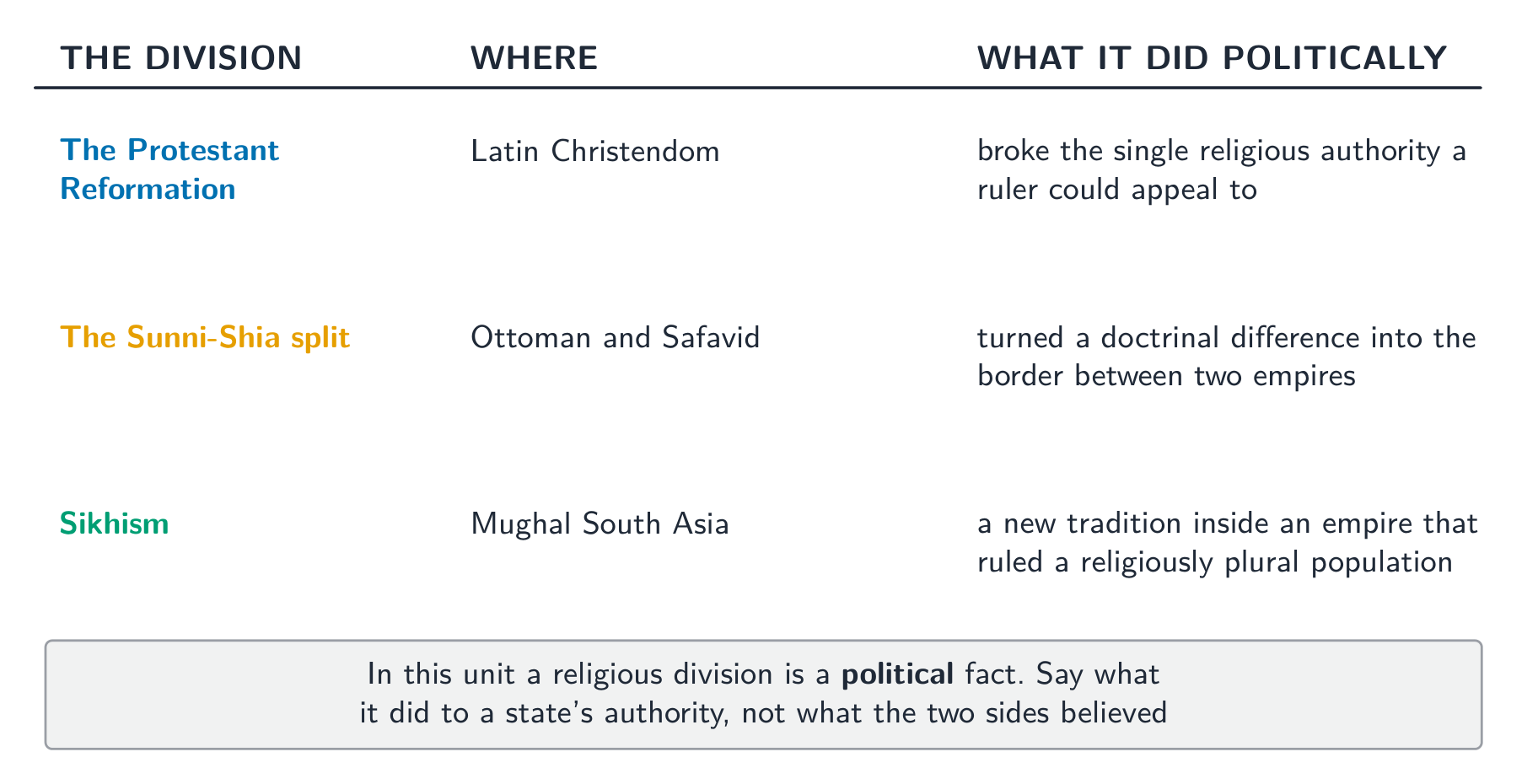
Which mechanism is at work?
Sort each case by how the change happened.
Which branch of Islam did the Safavids make their state religion?
Difficulté 1/5 · 100 pièces + un petit bonus lors de la première réussite aujourd'hui
In 1501, under Shah Ismail.
Worked example: a new faith from an encounter
- Setting: in Punjab, in South Asia, Hindus and Muslims lived side by side.
- Founder: Guru Nanak (1469–1539) taught one God beyond both traditions, equality and service.
- Result: Sikhism 锡克教 became a new religion, partly syncretic 融合的 — drawing on ideas from both — but with its own scripture and practices.
Match each case to its mechanism.
Difficulté 2/5 · 140 pièces + un petit bonus lors de la première réussite aujourd'hui
Three mechanisms.
Religion and state authority
- Rulers used religion to show their right to rule: Süleyman the Magnificent built the great Süleymaniye Mosque in Istanbul (1550–57).
- Religious difference could also cause war, as in the Thirty Years' War (1618–48) in Europe.

Put these events in order.
Difficulté 3/5 · 200 pièces + un petit bonus lors de la première réussite aujourd'hui
1501, 1517, 1550, 1618.
Continuity and change
- Change: Christianity split, a Sunni–Shi'a border hardened, and a new faith emerged.
- Continuity: religion remained central to how states justified their power.
The Reformation was not only about faith. Rulers joined it partly to gain power and Church land from Rome — politics and religion were mixed.
Rulers joined the Reformation only for religious reasons.
Difficulté 1/5 · 100 pièces + un petit bonus lors de la première réussite aujourd'hui
Power and Church land mattered too.
From 1450 to 1750, the Protestant Reformation split Western Christianity, the Ottoman–Safavid rivalry deepened the Sunni–Shi'a divide, and Sikhism grew from an encounter between Hinduism and Islam. In each case, religion shaped and was shaped by state power.
Explain how religion affected state power between 1450 and 1750.
Causation.