Empires Expand
Introduit| English | Sens |
|---|---|
| Ottoman/ˈɒtəmən/ | Ottomans |
| Mughal/ˈməʊɡl/ | Mogols |
| gunpowder empire | A large land empire, such as the Ottoman, Safavid or Mughal Empire, that used expensive cannons and guns to expand and to centralise power. |
| Safavids/ˈsæfəvɪdz/ | The dynasty that ruled Persia (Iran) from 1501 to 1736 and made Shi'a Islam the state religion. |
| Armed trade/ɑːmd treɪd/ | commerce armé |
Cannons at the walls, May 1453
- In April 1453, the Ottoman sultan Mehmed II, aged 21, besieged Constantinople. A Hungarian engineer named Orban cast him a huge bronze cannon that fired stone balls weighing about 500 kg. After 53 days of bombardment, on 29 May, Ottoman troops broke through the city's thousand-year-old walls. Constantinople became Istanbul, the Ottoman capital.
- From 1450 to 1750, land empires used gunpowder weapons to expand and to hold power.
The siege of Constantinople lasted 53 days. About how many weeks is that? (whole number)
Difficulté 2/5 · 140 pièces + un petit bonus lors de la première réussite aujourd'hui
53 ÷ 7 ≈ 7.6, about 8.
One technology, both hemispheres
- Gunpowder weapons were expensive, so rulers who could pay for cannons, guns and trained soldiers gained power over local lords.
- Historians call each of the Ottoman, Safavid and Mughal states a gunpowder empire 火药帝国.
Why did gunpowder weapons increase rulers' power?
Difficulté 1/5 · 100 pièces + un petit bonus lors de la première réussite aujourd'hui
Cost concentrated power.
The land empires
- The Ottoman 奥斯曼 Empire in Southwest Asia, North Africa and southeast Europe; the Safavids 萨法维王朝 in Persia (Iran).
- The Mughal 莫卧儿 Empire in South Asia; the Manchu Qing dynasty in China from 1644.
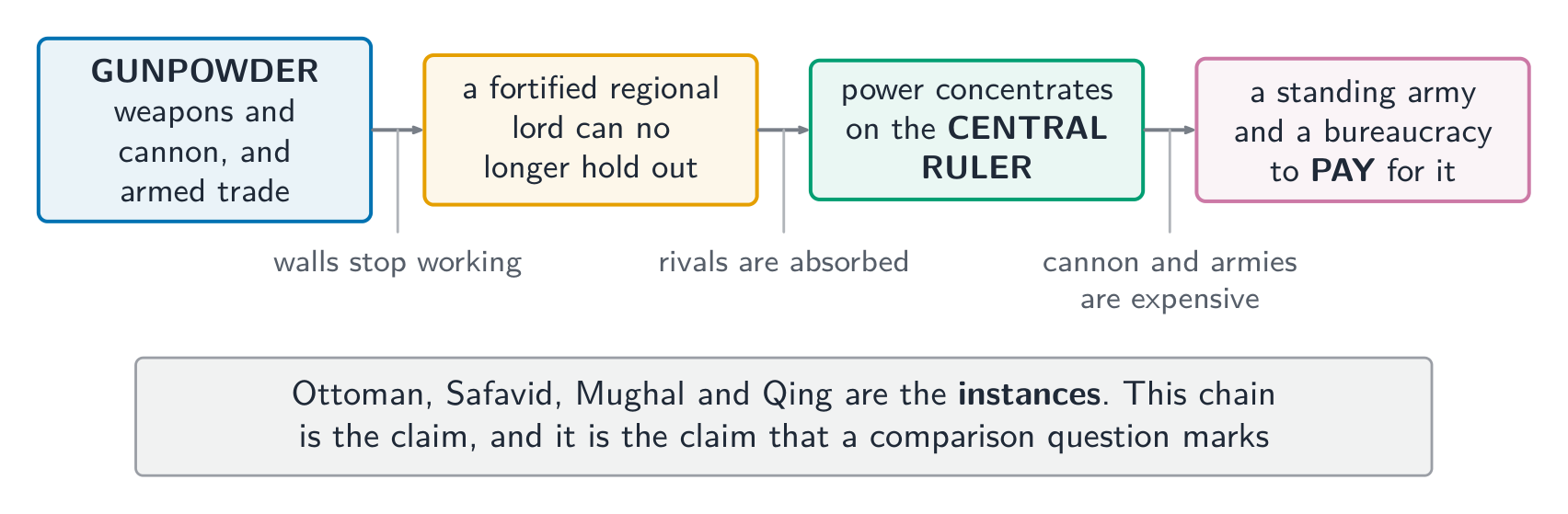
Assemble the gunpowder-empire claim
Military technology and political centralisation grew together, and the mechanism is what is marked.
Match each empire to its region.
Difficulté 2/5 · 140 pièces + un petit bonus lors de la première réussite aujourd'hui
Land empires.
Worked example: empires collided
- Event: at Chaldiran in 1514, Ottoman troops with cannons and muskets defeated the Safavid cavalry.
- Cause: a political rivalry over land, deepened by religion — the Ottomans were Sunni, the Safavids Shi'a.
- Result: the border between them, roughly the border of modern Turkey and Iran, lasted for centuries.
What deepened the Ottoman–Safavid rivalry?
Difficulté 1/5 · 100 pièces + un petit bonus lors de la première réussite aujourd'hui
Politics and religion together.
Sea empires and armed trade
- Portugal, Spain, the Netherlands and Britain built sea empires with armed ships.
- Armed trade 武装贸易 meant using cannons on ships to force trading rights, as Portugal did in the Indian Ocean after 1500.
Disputes and expansion
- Empires also fought over religion: the Mughal ruler Aurangzeb (1658–1707) fought Hindu Marathas and Sikhs.
- The Qing expanded into Mongolia, Tibet and Xinjiang in the 18th century.
Put these events in order.
Difficulté 3/5 · 200 pièces + un petit bonus lors de la première réussite aujourd'hui
1453, 1514, 1644, 1658.
Gunpowder alone did not build empires. Rulers also needed taxes, bureaucracies and loyal armies to pay for and use the weapons.
Gunpowder alone was enough to build an empire.
Difficulté 1/5 · 100 pièces + un petit bonus lors de la première réussite aujourd'hui
Taxes and bureaucracies were needed too.
From 1450, the Ottomans, Safavids, Mughals and Qing used costly gunpowder weapons to expand and centralise power, as at Constantinople (1453) and Chaldiran (1514). Sea empires used armed trade, and political and religious rivalries shaped borders that lasted for centuries.
Explain how land empires expanded between 1450 and 1750.
Causation.