Cultural Consequences of Connectivity
Introduit| English | Sens |
|---|---|
| paper/ˈpeɪpə/ | papier |
| gunpowder/ˈɡʌnpaʊdə/ | poudre à canon |
A young man leaves Tangier, 1325
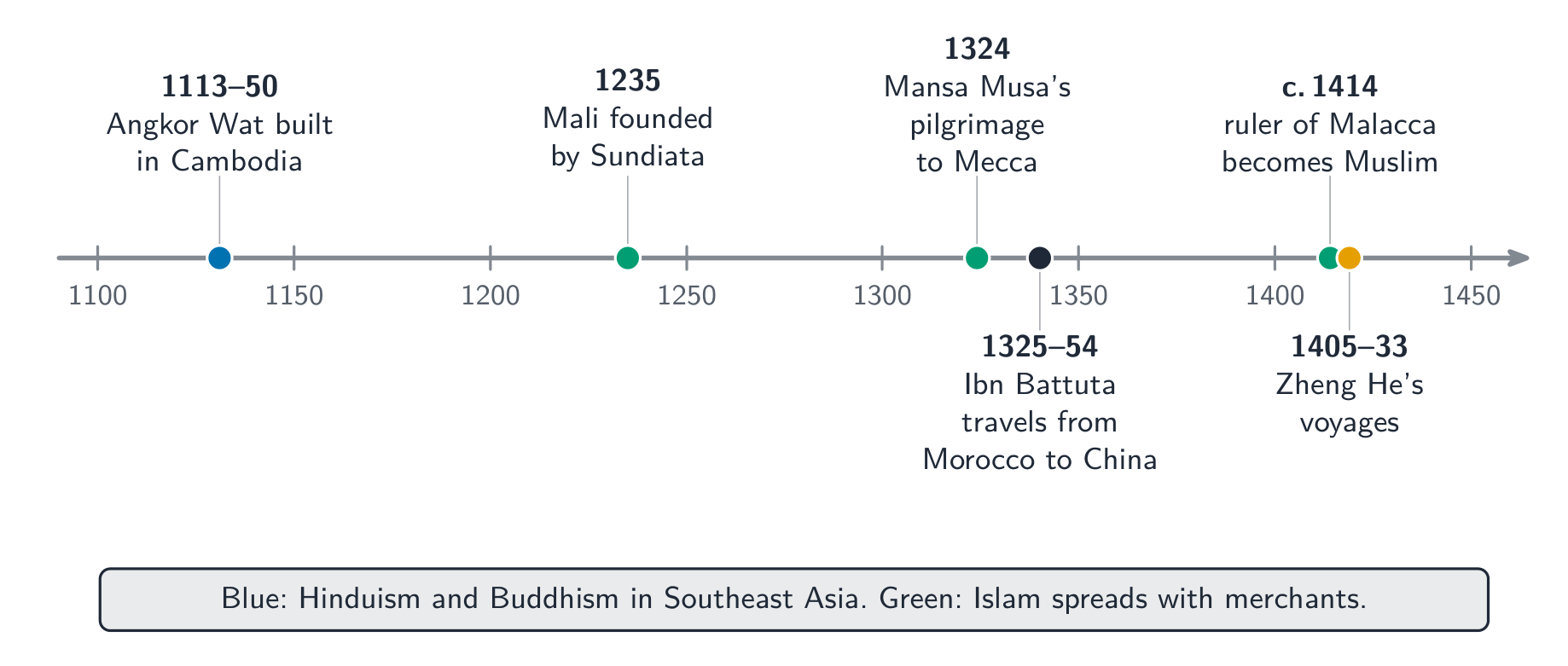
- In 1325, Ibn Battuta, a 21-year-old legal scholar, left Tangier in Morocco to make the pilgrimage to Mecca. He did not come home for 24 years. He travelled through the Middle East, East Africa, India and China, and later to Mali — about 117 000 km in all. Everywhere he went, he found Muslim communities, judges and merchants who spoke Arabic.
- Trade networks spread more than goods: religions, technologies and ideas moved along them too.
Ibn Battuta left Tangier aged 21 and was away 24 years. How old was he when he came home?
Difficulté 2/5 · 140 pièces + un petit bonus lors de la première réussite aujourd'hui
21 + 24.
Contact spread more than goods
- Merchants, pilgrims and missionaries carried beliefs and skills along the Silk Roads, the Indian Ocean and trans-Saharan routes.
- Cities on these routes grew rich and mixed.
Religions travelled the trade routes
- Islam spread into sub-Saharan Africa through trans-Saharan merchants; rulers of Mali, such as Mansa Musa, became Muslim.
- Hinduism and Buddhism spread into Southeast Asia; the Hindu–Buddhist temple of Angkor Wat in Cambodia was built in the 12th century.
Which kind of diffusion is this?
Sort each example by the CED's categories.
Match each religion to where it spread.
Difficulté 2/5 · 140 pièces + un petit bonus lors de la première réussite aujourd'hui
Religions on trade routes.
Worked example: two technologies from China
- Paper 纸: made in China by about 100 CE, it reached the Islamic world after 751; Baghdad had a paper mill by about 794, and paper reached Europe by the 12th century.
- Gunpowder 火药: invented in China by the 9th century, it spread west along trade routes and with the Mongols, reaching Europe by the 13th century.
- Effect: paper made books and records cheaper; gunpowder later changed warfare.
Put the spread of paper in order.
Difficulté 3/5 · 200 pièces + un petit bonus lors de la première réussite aujourd'hui
About 100 CE to the 12th century.
Cities rose and fell
- Trade cities such as Samarkand, Kilwa and Hangzhou grew rich.
- Cities could also decline when routes changed or when disease, such as the Black Death in the 1340s, spread along the same routes.
Disease spread along the same routes as trade.
Difficulté 1/5 · 100 pièces + un petit bonus lors de la première réussite aujourd'hui
The Black Death.
Travellers wrote it down
- Ibn Battuta's Rihla and Marco Polo's account of China told readers about distant lands.
- These accounts are evidence of connectivity, though historians check them carefully.
Match each to its type.
Difficulté 2/5 · 140 pièces + un petit bonus lors de la première réussite aujourd'hui
Three kinds.
Ideas did not spread by themselves. They moved with people — merchants, pilgrims and travellers — along trade routes.
Ideas spread by themselves, without people.
Difficulté 1/5 · 100 pièces + un petit bonus lors de la première réussite aujourd'hui
They moved with people.
Trade networks carried religions such as Islam and Buddhism, technologies such as paper and gunpowder, and disease such as the Black Death. Travellers like Ibn Battuta, who covered about 117 000 km, show how connected Afro-Eurasia had become.
Explain how trade networks spread culture and technology between 1200 and 1450.
Causation.