The Silk Roads
Introduit| English | Sens |
|---|---|
| forms of credit/fɔːmz ɒv ˈkredɪt/ | Ways of buying and selling with promises to pay later, such as loans and bills of exchange. |
| Bills of exchange/bɪlz ɒv eksˈtʃeɪndʒ/ | lettres de change |
| money economies/ˈmʌni ɪˈkɒnəmiz/ | économies monétaires |
| caravanserai/ˈkærəvænsəraɪ/ | A walled roadside inn on a trade route where caravans of merchants and animals could rest safely. |
A merchant's guidebook to China, about 1340
- Around 1340, Francesco Pegolotti, an agent of a Florentine bank, wrote a handbook for merchants travelling to China. He listed the stages of the road from the Black Sea to Beijing, the goods to carry and the coins to use. Under Mongol rule, he wrote, the road was "perfectly safe, whether by day or by night". Merchants should carry silver and exchange it for Chinese paper money on arrival.
- From 1200 to 1450, the Silk Roads grew busier because of new forms of credit, safe routes and rising demand for luxury goods.
Why did Pegolotti call the road to China safe?
Difficulté 1/5 · 100 pièces + un petit bonus lors de la première réussite aujourd'hui
Mongol control.
Old routes, new volume
- The Silk Roads had linked China and the Mediterranean for over 1000 years.
- Mongol control after the 1250s made the routes safer, so trade grew much larger.
Credit is a technology
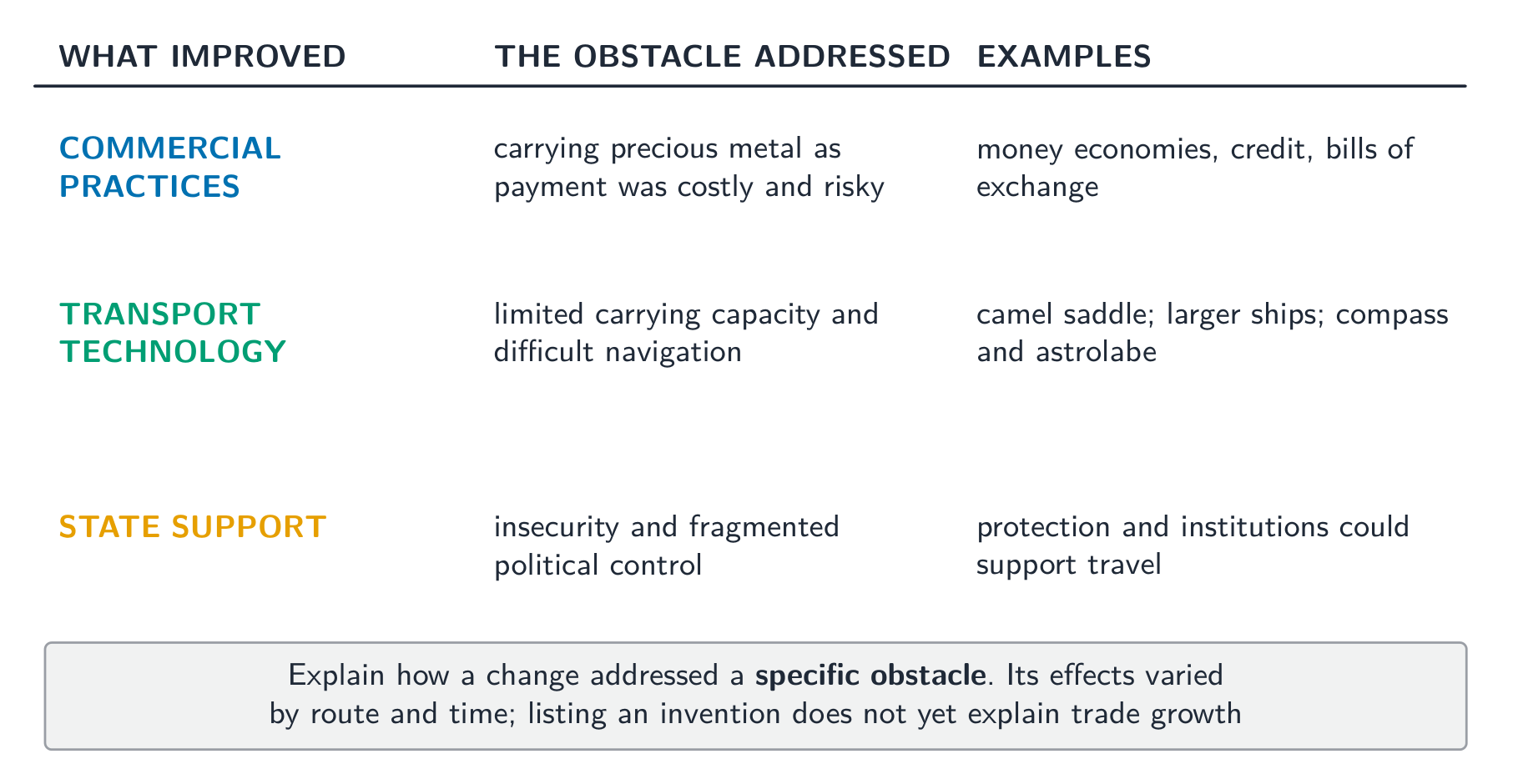
- Bills of exchange 汇票 let a merchant deposit money in one city and collect it in another, so he did not have to carry heavy coins.
- These forms of credit 信用形式 and paper money in China helped build money economies 货币经济, where goods were bought with money rather than bartered.
Cause or effect of network growth?
Sort each item by its place in the CED's causal sentence.
What did a bill of exchange let a merchant do?
Difficulté 1/5 · 100 pièces + un petit bonus lors de la première réussite aujourd'hui
Credit is a technology.
Worked example: the caravanserai
- Obstacle: caravans crossing deserts and mountains needed safe places to rest.
- Enabler: the caravanserai 商队驿站 — a walled inn about a day's journey apart, with water, food and stables.
- Effect: merchants could travel further safely, and trade cities such as Kashgar and Samarkand grew at the crossroads.
Match each to its category.
Difficulté 2/5 · 140 pièces + un petit bonus lors de la première réussite aujourd'hui
Cause, effect or neither.
If caravanserais were about 30 km apart, how many would a caravan use on a 600 km trip?
Difficulté 2/5 · 140 pièces + un petit bonus lors de la première réussite aujourd'hui
600 ÷ 30.
Trade built cities
- Samarkand, Bukhara and Kashgar grew rich as markets and centres of learning.
- Merchants spread religions and ideas along with goods.
Demand pulled production
- European and Islamic demand for Chinese silk and porcelain led China to expand production for export.
- Jingdezhen in China became a centre for blue-and-white porcelain, sold as far away as Persia and East Africa.
What did Jingdezhen become famous for?
Difficulté 1/5 · 100 pièces + un petit bonus lors de la première réussite aujourd'hui
Demand pulled production.
Silk and porcelain did not cause trade to grow — they were what was traded. The causes were credit, safety and demand; the goods themselves were neither cause nor effect.
Silk itself caused the Silk Roads to grow.
Difficulté 1/5 · 100 pièces + un petit bonus lors de la première réussite aujourd'hui
It was what was traded.
From 1200 to 1450, the Silk Roads grew busier because Mongol rule made them safe, bills of exchange and paper money made trade easier, and caravanserais gave shelter. Trade built cities like Samarkand and pulled China to make more silk and porcelain for export.
Explain the causes and effects of the growth of Silk Road trade from 1200 to 1450.
Causation.