State Building in the Americas
Introduit| English | Sens |
|---|---|
| city-states/ˈsɪti steɪts/ | états-cités |
| tribute/ˈtrɪbjuːt/ | Goods or money paid by a weaker state or group to a stronger one as a sign of submission. |
"Like the enchantments in a legend", November 1519
- On 8 November 1519, the Spanish soldier Bernal Díaz walked along a causeway into Tenochtitlan, the capital of the Mexica (Aztecs), built on islands in a lake. Years later he wrote that the towers and temples rising from the water were "like the enchantments" in a legend, and some soldiers asked whether it was a dream. With perhaps 200 000 people, it was larger than any city in Spain.
- From 1200 to 1450, states in the Americas grew in size and reach: city-states, tributary empires and large settlements.
How did Tenochtitlan compare with Spanish cities in 1519?
Difficulté 1/5 · 100 pièces + un petit bonus lors de la première réussite aujourd'hui
About 200 000 people.
Three kinds of system
- City-states 城邦: the Maya were many independent cities sharing one written culture.
- Empires: the Mexica and the Inca; large settlements: Cahokia (in today's Illinois) and Chaco Canyon (in today's New Mexico).
Match each to its kind of system.
Difficulté 2/5 · 140 pièces + un petit bonus lors de la première réussite aujourd'hui
Three kinds.
Tribute instead of tax
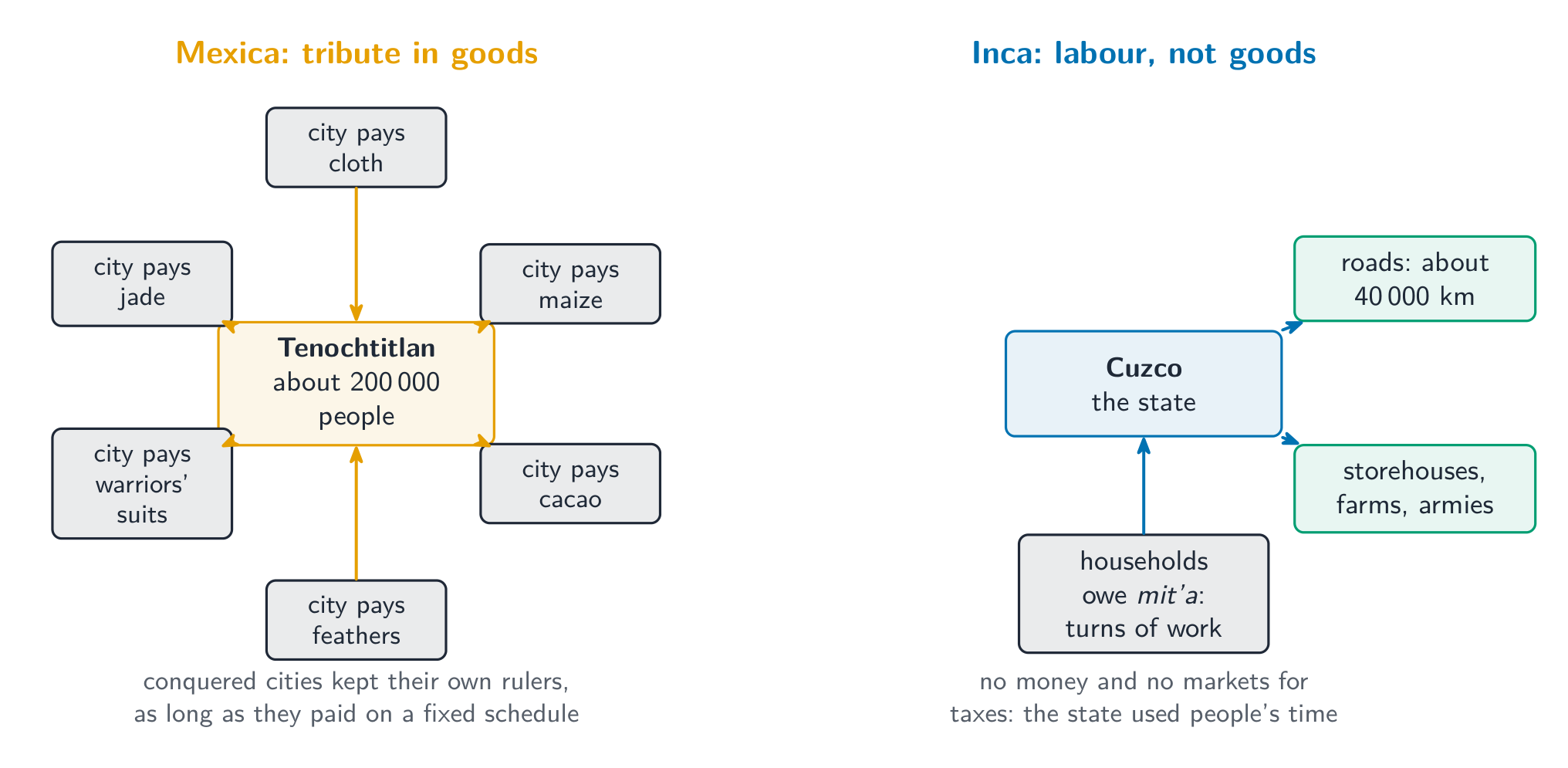
- The Mexica conquered cities and demanded tribute 贡品 — cloth, maize, cacao, feathers — delivered on a fixed schedule.
- Conquered cities kept their own rulers as long as they paid.
City-states, tributary empire, or large settlement?
Sort each of the CED's American examples.
What did conquered cities give the Mexica?
Difficulté 1/5 · 100 pièces + un petit bonus lors de la première réussite aujourd'hui
Tribute.
Worked example: the Inca solution
- Problem: rule an empire stretching about 4000 km along the Andes.
- Solution: the mit'a — each community owed labour to the state, building about 40 000 km of roads, terraces and storehouses.
- Comparison: the Mexica took goods as tribute; the Inca took labour and ran the empire more directly through officials.
How did the Inca solution differ from the Mexica?
Difficulté 1/5 · 100 pièces + un petit bonus lors de la première réussite aujourd'hui
Mit'a versus tribute.
Large settlements
- Cahokia, near the Mississippi River, had perhaps 10 000–20 000 people around 1100 and built huge earth mounds.
- Chaco Canyon's "great houses" had hundreds of rooms, linked by straight roads.
Expanding in scope and reach
- The Inca Empire grew mostly after 1438, under Pachacuti; the Mexica expanded from 1428.
- Both were young empires when the Spanish arrived.
The Inca expansion began in 1438; the Spanish arrived in Peru in 1532. How many years later?
Difficulté 2/5 · 140 pièces + un petit bonus lors de la première réussite aujourd'hui
1532 − 1438.
The Americas were not empty or simple before 1492. Tenochtitlan was larger than any Spanish city, and the Inca ran a road network of about 40 000 km.
The Americas had only small, simple societies before 1492.
Difficulté 1/5 · 100 pièces + un petit bonus lors de la première réussite aujourd'hui
Tenochtitlan and the Inca roads.
From 1200 to 1450, the Maya formed city-states, the Mexica built an empire on tribute, the Inca built one on labour and roads, and Cahokia and Chaco were large settlements. Tenochtitlan's size amazed the Spanish in 1519.
Compare how the Mexica and the Inca ruled their empires.
Comparison.