The United States since 1980
Introduit| English | Sens |
|---|---|
| inequality/ɪniːˈkwɒlɪti/ | An unequal distribution of a quantity, opportunity or outcome between people or groups. |
537 votes in Florida, 2000
- On election night in November 2000 the presidency came down to Florida, where George W. Bush led Al Gore by a few hundred votes out of almost six million. Recounts went on for five weeks until, on 12 December, the Supreme Court stopped them in Bush v. Gore. Bush won Florida by 537 votes — and the presidency — while Gore won more votes nationally.
- Since 1980 the United States has been reshaped by a conservative turn, a new economy, new immigrants and an unsettled role in the world — and its politics have become closely and bitterly divided.
How was the 2000 election finally decided?
Difficulté 1/5 · 100 pièces + un petit bonus lors de la première réussite aujourd'hui
Bush v. Gore, 12 December 2000.
A conservative turn
- Reagan's victory in 1980 cut taxes and regulation; in 1994 Republicans won the House for the first time in 40 years with their "Contract with America".
- Democrats moved towards the centre: President Clinton signed welfare reform in 1996, limiting most families to five years of federal aid.
In 1994 Republicans won the House for the first time in 40 years.
Difficulté 1/5 · 100 pièces + un petit bonus lors de la première réussite aujourd'hui
The Contract with America.
A new economy
- Computers and the internet created new industries, and trade deals such as NAFTA (1994) and China joining the World Trade Organization (2001) moved factory work abroad. Manufacturing jobs fell from about 17 million in 2000 to under 12 million in 2010.
- Incomes grew fastest at the top, so inequality 不平等 widened; the financial crisis of 2008 cost about 8.7 million jobs.
What happened to manufacturing jobs between 2000 and 2010?
Difficulté 1/5 · 100 pièces + un petit bonus lors de la première réussite aujourd'hui
Trade and technology.
New Americans
- After the 1965 Immigration Act, most immigrants came from Latin America and Asia. The share of Americans born abroad more than doubled, from 6.2% in 1980 to 13.7% in 2020.
- People and power moved south and west: in the 2020 election Texas, Florida and California together held almost a quarter of all electoral votes.
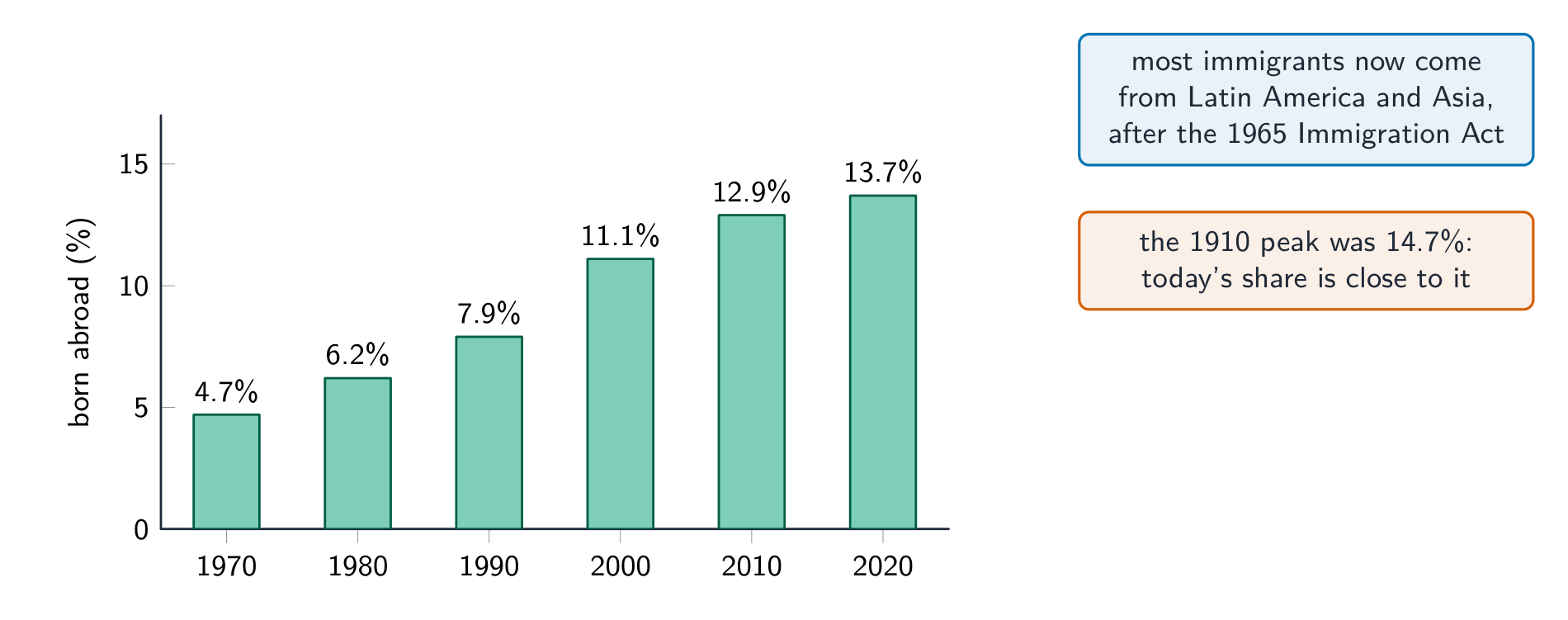
The share of Americans born abroad rose from 6.2% in 1980 to ____% in 2020.
Difficulté 1/5 · 100 pièces + un petit bonus lors de la première réussite aujourd'hui
More than doubled.
Worked example: read the trend. The foreign-born share rose from 4.7% in 1970 to 13.7% in 2020. That is 9 percentage points, or almost three times the 1970 share. The rate was close to its 1910 peak of 14.7%. So "a nation of immigrants" describes the present as well as the past.
The foreign-born share rose from 4.7% (1970) to 13.7% (2020). By how many percentage points?
Difficulté 1/5 · 100 pièces + un petit bonus lors de la première réussite aujourd'hui
13.7 − 4.7 = 9.
An unsettled role in the world
- After the Soviet Union ended in 1991 the US was the only superpower; it led the Gulf War (1991) and interventions in the Balkans.
- After 11 September 2001 it fought long wars in Afghanistan (2001–2021) and Iraq (2003–2011), and Americans argued again about how far US power should reach.
Politics, economy, society or world role?
Sort each development since 1980.
Put these in order.
Difficulté 3/5 · 200 pièces + un petit bonus lors de la première réussite aujourd'hui
1991, 2001, 2003, 2008.
This unit ends in the present. The arguments about trade, immigration and America's role are still going on, so write "historians and voters still disagree" rather than inventing a final verdict.
Since 1980 the US has taken a conservative turn (Reagan, the 1994 Congress, welfare reform), moved to a computer-based, global economy with wider inequality, and become more diverse: the foreign-born share rose from 6.2% to 13.7%. After the Cold War and 2001 its role in the world was argued over again, and close elections such as 2000 showed a divided country.
Explain two ways the United States changed after 1980, and why historians still disagree about their effects.
A course that ends in the present.