Liberalism at Its Height
Introduit| English | Sens |
|---|---|
| liberalism/ˈlɪbərəlɪzəm/ | A political tradition emphasising individual rights, constitutional government and limits on arbitrary power. |
| Great Society/ɡreɪt səˈsaɪəti/ | Johnson's set of programmes on poverty, education, and health care. |
| Medicare | The US government health insurance program for people aged 65 and over, created in 1965. |
A president on a porch in Kentucky, April 1964
- On 24 April 1964, President Lyndon Johnson sat on the porch of Tom Fletcher, an unemployed father of eight in Inez, Kentucky, who earned about 400 dollars a year. The photographs showed Americans a poverty that the boom had passed by. That year Johnson declared an "unconditional war on poverty".
- In the 1960s, liberalism — the belief that government should act to solve social problems — reached its height.
Why did Johnson visit Inez, Kentucky, in 1964?
Difficulté 1/5 · 100 pièces + un petit bonus lors de la première réussite aujourd'hui
The War on Poverty.
What liberalism meant at its height
- Liberalism 自由主义 in the 1960s meant using federal power to end poverty and discrimination, while fighting communism abroad.
- It built on the New Deal, and Johnson's landslide in 1964 gave Democrats large majorities in Congress.
The Great Society's aims
- The Great Society 伟大社会 aimed to end poverty and racial discrimination. The Economic Opportunity Act (1964) funded job training and Head Start for young children.
- Medicare 联邦医疗保险 (1965) gave health insurance to Americans over 65; Medicaid helped the poor.
A definition, an aim, or the immigration change?
Sort each element of 1960s liberalism.
Match each program to its purpose.
Difficulté 2/5 · 140 pièces + un petit bonus lors de la première réussite aujourd'hui
Great Society aims.
Worked example: did poverty fall?
- Known: the poverty rate was about 19% in 1964 and about 11% in 1973.
- Method: subtract: 19 − 11 = 8 percentage points.
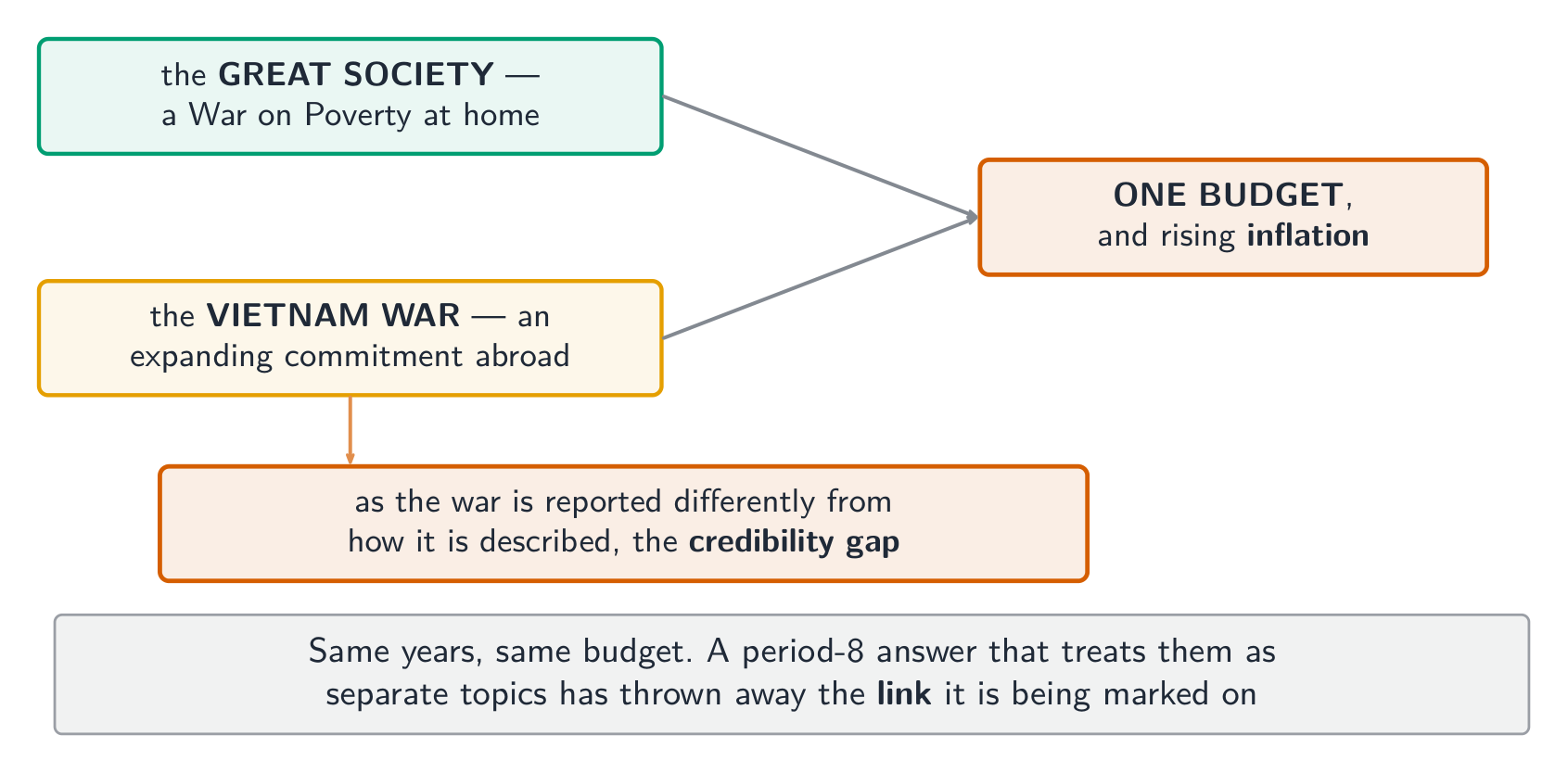
- But: the war in Vietnam competed for money — "guns and butter" — and inflation rose after 1966, so programs were never funded as fully as planned.
Poverty fell from about 19% in 1964 to about 11% in 1973. By how many percentage points?
Difficulté 2/5 · 140 pièces + un petit bonus lors de la première réussite aujourd'hui
19 − 11.
Immigration law changed
- The Immigration and Nationality Act of 1965 ended the national-origin quotas of 1924, which had favoured Northern Europe.
- Immigration from Asia and Latin America grew strongly in later decades.
What did the 1965 immigration act end?
Difficulté 1/5 · 100 pièces + un petit bonus lors de la première réussite aujourd'hui
Immigration from Asia and Latin America grew afterwards.
The Warren Court
- The Supreme Court under Earl Warren expanded rights: Gideon v. Wainwright (1963) gave poor defendants a lawyer, and Miranda v. Arizona (1966) required police to tell suspects their rights.
- Critics said the Court and federal government had grown too powerful.
Which were Warren Court decisions?
Difficulté 2/5 · 140 pièces + un petit bonus lors de la première réussite aujourd'hui
The 1960s expansion of rights.
The Great Society did not fail completely. Poverty fell sharply, especially among older people after Medicare, even though the war and inflation limited it.
The Great Society failed completely to reduce poverty.
Difficulté 1/5 · 100 pièces + un petit bonus lors de la première réussite aujourd'hui
Poverty fell sharply.
In the 1960s, liberals used federal power for social goals. Johnson's Great Society created Head Start, Medicare and Medicaid, poverty fell from about 19% to 11%, and the 1965 immigration act ended national quotas — but Vietnam, inflation and critics of big government limited it.
Evaluate how far the Great Society achieved its aims.
Extent.